Intraday Trading Time








Key takeaways:
- The period between 9:30 AM to 11 AM often provides volume and price direction to traders.
- Starting from 7 December 2026, all securities, including F&O securities, will be available until 3:30 PM, so please see the square-off time on Dhan.
- Three trades per day with 1% risk on capital is recommended
- Expiry days (Tuesday for Nifty, Thursday for Sensex) are more volatile, so halve your position size or wait until after 9:45 AM.
Two traders can select the same stock, employ the same strategy, and invest with the same capital, yet produce entirely different results by the end of the day. The time of day when placing the order plays an important role.
There is about a 6-hour trading session per day in the markets; yet, all six hours are not the same. Some of these sessions provide opportunities for fast moves and huge volumes, while others bring nothing but noise and costs.
The guide presents the trading hours in India after the latest changes in market closing, windows suited for intraday trading, and construction of a trading schedule based on them.
Trading hours in India: What are the intraday trading hours?
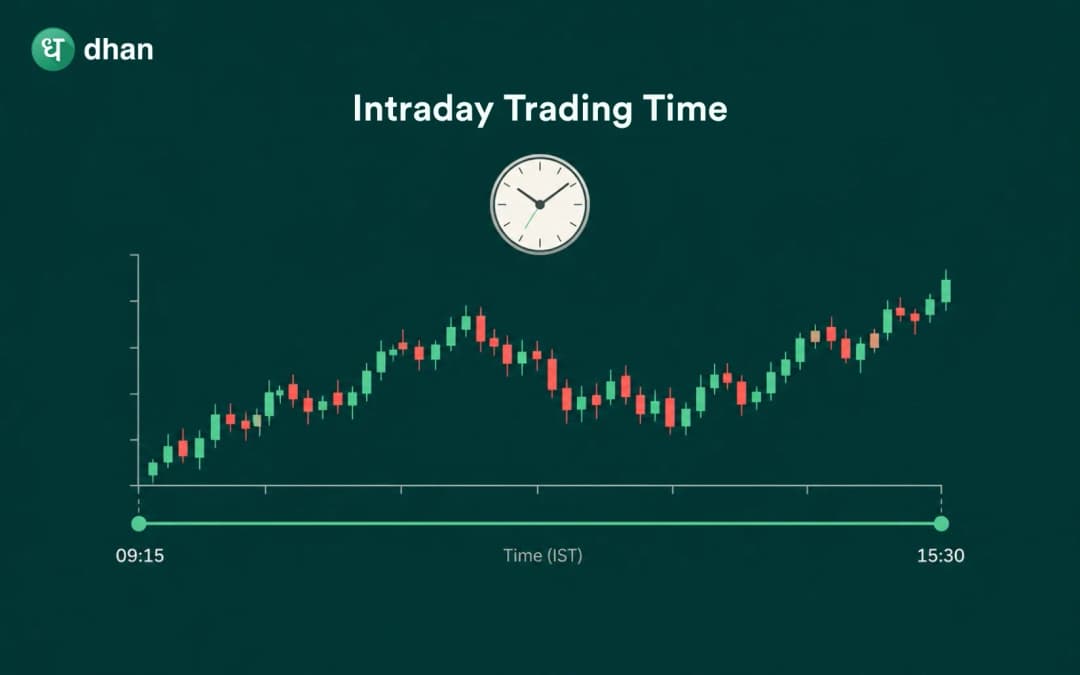
The typical intraday trading time on NSE and BSE is 9:15 AM to 3:30 PM, from Monday to Friday. As of 3 August 2026, the closing time depends on the stock that is being traded.
Futures and options stocks will stop regular trading at 3:15 PM and enter into a closing auction. Other stocks will trade until 3:30 PM.
In case of Dhan, open equity intraday positions are squared off at 3:10 PM, and derivatives intraday positions at 3:25 PM. The 3:10 PM cut-off is the real deadline for equity trades, regardless of the exchange clock.
The auto square-off is charged at ₹20 plus GST, totalling ₹23.60 per order. The trade should be closed manually prior to the cut-off time to avoid the cost.
What changes on 7 December 2026?
SEBI issued the circular on 15 October 2026 and revised the closing window once again. As of 7 December 2026, all stocks, including F&O stocks, will trade until 3:30 PM.
The closing auction will be reduced to 10 minutes, from 3:30 to 3:40 PM. Equity derivatives will trade until 3:45 PM, although expiring index contracts will stop at 3:30 PM on expiry days.
It is necessary to check the support page of Dhan for the updated square-off time before that date, since the exit deadline will change.
What are the best hours for intraday trading?
According to NSE data, the highest volumes and volatility appear close to the open and close time periods, and lower throughout the middle of the day. Researchers call this a U-shaped pattern.
The higher the volatility, the greater the chances of the price moving beyond the costs. However, it hits the stop-loss order as well. Therefore, the best trading window is not the busiest one.
The windows below are a framework developed using this pattern. The particular cut-offs are just general rules and not guarantees.
9:00 to 9:15 AM: Pre-open session
Orders keep accumulating up to the time of the pre-opening session, whereby the exchange determines the opening price through a call auction. The pre-opening session should be viewed as a briefing window and not a trading window.
Make notes of the stocks selected for trading, which are indicated to open more than 1% away from the previous closing price. They will move quickly, and therefore, require more caution.
9:15 to 9:30 AM: The opening burst
Volatility remains elevated for the first 30 minutes as the effects of overnight news begin to appear. The spreads will be wide, and stops will be hit easily.
Until one becomes more experienced, do not make any orders during these 15 minutes. Note the high and low of the first 15-minute candle and use them as a reference level.
9:30 to 11:00 AM: Prime window
After the opening noise, the volume is high, and price chooses its direction. This is generally the best period for most beginner traders.
Look for the stocks breaking above or below the first candle high/low on the growing volume. Place the stop loss on the opposite side of the range; make no more than two trades during this window.
11:00 AM to 1:30 PM: The slow patch
The volume of trades decreases; the prices range within a narrow space and form false breakouts. The cost remains the same, but the potential profit decreases.
Use this period for reviewing the morning trades and writing the journal. In case of trading necessity, reduce the trading volume by half.
1:30 to 2:30 PM: The second window
As the closing time approaches, activity increases again. Now the trades have less time to develop, so it is necessary to choose setups with a clear target and a tight stop-loss.
Allow one trade during this window. Make 2:30 PM the last time to enter the trade, since Dhan squares off the equity positions at 3:10 PM.
2:30 to 3:10 PM: The exit window
Do not open new trades anymore and concentrate on closing the existing ones. Close the trade by 3:05 PM yourself to avoid both the cost of ₹23.60 square-off and a rushed fill.
Moreover, there will be nothing to gain in waiting in F&O stocks. After 3:15 PM, the orders in them will be entered into the closing auction, not executed immediately.
Which days require special attention?
Expiry days affect the dynamics of the market. Nifty weekly contracts expire every Tuesday on NSE, and Sensex weekly contracts expire every Thursday on BSE.
Monthly contracts on NSE also expire on the last Tuesday of the month. Premiums on options become extremely volatile on those days, and SEBI restricted the number of weekly expiries to one per exchange in its measures to limit losses of retail traders.
The best thing is to reduce the position size in half on expiry days, or wait until the market reveals its direction after 9:45 AM.
Check the calendar of corporate results prior to trading any stock, because the news may force the price to trade well outside its usual range. Muhurat trading and other special sessions follow their own schedules, so make sure to look at the exchange holidays calendar as well.
How do you create a daily intraday schedule?
Fit all the windows into one timetable and adhere to it daily.
- Pre-9:00 AM, select three to five liquid stocks, preferably from the Nifty 50.
- 9:00 to 9:15 AM, identify pre-open gaps and write down the key levels for each stock.
- 9:15 to 9:30 AM, observe and mark the high and low of the first candle.
- 9:30 to 11:00 AM, execute up to two trades with the risk of 1% of your capital each.
- 11:00 AM to 1:30 PM, review and journal your trades and have a break.
- 1:30 to 2:30 PM, execute at most one trade.
- 2:30 to 3:05 PM, do not open any new trades and close the open positions.
This will restrict you to three trades a day, which will help keep expenses and emotions under control. SEBI found in its FY23 study that loss-making intraday traders placed significantly more trades on average than profitable traders.
Dhan offers TradingView charts for free on tv.dhan.co, making it handy to mark the first 15-minute candle. You can use the built-in screeners in the ScanX screener on Dhan Web for the shortlist.
Dhan Web also features a CAS dashboard where you can watch the live closing auction. Use it to learn about the closing of the F&O stocks.
Conclusion
Timing is the deciding factor for intraday trading. Volume and volatility levels are high during market opening and closing time periods, while midday is calm.
The realistic approach is to watch the first 15 minutes, trade from 9:30 to 11:00 AM, remain light during midday, make one trade post 1:30 PM, and exit before Dhan’s 3:10 PM squaring off.
Use smaller sizes on expiry days, and note the changes to the closing rules on 7 December 2026.
FAQs
What is the best time for intraday trading in India?
For most beginners, the best window is 9:30 to 11:00 AM, with 1:30 to 2:30 PM as the second best window. The first 15 minutes and the midday quiet period feature more noise and fewer rewards.
What are the intraday trading hours on Dhan?
Markets open at 9:15 AM, and the normal trading hours for F&O stocks end at 3:15 PM, whereas other stocks trade till 3:30 PM. Dhan squares off equity intraday positions at 3:10 PM and derivatives intraday positions at 3:25 PM.
Should beginners trade in the first 15 minutes?
Prices are swinging wildly at the beginning of the session, and spreads are wide. Observing the formation of the first candle is educational, but trading is not.
Can you do intraday trading after 3:30 PM?
Derivatives currently trade till 3:40 PM; however, Dhan squares off derivatives intraday positions at 3:25 PM. Commodity contracts on MCX trade till late in the evening, even up to 11:30 PM or 11:55 PM, depending on the season. Equity cash intraday trades must be squared off prior to the market close.
Is the pre-open session suitable for intraday trading?
It is better suited for observations. The opening price is determined by auction, and the orders that do not get matched continue trading in the regular session, so there is no guarantee that placing a pre-open order guarantees execution.