What happens if you forget to Square-off Intraday Position?








Key takeaways
- Squaring off involves closing an already open position on a particular day, in the same quantity, by placing an opposite order.
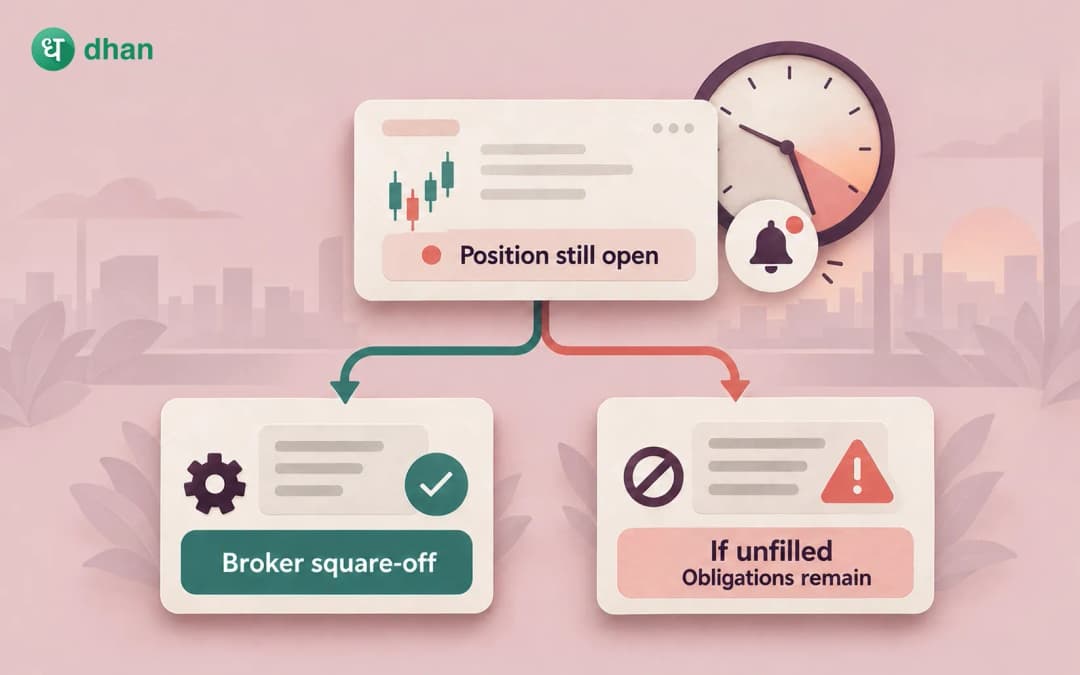
- Your broker's risk management may close an open intraday position automatically.
- An unresolved position can also result in additional margin requirements, losses or other obligations for the trader.
- You should use stop-loss and target orders to help automate parts of your trade-management process.
Suppose you open an intraday position in the morning, thinking about closing it before the trading session ends, but you get distracted and forget about it. In contrast to a delivery position, an intraday position is meant for trading on the same day and is usually closed prior to the broker's intraday cut-off time. So then, what happens if you forget to square off an intraday position, and can it lead to additional charges or unexpected losses?
The result will vary according to the broker, product type, market segment and circumstances at the end of the trading session. In most cases, the broker's risk-management system automatically closes the open position, but it may come with an auto square-off fee. However, in exceptional cases, where due to a number of reasons, including illiquidity or technical reasons, the position cannot be closed, additional risks and obligations may apply. In this blog, let us understand what really happens if one forgets to square off an intraday position.
Why do intraday positions need to be Squared -off?
Squaring off is defined as closing an already opened intraday position on a particular day, in the same quantity, by placing an opposite order. Intraday products are designed especially for trades that are opened and closed on the same trading day. MIS (Margin Intraday Square-off) is an intraday product where positions are squared off at the end of the day automatically. On the other hand, Cash or Carry On order (CNC) is used for delivery-based trades.
This is why the official closing time of the market cannot be taken as a deadline for closing an intraday position. Brokers can independently initiate an auto square-off process prior to the market close, which may vary as per different brokers and market segments.
What happens if you forget to Square-off Intraday Position?
Here is what can occur if you forget to square off an intraday position:
The broker may automatically square off the position
The broker's risk management may close an open intraday position automatically, so that it is not carried overnight. This is typically done prior to the broker's defined intraday cut-off time. This timing and process can differ among brokers and market segments.
Your position may be closed at an unfavourable price
An automatic square-off can occur at a market price which is different from the price at which you would have exited the trade manually. This can affect the net profit or loss, especially if the stock or contract has a lot of volatility. For instance, if an investor purchases 100 shares of a company at ₹200 and sells them at ₹194, then he/she will incur a gross loss of ₹600 (excluding applicable charges).
In exceptional cases, the position may remain open
There can be times when an intraday position may remain open because of circumstances such as illiquidity, connectivity problems, system issues or other market-related factors. In these situations, the broker has the right to take further risk-management or settlement action based on its governing policies. An unresolved position can also result in additional margin requirements, losses or other obligations for the trader.
Does forgetting to Square-off mean the shares become delivery shares?
No, traders should not presume that an intraday position turns into an ordinary delivery position automatically because they forgot to close it.
An unclosed position will be treated according to the product, the rules of the broker, the market conditions and the reasons why the position was not closed out. The NSE product structure itself differentiates between intraday MIS position and delivery based CNC/ overnight NRML position.
What are the risks of forgetting to Square-off?
When traders forget to close an intraday trade, it can lead to various practical risks:
- Unexpected P&L: The position may be closed at a price different from your preferred exit level.
- Auto square-off charges: The broker may charge a fee for automatically closing the position.
- Market volatility: A sudden change in the market price before which the position is closed can impact the realised P&L.
- Margin-related issues: An open position which is not closed can result in extra margin requirements depending on the situation.
- Settlement complications: Can become relevant if some short positions cannot be closed.
- Overnight exposure: If there’s any exceptional failure to close the position, it can leave the trader exposed beyond the intended intraday period.
How to avoid forgetting to Square-off Intraday Position
Here are a few practices which traders can employ to avoid forgetting to square off an intraday position:
Set an exit reminder
Set an alarm 15–30 minutes before your broker's stated intraday square-off time. This will allow you to review any open positions and close them manually instead of relying on the broker's RMS procedure. The exact reminder should be based on your broker's latest cut-off time, not simply on the market's closing time.
Monitor the positions tab
Check your open positions before the end of each trading session. Make sure the quantity has been reset to zero once you have placed your exit order. Also check the order and trade status to make sure an exit order was actually executed.
Use stop-loss and target orders
Stop-loss and target orders can help automate parts of your trade-management process. They should not be used as a substitute for confirming that an intraday position has been closed, though.
Know your broker's auto square-off policy
Please review the square-off time, eligible products and auto square-off charges of the broker before placing an intraday trade. This information can vary from broker to broker and across equity, derivatives and commodity segments. It can be useful to have these details in hand so you can plan your exit rather than depending on an automatic closure.
Avoid opening a fresh position close to the cut-off
If you open an intraday position just before the broker's square-off time, then you may have only a small window to control the trade. A sudden price movement, order rejection or lack of liquidity can make an orderly exit more difficult. Allow yourself enough time to close a position rather than using the last few minutes as an additional trading opportunity.
Understand the product type before placing the trade
Always check whether your order is being placed as intraday, delivery or an eligible overnight product. It is the product type which will determine how the position will be treated at the end of the trading session.
What should you do if you realise you forgot to square-off?
If you suddenly realise that you have an open intraday position, don't assume that the broker has closed it, and check the Positions tab first. If it is still open and the market is still taking orders, look to see if it is possible to manually exit it prior to the applicable cut-off. Following that, check the order and trade book to ensure that the exit has been completed successfully.
Also see your ledger or contract note for the resultant P&L and charges applicable. If the position could not be closed, contact your broker's support or risk-management team to find out how it will be dealt with. It's crucial to respond swiftly as the consequences can vary based on the security, the product, market conditions and broker policy.
Intraday Position vs Delivery Position
Here is the difference between an intraday position and a delivery position:
The primary difference is that an intraday position is supposed to be closed on the same day, and the delivery position is supposed to be held for more than one day. NSE's educational material categorises MIS as an intraday product, CNC as delivery-based, and NRML as an overnight F&O product.
Final takeaways
Forgetting to square off an intraday position does not necessarily mean that you will be left with an open position indefinitely. Your broker may close it out automatically, but you might be charged with an auto-square-off charge, and it might be closed out at a price that generates a different P&L than what you anticipated.
Exceptional circumstances can create additional risks, so knowing your broker's cut-off time and risk-management policy is an important part of intraday trading.
FAQs
What happens if I forget to square off an intraday position?
The broker may automatically square off the position according to its intraday risk-management process. An auto square-off charge may be applicable, and the position may be closed at the market price, and not necessarily at your desired exit price.
Will my broker automatically square off my intraday position?
For intraday products, many brokers have an automatic square-off feature. But depending on different brokers and market segments, the timing, charges, and treatment of positions may differ.
Do I have to pay charges if my broker squares off my position?
There can be some brokers who can charge a separate auto square-off charge if they close an intraday position on your behalf.
What happens if an intraday position cannot be squared off?
An unsuccessful square-off can occur in exceptional circumstances such as illiquidity, connectivity problems or system issues. As per the broker's policy, the position may be treated as a carry-forward position. Further, it may be subject to RMS action, margin requirements or settlement-related consequences.
Can an intraday position become a delivery position?
One shouldn’t assume the intraday position will become a delivery position automatically. The way it is treated depends on the product rules of the broker and the situation in which the position is held.