Mahanadi Coalfields IPO - Day 1: 0.38x subscribed, Retail portion at 0.14x







Key takeaways:
- The Mahanadi Coalfields IPO is a mainboard book-built issue of ₹8,981.12 crore, structured entirely as an offer for sale (OFS) of 66,18,36,300 equity shares by promoter Coal India Limited.
- The price band is set at ₹129 to ₹136 per equity share, with an employee discount of ₹6 per share and a minimum retail lot size of 110 shares.
- The IPO subscription window opened today, Thursday, November 19, 2026, and will close on Monday, November 23, 2026.
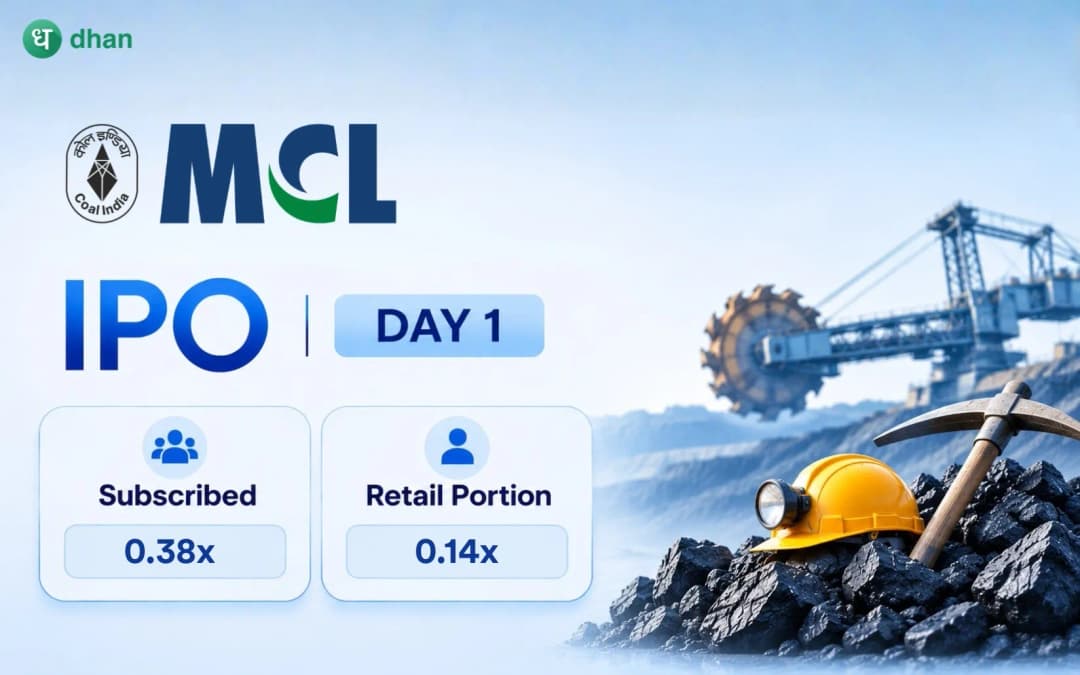
- On Day 1, the public issue recorded a measured opening with an overall subscription of 0.38 times, while the Retail Individual Investor (RII) portion stood at 0.14 times.
- Bidding on Day 1 was led by Qualified Institutional Buyers (QIBs - Ex Anchor) at 1.26 times, followed by eligible Coal India Shareholders at 0.15 times.
Mahanadi Coalfields Limited (MCL), the largest coal-producing subsidiary of Coal India Limited, opened its ₹8,981.12 crore initial public offering for public subscription on Thursday, November 19, 2026. As one of the largest public sector unit (PSU) mainboard issues of the year, the offering marks a 10% stake divestment by parent Coal India Limited, bringing Coal India’s third subsidiary to the domestic bourses in 2026.
Let’s take a closer look at the key details, IPO schedule, company fundamentals, and Day 1 bidding trends of the Mahanadi Coalfields IPO.
Key details of Mahanadi Coalfields IPO
Here are the key structural details of the Mahanadi Coalfields IPO, as per its Red Herring Prospectus (RHP) filed with SEBI:
Key dates for the Mahanadi Coalfields IPO
The indicative timeline for the Mahanadi Coalfields IPO, as disclosed in the SEBI RHP, is outlined below:
About Mahanadi Coalfields
Incorporated on April 3, 1992, and headquartered in Sambalpur, Odisha, Mahanadi Coalfields Limited is a wholly owned Miniratna Category-I subsidiary of Coal India. It is India’s largest single coal-producing company. As of April 1, 2026, the company had audited coal reserves of 9,840.31 MT, which could last for about 45 years based on its FY26 production.
It produced 218.31 million tonnes (MT) of primarily raw non-coking coal in FY26, accounting for roughly 21% of India’s total domestic coal production and 28.4% of Coal India’s overall output.
MCL operates 17 mines (14 opencast and 3 underground) across the Talcher and Ib Valley coalfields in Odisha, alongside a 10 MTPA coal washery. Opencast mining contributed 99.85% of its FY26 output, while blast-free surface miners (74 deployed as of September 30, 2026) accounted for 99.37% of production.
Financially, MCL revenue from operations moderated marginally by 2.6% from ₹31,353.0 crore in FY25 to ₹30,549.6 crore in FY26 (with total income rising 2.6% to ₹33,899.28 crore) and Profit After Tax (PAT) edged down 1.2% from ₹10,825.12 crore to ₹10,698.12 crore.
Subscription status on Day 1
Ahead of the public opening, MCL raised ₹2,295.2 crore from 53 anchor investors on November 18, 2026, by allotting 16,87,68,255 equity shares at ₹136 per share. On Day 1, public bidding got off to a slow start across all investor categories. Here are the subscription numbers across each category at the end of the Day 1 bidding session:
Investor sentiment on Day 1
Investor appetite on Day 1 of the MCL IPO seems cautious and discerning, which is often common for large-ticket PSU offerings. The positives attracting investors to this IPO are MCL’s robust ₹2,295.2 crore anchor book, its dominant 21% share in India's coal production, industry-best operating margins, negligible debt, consistent dividend track record, and a P/E valuation of ~8.42x FY26 earnings.
Meanwhile, market participants continue to be wary of factors like the IPO being a 100% OFS; recent moderation in operating revenue and PAT, geographic concentration in the coalfields of Odisha, high customer and sector concentration, heavy reliance on third-party contractors, pending environmental and forest clearances for expansion projects, and significant contingent liabilities.
Thus, market participants will be closely tracking the participation of institutional (QIB) and NIIs on Day 2 and Day 3 to determine final demand.