Gold Rate Trends around Dhanteras & Diwali in the past 15 years



Key takeaways:
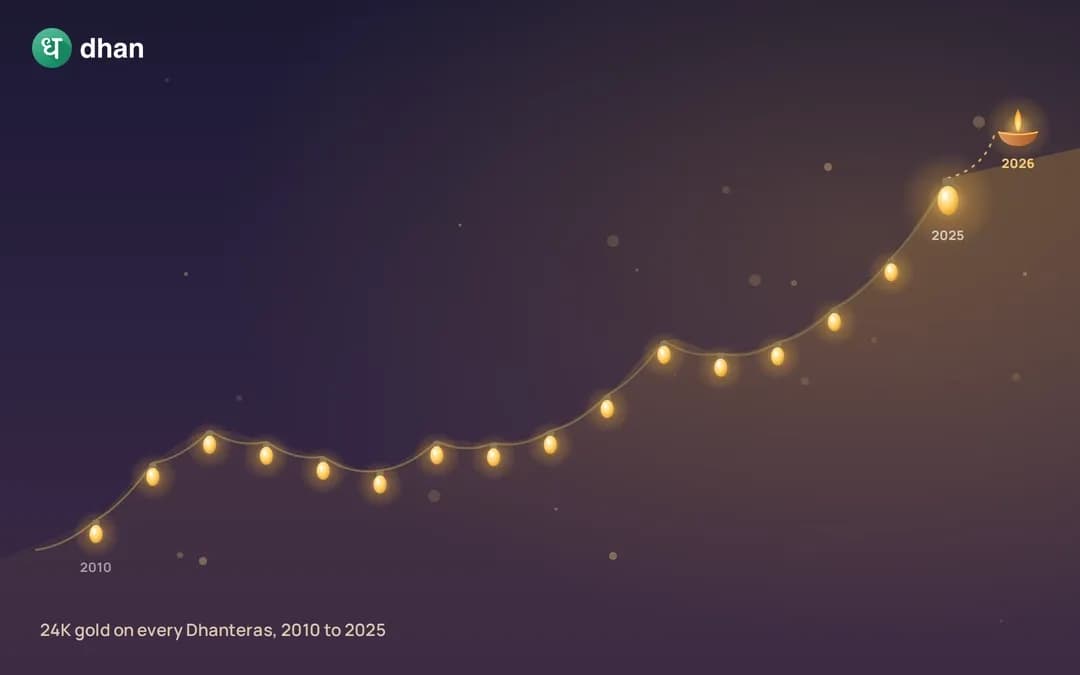
- 24K gold rose from ₹19,704 per 10 grams in Dhanteras 2010 to ₹1,21,164 in 2025.
- Dhanteras prices fell in 2013, 2014, 2015 and 2021, showing that festive demand alone does not guarantee higher prices.
- In 2026, gold gained 12.08% in August after falling 2.29% in June and 3.03% in July.
- Geopolitical uncertainty, interest-rate expectations, currency movements and central-bank buying remain important drivers of gold prices.
- Gold is entering the festive season at a much higher level than last year, so investors need to consider short-term corrections even if the longer-term trend remains positive.
Gold enters the 2026 festive season from a higher base than a year ago. On Dhanteras 2025, the 24K gold price stood at ₹1,21,164 per 10 grams. By 30 September 2026, 24K gold was quoted at ₹1,46,818 per 10 grams, based on the latest data. This puts the price around 25.94% above the 2025 Dhanteras level.
The rise, however, has not been linear. A strong long-term trend does not necessarily mean prices will move higher in a straight line.
Dhanteras in 2026 falls on Friday, November 6, marking the beginning of the five-day Diwali festivities. With over a month left to this festival, the key question is not simply whether gold has risen, but what its historical performance and the factors driving prices can tell us about the outlook for Dhanteras 2026.
Gold price trend in 2026: Monthly performance and key market movements
Before we look at how gold performed on the previous Dhanteras, let’s first see how gold has performed so far in this financial year. The monthly data for April to August shows a volatile but broadly upward trend.
The most important feature of this data is the change in volatility.
April recorded a 2.88% rise, while May was almost unchanged with a marginal 0.07% increase. June and July then saw consecutive declines of 2.29% and 3.03%, respectively. Gold subsequently reversed direction sharply in August, gaining 12.08%, the strongest monthly move in the period covered, but in September it again fell by 5.15%.
This means the 2026 rally should not be interpreted as a straight-line move. Gold has already demonstrated that meaningful corrections can occur even within a broader uptrend.
How has gold performed on Dhanteras over the years?
As we saw in the table above, gold has remained broadly positive in the short term. Now, let’s look at the longer-term Dhanteras data to see how domestic gold prices have changed over the past 15 years.
The data offers a useful analytical perspective. Gold stood at ₹19,704 per 10 grams on Dhanteras 2010, compared with ₹1,21,164 in 2025. That represents a substantial increase over the period.
But the year-on-year figures also show that gold does not rise every festive season. Dhanteras prices declined in 2013, 2014, 2015 and 2021. This suggests that festive demand alone does not guarantee higher gold prices. Broader factors such as interest rates, currency movements, inflation, global uncertainty and investor demand can have a greater influence on prices.
The sharpest increase in the period shown came in 2025, when the Dhanteras price was 53.12% higher than a year earlier. This followed several years of strong gains, highlighting how quickly gold prices can re-rate when multiple supportive factors come together.
Why has gold remained strong?
Several structural factors have supported gold, according to the supplied 2026 research.
Geopolitical uncertainty
Gold tends to attract investor attention when geopolitical risks increase. Trade disputes, conflicts, sanctions and threats to global supply chains can raise uncertainty and encourage safe-haven demand.
However, the relationship is not automatic. Markets may price geopolitical risks before a major event actually occurs, meaning the eventual event can sometimes result in profit-taking rather than another sharp rally.
Interest rates and the dollar
Gold does not generate interest income. Consequently, changes in interest-rate expectations can influence its relative attractiveness.
The global gold market is also heavily influenced by the US dollar. For Indian buyers, the domestic price reflects not only international gold prices but also movements in the rupee. A weaker rupee can amplify the impact of a rise in international gold prices.
Central-bank demand
Central-bank buying has become an important part of the longer-term gold story highlighted in the supplied research. Continued accumulation can provide structural support to demand even when short-term investor sentiment becomes weaker.
Why is it considered auspicious to buy Gold during Dhanteras?
The belief in Dhanteras as the most auspicious day to buy gold is rooted deeply in symbolism, tradition, and cultural psychology. For centuries, gold has been associated with Goddess Lakshmi, the deity of wealth, and buying gold on this day is thought to bring prosperity.
This is not merely a spiritual belief, but according to jewellers, the festive demand during Dhanteras contributes a large chunk of their yearly sales.
Tradition also plays a big role, with families handing down the tradition of buying gold during Dhanteras across generations, which ensures a stable seasonal influx of demand.
Falling on the Trayodashi tithi just before Diwali, the occasion symbolises new beginnings, which also reflects in the financial markets and jewellery businesses, often leading to stronger Q3 earnings and a demand-led hike in gold stocks.
The celebratory atmosphere enhances this effect. Gold buying becomes a communal ritual with crowded showrooms, promotional activities, and extensive advertising, thereby creating a herd-driven momentum. This sentimental demand often results in short-term price volatility during the Diwali window.
Gold is not just an ornament in India, but also serves as a store of value and an inflation hedge. This mixed nature positions gold buying during Dhanteras as a practice that is both faith-based and financially driven.
What does this mean for Dhanteras 2026?
The most important analytical observation is that gold is entering the festive season after a move higher, but also after demonstrating considerable volatility.
At ₹1,46,818 per 10 grams on September 30, gold was already substantially above the ₹1,21,164 Dhanteras level recorded in 2025.
That does not, by itself, indicate that gold must continue higher into Diwali.
Instead, festive buyers should distinguish between structural support and entry-point risk. The structural case for gold can remain intact even while the metal experiences short-term corrections. June's 2% decline is a useful reminder of that risk.
For jewellery buyers purchasing for an occasion, the objective is different from that of a short-term trader. Buying decisions are generally driven by the need for the metal and the timing of the festival rather than an attempt to identify the exact market bottom.
For investment-oriented buyers, a staggered approach can reduce the dependence on a single entry price. The underlying principle is simple: when an asset is volatile, spreading purchases over time can reduce the risk of committing the entire amount immediately before a correction.
The bottom line
The historical record suggests that gold has delivered a strong long-term increase around the Dhanteras period, but it also shows that positive festive-season returns are not guaranteed every year.
The 2026 price data supports the same conclusion. Gold has moved sharply higher over the past few months, but the route has included monthly declines in June & July and a strong rebound in August.
For Dhanteras 2026, therefore, the more useful question is not “Will gold definitely rise?” It is whether the forces supporting gold - geopolitical uncertainty, monetary-policy expectations, currency movements and central-bank demand remain strong enough to offset the possibility of short-term profit-taking and corrections.