Poor Man Covered Call






Key takeaways
- A poor man's covered call is an options strategy that uses a long-term call option instead of buying 100 shares of the underlying asset, combined with a short-term call sold against it.
- The strategy involves buying a deep ITM LEAPS call and selling shorter-term calls at higher strike prices. The strategy aims to collect option premiums during a slightly bullish view.
- A PMCC requires less upfront capital than a traditional covered call, but it introduces risks related to time decay, implied volatility, assignment, and the long call's expiration.
A traditional covered call requires a trader to own shares of a stock and sell call options against those shares. But this strategy has a drawback. If the stock is expensive, owning the stock requires huge capital.
A poor man’s covered call serves as a capital-efficient substitute for a standard covered call. The strategy is to buy a long-dated call option and sell shorter-dated calls against it, instead of buying actual stock. This strategy replaces the actual ownership of the stock with a long call, and the income is created by selling the short call.
For example, if you have to buy 100 shares of a stock trading at ₹1,000, you will need ₹1,00,000 starting capital. A long-term call option on the same stock may cost much less, depending on its strike price, expiration, and implied volatility. The trader can then sell shorter-term calls to collect premiums.
What is a Poor Man's Covered Call?
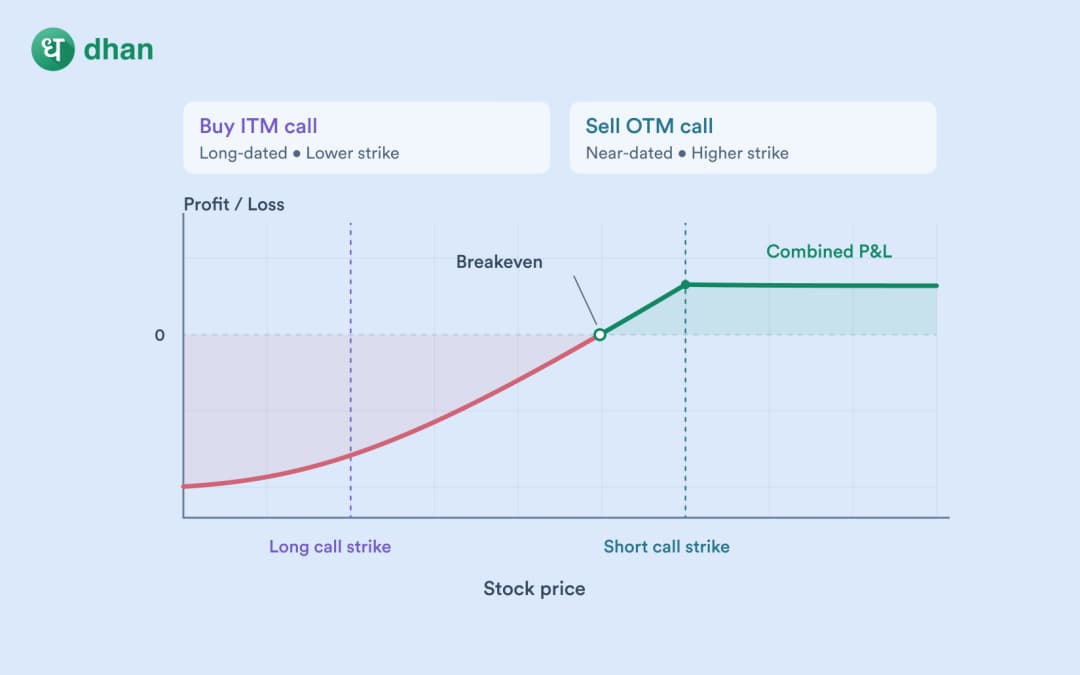
A poor man's covered call is a diagonal call spread that combines two call options with different strike prices and expiration dates.
The trader buys a long-term call option, usually deep in the money, and sells a shorter-term call option with a higher strike price. Both options reference the same underlying stock or ETF.
Long call options give you exposure to the stock's upside while hanging onto their time value longer because of their distant expiration date. Selling short call options brings in steady premium income, though it does mean you're on the hook to deliver shares if assigned.
The strategy is called a poor man's covered call because it can provide exposure similar to a covered call without requiring the trader to purchase the full number of shares. It is not identical to owning shares, though, because an option has an expiration date and behaves differently from the underlying stock.
Working principle of a Poor Man's Covered Call
The strategy involves two main positions.
Step 1: Buy a long-term call option
The trader purchases a call option with a relatively distant expiration date. Traders usually choose a deep in-the-money option because it has a higher delta, meaning its price generally responds more closely to movements in the underlying stock than that of a lower-delta call.
Let's say a stock is trading at ₹500. A trader buys a call option on a stock with a strike price of ₹400 and many months to expiry. The premium paid is ₹120 per share.
The stock trades ₹100 higher than the strike price, so the option’s intrinsic value is ₹100. So the time value is ₹ 20 out of the quoted premium of ₹ 120.
The trader now has bullish exposure to the stock without purchasing the shares outright. However, the option can still lose value if the stock falls, time passes, or implied volatility declines.
Step 2: Sell a shorter-term call option
The trader sells a call option with a nearer expiration date and a higher strike price. This is the short call, and the premium received helps offset the cost of holding the long call.
Continuing the example, suppose the trader sells a call with a strike price of ₹540 and receives a premium of ₹10 per share. If each contract represents 100 shares, the trader receives ₹1,000 before transaction costs.
The short call is out of the money as the stock trades at ₹500, below the ₹540 strike. If the stock remains below ₹540 at expiration, the short call may expire worthless and the trader can retain the premium. The trader can then decide whether to sell another call with a later expiration.
If the stock rises above ₹540, the short call may become profitable for its buyer and create an obligation for the seller. The long call can gain value as the stock rises, but the two options will not necessarily offset each other perfectly.
Step 3: Manage the short call and long call
A PMCC requires ongoing management as the short call expires sooner than the long call. After the short call expires, the trader can sell another call, although it should have sufficient time value and the position remains appropriate.
If the stock moves sharply, the short call might need to be closed out or rolled to another strike or expiration. Rolling is when you close your current option and open a new one; you might pay more, and it doesn't ensure a better result.
If the stock falls significantly, the long call may lose value. The trader must assess whether continuing to hold it makes sense rather than selling calls simply to recover the original premium paid.
Maximum profit and loss in a PMCC
The maximum profit and loss of a poor man's covered call depend on the exact strikes, premiums, expiration dates, and how the position is managed. Since the options expire at different times, there isn't a single, fixed formula to predict every possible payoff at expiration.
Your starting cost or net debit is simply what you paid for the long call minus what you brought in from selling the short call. Under a standard option spread where both legs expire together, you can easily figure out your maximum profit by comparing the difference between strike prices to that initial cost. But with a PMCC, the short call expires first. That means your actual return depends on what happens with the short call plus whatever value remains in your long call.
If the stock drops or stays below your long call’s strike price all the way to expiration, you could end up losing most or all of what you paid for it. The small premium you collect from the short call won't cover that loss. So, when looking at your risk, focus on where things stand when the short call expires and factor in what the long call is still worth—don't just assume the premiums you collect are free money.
Advantages of a Poor Man's Covered Call
The poor man’s covered call strategy has the following advantages.
- The trader buys a long call rather than purchasing the full share position, which can reduce the initial cash outlay.
- Selling short-term calls can generate premiums while the long call provides bullish exposure to the stock.
- A deep in-the-money long call can gain value when the stock rises. The short call limits some of the position's upside above its own strike and expiration period, so the trader must manage the trade if the stock rallies sharply.
- The trader can reassess the short call after expiration or close it before expiration. Adjustments can be made to respond to market changes, but rolling has a cost and does not eliminate risk.
Limitations of a Poor Man's Covered Call
Along with advantages, the poor man’s covered call strategy has some limitations as follows:
- The long call loses time value as expiration approaches, all else being equal. If the stock does not rise enough to offset this effect, the position may lose value despite collecting short-call premiums.
- If the stock's price increases sharply, then the short call’s value increases, which can create a loss for the seller. Although the long call may offset some part of the loss, it won't be able to recover it fully due to differences in delta, IV and time decay.
- A fall in implied volatility can reduce the long call's premium, while changes in volatility can also affect the short call.
- If the short call is exercised or assigned, the trader may face a stock-delivery or settlement obligation depending on the contract.
To sum up
By substituting stock ownership with a long-dated call option and selling short-term calls to collect premiums, a poor man's covered call offers a lower capital requirement than a standard covered call. But the strategy has some other risks, such as time decay, shifts in volatility, early assignment, and option expiration, which can affect your position.
This strategy works best if you have a moderately bullish outlook on the stock. Before entering the position, you must evaluate the starting net debit, calculate potential downside losses, and determine an adjustment plan for different situations.
FAQs
Is a poor man's covered call profitable?
It can be profitable when the stock's movement and option premiums work in the trader's favour.
Is the poor man's covered call strategy used by novices?
The poor man’s covered call is usually not recommended for beginners as it is a multi-leg options strategy. It requires an understanding of the Greeks and options behaviour. Hence, beginners must first watch and understand the behaviour. Also, they can always use paper trading to build familiarity with the strategy.
Which is riskier: poor man's covered call or a covered call?
Both strategies contain risk. In the case of a poor man’s covered call, the risk of sharp downside movements and time decay plays a crucial role, while a standard covered call carries greater downside risk due to full capital exposure from owning the underlying stock.
What happens if the short call expires worthless?
It allows the trader to keep the premium received by selling the short call. The long call remains open, and the trader can decide whether to sell another short call or close the position.
How much capital is required for a poor man's covered call?
The initial cost is generally the premium paid for the long call minus the premium received from the short call, multiplied by the contract size.