How to Keep Gold Safe in 2026?







Gold occupies a special place in Indian families and culture, both as an investment asset and a cultural treasure. As gold rates increase and more market participants become financially aware in 2026, the need to store physical gold in a secure place is more than ever. It can be jewellery, coins, or bars, but inappropriate storage can subject investors to theft, damage, or financial loss.
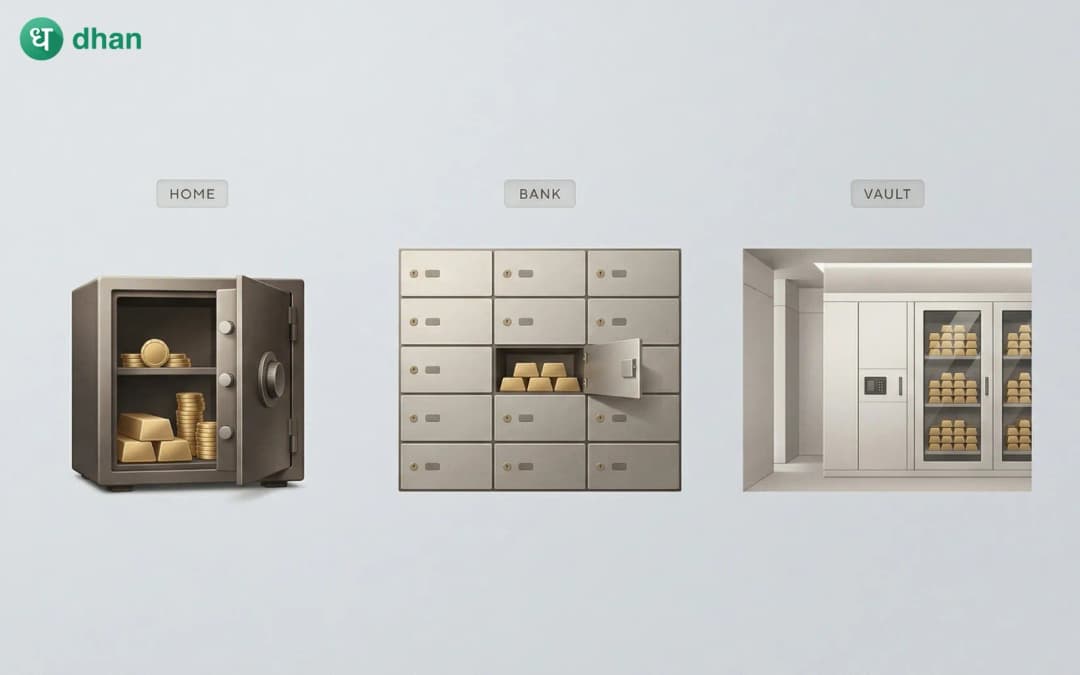
Today, due to the advancements in technology, Indian investors have a variety of storage facilities, such as the conventional home safes, bank lockers, and the new insured vault services. But one of the emerging trends in 2026 is to buy digital gold. Each of these options has its unique benefits, risks, and regulatory framework catering to the varied demands of investors. Let’s explore each of these gold storage options in 2026 to make an informed decision.
Bank Lockers
Bank lockers are still one of the most popular methods of storing physical gold in India, which offers gold storage at minimal charges, often starting from Rs. 1000+ GST per year. These lockers are placed within secure vaults that have characteristics like CCTV surveillance, limited access, and dual-control systems. According to the Reserve Bank of India guidelines, these lockers are meant to keep valuables such as jewellery, documents, and precious metals in a secure place. But they came with some constraints. Like RBI rules state that in case of loss due to bank negligence, the bank liability is capped at 100 times the annual locker rent.
This implies that if an investor’s bank locker rent is Rs. 5,000 per year, they are only eligible for compensation up to Rs. 5 lakh, even though the gold stored in the bank locker might be worth a lot more. Additionally, it also states that banks are not liable for losses in case of natural calamities like floods or earthquakes. Also, most banks do not insure the contents of lockers, and customers need to take separate insurance cover on high-value gold holdings.
Home Storage
The convenience and easy accessibility of gold at home are still preferred by many Indian families. This option is now more secure than ever with the emergence of advanced home safes and digital lockers. However, home storage of physical gold carries significant risks of theft, burglary, and accidental damage. Additionally, home storage does not have institutional security or surveillance as bank lockers do.
To reduce risks of home storage of physical gold, investors nowadays are installing heavy-duty, fire-resistant safes equipped with biometric locks and IoT-enabled tamper alerts. With this, they also insured it with extensive insurance coverage. In 2026, Indian insurers provide jewellery insurance add-ons, which cover theft, fire, and even loss during transit. This makes home storage of physical gold feasible to individuals who require their gold regularly but are not ready to pay bank locker fees.
Gold Deposit Schemes
Gold deposit schemes offer an attractive alternative to investors who consider gold as an asset rather than jewellery. These schemes, regulated by the Reserve Bank of India, enable individuals to deposit their physical gold in banks and receive interest on the same and withdraw either physical gold or monetary value after the end of a specified period. This not only removes storage issues but also earns income for individuals.
Also, the banking system keeps the gold safe, eliminating the risks of physical storage. However, this alternative might not be appropriate for storing jewellery that has sentimental value, as the gold is usually melted and turned into standard forms under the gold deposit schemes.
Digital Gold Investments
In 2026, a significant number of savvy investors have transitioned from physical gold to digital gold investment instruments. By choosing online gold investments, the storage problem is effectively delegated to professional custodians. The digital gold investment instruments include Gold ETFs and Gold mutual funds.
Gold ETFs are funds that represent units of 99.5% pure physical gold, which are traded on the stock markets. When investors purchase gold ETFs, the physical metal is stored in highly secure, SEBI-regulated vaults, while the investors receive the online ETF units in their demat account, which eliminates theft risk or locker charges.
Gold mutual funds invest directly in Gold ETFs. They are the ideal choice for investors who prefer a disciplined approach to investing. As gold mutual funds allow for a systematic investment plan (SIP) with as little as Rs. 500, allowing investors to accumulate gold storage-free over time. Along with this, these ETFs and mutual funds can be sold immediately on the exchange at the current market price, unlike physical jewellery, which requires making charges and a sell-back spread.
Gold Vault by Dhan: A New Way to Buy Gold
Gold Vault is a simpler and more transparent way to own real Gold & Silver. It is not meant as an alternative to digital gold, but rather, a way to ensure that you can bring your digital gold to the physical world with trust, transparency, and safety.
Gold Vault allows you to buy exchange-traded bullion directly at live MCX-linked prices with complete price transparency and assured purity. After settlement, the bullion you’ve bought is stored in a secure SEBI-registered vault, and you can request physical delivery at any time.
There are three factors that make Gold Vault feel effortless and trustworthy:
- Exchange-backed pricing
- Institutional-grade storage
- Doorstep delivery
You can try it out by opening a Dhan account!
The bottom line
In 2026, the storage of physical gold is no longer restricted to the traditional means. Bank lockers, home safes, gold deposit schemes, and online gold investment are some of the options available to Indian investors for physical gold storage. Bank lockers offer institutional security, but lack liability and 100% insurance. Home storage is convenient but needs extra precautions. Gold deposit schemes eliminate storage concerns while generating returns, but they melt the gold before storing it, while online gold investments eliminate storage risks, offer liquidity, and transparency. Thus, all these alternatives have their pros and cons.
Ultimately, the choice of a storage method for physical gold depends on individual objectives, their gold holding size, usage needs, and risk appetite. Combining secure storage with adequate insurance ensures that their gold is not only physically safe but also financially secure in the long run.