



Understanding the Taxation of SLBM in India


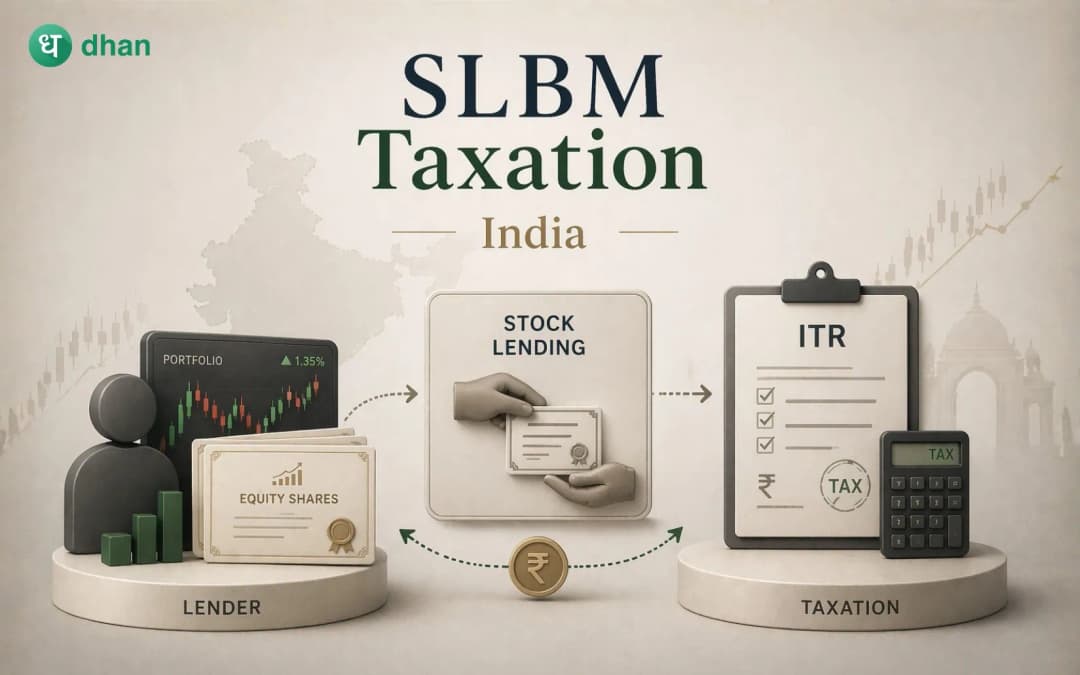


In the Indian stock market, recently, a new way to earn passive income from the existing stocks held in their Demat accounts is gaining popularity among long-term investors. This new way is Securities Lending and Borrowing Mechanism (SLBM).
New age brokerage platforms are democratising SLBM to retail investors, with thousands of investors earning passive income by lending their stocks to borrowers, benefiting both lenders and borrowers. But as the ITR filing season draws near, a question is arising among market participants:
How is SLBM income taxed?
The answer to this question is different for lenders and borrowers, and filing it incorrectly in the ITR can attract notices or lead to wrong tax payments. Thus, here we will explore the taxation on SLBM for lenders and borrowers in detail to avoid any such complication.
What is SLBM?
Before going forward to understand the taxation for the Securities Lending and Borrowing Mechanism (SLBM), let’s understand what SLBM is.
SLBM is a Securities and Exchange Board of India (SEBI) regulated process where an investor can lend their shares to other market participants. SLBM offers investors with a long-term stock portfolio an opportunity to earn risk-free additional returns by lending their existing holdings.
The Securities and Exchange Board of India (SEBI) acts as the regulator of this process, and trades are guaranteed by approved intermediaries such as NSE Clearing Ltd (NCL), which reduces the counterparty risk.
The lending and borrowing period can range from one month to a maximum of one year. The borrower is expected to return the securities on contract expiry. An early recall facility is also permitted in the event that the investor wants to sell the stock. A rollover facility is also available for three months.
The tax protection
There is a baseline tax protection that every SLBM participant should be aware of. The Central Board of Direct Taxes (CBDT) has stated that lending and borrowing under SLBM will not be considered as a "transfer of securities" under Section 2(47) of the Income Tax Act, 1961, in the hands of the lender. This means that no capital gains will arise in the hands of the assessee solely due to SLBM.
CBDT has also excluded stock lending and borrowing from the purview of Securities Transaction Tax (STT) and capital gains tax at the time of lending or borrowing. It implies that lending shares through SLBM does not attract tax as a sale or transfer.
Taxation for the lender (Stock renter)
In SLBM, when investors rent out their stocks through SLBM, the income they receive as rent fees is considered income from other sources. This income is added to their total taxable income and is taxed at their income tax slab rate.
This is in contrast to the flat rates of 12.5% (LTCG) or 20% (STCG) for capital gains. The income from SLBM rentals is considered regular income; if the lender is in the 30% tax slab, their SLBM lending fees will also be taxed at 30%.
If a dividend is declared during the lending period, lenders are entitled to receive it as the beneficial owner. This dividend income will also be taxed as income from other sources at their applicable tax rate. Additionally, there is no GST liability on lending income for the lender.
Furthermore, investors' SLBM income does not require a separate ITR filing. As per the Exchange regulations, income from SLBM is to be clubbed under income from other sources and can be reported in the same ITR.
Taxation for the borrower
For borrowers who borrow stocks for short selling, arbitrage, or delivery, their tax treatment is different from that of lenders. On borrowing shares through SLBM, the borrowing fee is subject to 18% GST under the Reverse Charge Mechanism (RCM). This means that the borrower is liable to pay GST, not the service provider.
When the borrower sells the shares, the borrower does not pay tax, as the profit from such a sale is not known. When the borrower buys back the shares to return to the lender, the difference between the sale price and the repurchase price will be considered as profit from business or capital gains, depending on how those shares are classified in the borrower's books.
If the company declares a dividend during the borrowing period, it will deduct TDS before paying the dividend. The TDS can be claimed in the ITR filing by the borrower, subject to applicable rules.
Does SLBM affect the lender's LTCG holding term?
One of the questions that long-term investors often ask is whether lending shares affects the holding period for Long-Term Capital Gains (LTCG), as LTCG exemptions only apply to shares held for over 12 months.
The answer is no, as the CBDT has clarified that SLBM transactions are not a transfer under Section 2(47) of the Income Tax Act; thus, the holding period is not reset during the loan period. Lenders' shares remain long-term even when lent out to borrowers.
Lender vs Borrower tax treatment at a glance
Till now, we have learned all about the taxation of SBM income for both lender and borrower. Here is a summarised view of it:
The bottom line
SLBM is a valuable tool for Indian investors to earn passive income from their idle investments, but it also comes with tax compliance obligations that can’t be overlooked. The CBDT circular offers foundational tax protection by classifying SLBM as a non-transfer event, but lenders still need to report fee lending income under income from other sources, while borrowers need to account for GST under RCM.
Developing an understanding and getting these right before the ITR filing deadline implies that market participants keep more of what they earn without the risk of tax notices down the line.