Nifty 50
 Sensex
 US Tech 100
 Dow Jones
 FTSE
 Dax
 CAC
 Nikkei 225
 Hang Seng
 SSE Composite
 TAIEX
 KOSPI
 Gift Nifty
 Strategy Indices
 Broad Market Indices
 Sectoral Indices
 Thematic Indices


How to Open Demat Account?

Verify Mobile & Email
This takes less than a minute and is super convenient!

Digital Account Opening
Submit required documents using your phone, laptop, or desktop!

E-Sign
The final step before your online demat account is active!

Documents Required to Open a Demat Account

Identity Proof
PAN card is mandatory (Please ensure your photo and sign on the card are clearly visible)

Bank Proof
Bank account statements of last 6 months, cancelled cheque and passbook (Any of these)

Address Proof
Aadhaar, passport, driving licence, voter ID, or bank account statements of last 6 months (Any of these)

Income Proof
Bank account statements of last 6 months, 3 months salary slips or ITR (Any of these)

Signature
Photo of your signature on a white paper (The signature must match the one on your PAN card)

Photograph
One passport size photograph is a must (Provide clearly visible and latest photograph)

Access All Dhan Platforms with One Demat Account

 App
- Web
 App
- Web


 ScanX

Why Open a Demat Account with Us?

Dedicated Support 24x7
Our support team is always on standby to help you on call & text

Online Account Opening
Start using Dhan in less than 10 minutes from your phone or desktop

We're #MadeForTrade
Building industry first features for India's traders & investors

Reliable & Transparent
SEBI registered - Millions of users already trust us

One Demat Account for All Segments
Things to Know About Demat Account
Things to Know About
Demat Account

What is a Demat Account?
A Demat Account, short for "Dematerialized Account," is an essential component in the Indian stock market. It holds your shares and securities electronically, eliminating the need for physical certificates. This account simplifies the process of buying, selling, and transferring shares, ensuring a seamless and paperless experience for investors. By converting physical shares into electronic form, a Demat Account provides enhanced security and reduces the risks associated with loss, theft, or damage of paper certificates. It also facilitates faster transactions, making it a vital tool for modern-day trading and investment.

How Does a Demat Account Work?
A Demat Account works similarly to a bank account, but instead of holding money, it stores your securities. When you buy shares, they are credited to your Demat Account in electronic form. Conversely, when you sell shares, they are debited from your account. Managed by depositories like NSDL (National Securities Depository Limited) and CDSL (Central Depository Services Limited), the account ensures secure and efficient handling of securities. The transactions are facilitated through Depository Participants (DPs), who act as intermediaries between the investor and the depository. This system provides a streamlined and efficient way to manage your investments.
Demat Account vs Other Accounts
Different Types of Demat Account in India
Eligibility Criteria to Open a Demat Account


Individual
Any individual above the age of 18, with valid identification and address proof, can open a Demat Account. This is suitable for both resident and non-resident individuals.
NRI
Non-Resident Indians (NRIs) are eligible to open a Demat Account, either repatriable or non-repatriable, allowing them to invest in Indian securities while residing abroad.
HUF
A legally constituted HUF can open a Demat account in the HUF’s name. The adult Karta is the authorised signatory. HUF PAN and HUF bank account are required; coparceners must be declared and KYC-compliant.
Corporate
Corporates and other entities, such as partnership firms and trusts, can open a Demat Account. They must provide the necessary documentation and comply with regulatory requirements for their investments.
Minor
Minors are eligible to open a Demat Account through their parent or legal guardian, allowing investments to be held in the minor’s name until they attain the age of 18. Required documents, include PAN, Aadhaar, date of birth proof, bank account details, and the guardian’s signature. The minor must also be physically present during the account opening process for verification.
Benefits of Having a Demat Account

Paperless Activation
Minors can open a Demat Account with the assistance of a guardian. The account is managed by the guardian until the minor reaches adulthood (18 years of age), ensuring their investments are handled responsibly.

Invest Across All Segments
With a Demat account, you have the flexibility to invest across various market segments, including equities, mutual funds, bonds, and more. This versatility ensures that all your investments are consolidated in one place, providing a seamless and efficient investment experience.

Easy Portfolio Management
A Demat account simplifies the management of your investment portfolio by allowing you to track and manage all your holdings in a single account. This consolidation helps in better monitoring of your investments and making informed financial decisions with ease.

Corporate Benefits & Actions
A Demat account simplifies receiving corporate benefits such as dividends, interest, and bonuses. All corporate actions are updated automatically in your account, ensuring that you don't miss out on any benefits, making the process smooth and efficient.

Quick Transfer of Shares
A Demat account ensures the quick and efficient transfer of shares. Transactions are executed electronically, significantly reducing the time needed for settlements and allowing you to manage your investments promptly and smoothly.

Lower Risk of Fraud
Using a Demat account greatly lowers the risk of fraud and theft. The electronic format of holding securities eliminates the risks associated with physical certificates, ensuring the safety and security of your investments.
Uses of Demat Account

Buy Stocks
A Demat account allows you to buy and hold stocks electronically. This makes buying, selling, and managing your stock investments easy and secure, eliminating the need for physical share certificates.

Invest in Mutual Funds
With a Demat account, you can invest in mutual funds seamlessly. It provides a centralized place to manage all your mutual fund investments, ensuring ease of access and efficient tracking. Mutual fund investments on Dhan are currently not in the demat form.

Buy ETFs
Using a Demat account, you can buy and hold Exchange-Traded Funds (ETFs). This allows you to diversify your portfolio with ease, benefiting from the flexibility and liquidity that ETFs offer.

Apply for IPO
A Demat account allows you to apply for Initial Public Offerings (IPOs) online. This makes the process quick and convenient, enabling you to invest in new companies as they go public.

Apply for NFO
With a Demat account, you can easily apply for New Fund Offers (NFOs). This allows you to invest in new mutual fund schemes at their launch, providing an opportunity to diversify your portfolio. Currently, NFO allotments on Dhan are not in the demat form.

Invest in Govt Bonds
Using a Demat account greatly lowers the risk of fraud and theft. The electronic format of holding securities eliminates the risks associated with physical certificates, ensuring the safety and security of your investments.
Types of Charges
for Demat Account
Account Opening Fees
Account opening fees are one-time charges levied by the Depository Participant (DP) when you first open a Demat account. These fees vary among different DPs and are generally minimal.
Custody Charges
Custody charges are fees for holding your securities in the Demat account. These charges are typically nominal and are based on the value of securities held in your account.

Annual Maintainance Charges
Annual Maintenance Charges (AMC) are yearly fees charged by the DP for maintaining your Demat account. These charges cover the cost of account maintenance and related services.
DP Transaction Charges
DP transaction charges are fees applied by the DP for processing each transaction, such as buying or selling securities. These charges vary depending on the DP and the type of transaction.
Important Terms Related to Demat Account
CDSL
CDSL, or Central Depository Services Limited, is one of the two main depositories in India. It holds securities in electronic form and facilitates their trading, ensuring smooth and secure transactions for investors.
NSDL
NSDL, or National Securities Depository Limited, is the other major depository in India. It provides electronic depository services, allowing investors to hold and transfer securities safely and efficiently.
Depository Participant (DP)
A Depository Participant (DP) acts as an intermediary between the investor and the depository. DPs facilitate the opening and maintenance of Demat accounts, enabling secure and efficient management of securities.
TPIN
TPIN, or Transaction Personal Identification Number, is a unique code used for authorizing trades in a Demat account. It adds an extra layer of security, ensuring that only authorized transactions are processed.
Broker
A broker is a licensed individual or firm that facilitates the buying and selling of securities on behalf of investors and traders. They act as intermediaries between the stock exchange and the investor, ensuring smooth transactions.
Settlement
Settlement refers to the process of transferring securities from the seller to the buyer and the corresponding payment from the buyer to the seller. It ensures that transactions are completed efficiently and accurately.
Brokerage
Brokerage is the fee charged by a broker for executing buy and sell orders placed by an investor. This fee is typically a percentage of the transaction value or a flat rate, depending on the broker's terms.
DEMAT
DEMAT also known as dematerialisation refers to the process of converting physical share certificates into electronic form. This makes managing and transferring securities more secure and efficient, reducing the risks associated with physical certificates.
Factors to Consider Before Opening Demat Account

Reputation of DP
Before opening a Demat account, consider the reputation of the Depository Participant (DP). Look for reviews, reliability, and the quality of customer service they provide to ensure a smooth and secure experience.

Security Features
Evaluate the security features offered by the DP. Ensure they provide robust measures like two-factor authentication, encryption, and regular security updates to protect your investments from fraud and unauthorised access.

Account Opening Charges and AMC
Be mindful of the account opening charges and Annual Maintenance Charges (AMC). Compare different DPs to find one that offers competitive fees and services, ensuring it fits within your budget while meeting your investment needs.
Customer Support
Assess the quality of customer support provided by the DP. Ensure they offer responsive and helpful service through various channels like phone, email, and chat to address any queries or issues promptly.

SEBI Registered
Verify that the DP is registered with the Securities and Exchange Board of India (SEBI). This ensures that the DP adheres to regulatory standards and provides a secure and compliant platform for your investments.

Services Offered
Consider the range of services offered by the DP. Look for additional features such as research reports, trading tools, and educational resources that can help enhance your investment experience and decision-making.
How to Open a Demat Account?
A step-by-step video on how to open a demat account in simple words. Guide to guide you through documents, charges, benefits and more!
Experience More at Industry Standard Prices
Experience More at
Industry Standard Prices
For Account Opening,
AMC & Platform Fees
Open free account with zero AMC or platform fees.

For Equity Delivery, ETFs,
IPO & Mutual Funds
Absolutely FREE! No hidden charges ever.
For Equity & ETFs Intraday and MTF
₹20 or 0.03% of trade value per executed order, whichever is lower.

For All Segment
Options & Futures
₹20 per executed order for equity & commodity F&O.
No hidden charges, ever!
View Pricing In DetailNo hidden charges, ever!
View Pricing In DetailLove from India's Traders & Investors
Love from India's
Traders & Investors


Ipsita Sahoo
@ipsiworld
I am loving Dhan app so far.
@DhanHQ @DhanCares Thanks for providing an amazing platform specially for traders.
#OptionsTrading #TRADINGTIPS

chirag_p
@chirag_721p
@dhanhq good broker and good tech support with best chart experience. #madefortrade with tradingview chart with no glitch in price movement

Shashank Singh
@knahsahs_hgnis
No matter what, but i will be the strongest cheerleader for @DhanHQ , hope to see you guys as the industry leader in coming 5 years, All the best, @BeingPractical u have literally inspired me a lot, cheers.


Novice Trader
@NoviceT7
I started using Dhan trading platform and I would say this is one of the best platform for the trader providing seamless UI @DhanHQ

Trading eye
@Priyabrata099
Dhan's platform is best in India.

TUKKEBAAZ TRADER
@tukkebaaztrader
Really best broker
I tried and traded in many brokers
But your platform is too good for trading

Gaurav (blue tick here)
@simplyGAURAV007
I got access to options app of @DhanHQ . Blown away by the ease of placing trade and brokerage calculation.For someone who ends up placing more than 20 intraday orders on an avg this thing is insanely powerful and cost effective. Wow!In love with the product. @BeingPractical 🔥🔥

Vivek Joshi
@mejoshivivek
You guys are dropping bombs on other discount brokers!🔥 Truly out of the box features!

Kshitiz Anand
@nuisancejunkie
Awesome job guys! @DhanHQ @DhanLive @DhanCares you listened! And did a wonderful job! Too good. Made my (and all the user's) day!

Chirag
@tweetsbychirag
Thanks for detail explanation and reaching out on behalf of me. You made me your lifetime customer. #CustomerService at its best.

Suneel.A
@a_suneel
@DhanHQ Undoubtedly the best trading platform I have used ! Love the UI and the ease of use.

Annamayya ks
@ksannamayya
@DhanHQ- excellent interphase and features for traders, just go through their features. U will not need any other broker. Amazon level customer service.


Aakash Kamdi
@johndoedeigner
There is a new player in the financial market -@RaiseTheBarHQ entering with its own ecosystem with scratch. The very first product is @DhanHQ awaiting early access & also can't wait to see other Products.

Ronak Bhagdev
@RonakBhagdev
@DhanHQ experience is super fast so far. Onboarding and applying for IPO were never that much easier. I am sure they must have some surprises coming in for long term investors like me.


Frequently Asked Questions
Questions on your mind? Dont worry we have the answers!
A "demat account", short for "dematerialized account," is your very own electronic storage facility for holding and managing financial securities like stocks. You need a demat account to trade and invest in the securities market, especially if you want to buy and sell stocks, bonds, and other such securities.
A demat account is used to hold and store financial securities in electronic format, while a trading account is used to place buy and sell orders for these securities in the stock market. Think of a demat account as your own locker, while the trading account is the means of bringing securities to that locker.
Any individual over the age of 18, resident or non-resident, as well as Hindu Undivided Family (HUF), partnership firms, public and private companies, and registered trusts can open a demat account on Dhan.
Below are the type of demat accounts available on Dhan:
1. Individual Demat Account
2. HUF Demat Account
3. Corporate Demat Account
4. Partnership Firm Demat Account
5. LLP Demat Account
The documents required to open a Dhan demat account are:
1. Proof of identity (PAN card, Aadhaar card, Passport, etc.).
2. Proof of address (Aadhaar card, Passport, utility bill, etc.).
3. Passport-sized photographs.
4. Bank account details.
5. Income proof (To activate Futures & Options Trading).
A demat account allows you to store shares and participate in the stock market. Thus, there are a few charges such as Account Opening, AMC, Platform Fees, Brokerage, Transaction, STT, SEBI turnover, Stamp Duty, GST and more associated with it.
However, on Dhan there are no account opening charges or AMC. Furthermore, you can invest in Stocks (delivery) for ₹0, while it is ₹20 or 0.03% for Equity Intraday & All Segment Futures. For All Segment Options, the charges are ₹20 of trade value. We are transparent with all charges and pricing.
1. Convenient access to financial securities from anywhere, anytime.
2. Reduced risk of loss and theft that was prevalent with physical certificates.
3. Fast and easy processes for buying and selling securities.
4. Real-time tracking of investments and portfolio performance.
Yes, you can open multiple demat accounts in India with different depository participants (DPs). However, it's essential to keep track of your investments across all accounts to manage them effectively.
To open demat account you will require a trusted broker and few documents, especially when the demat account opening process is online. On Dhan you can easily open demat account online on in less than 10 minutes by following these steps:
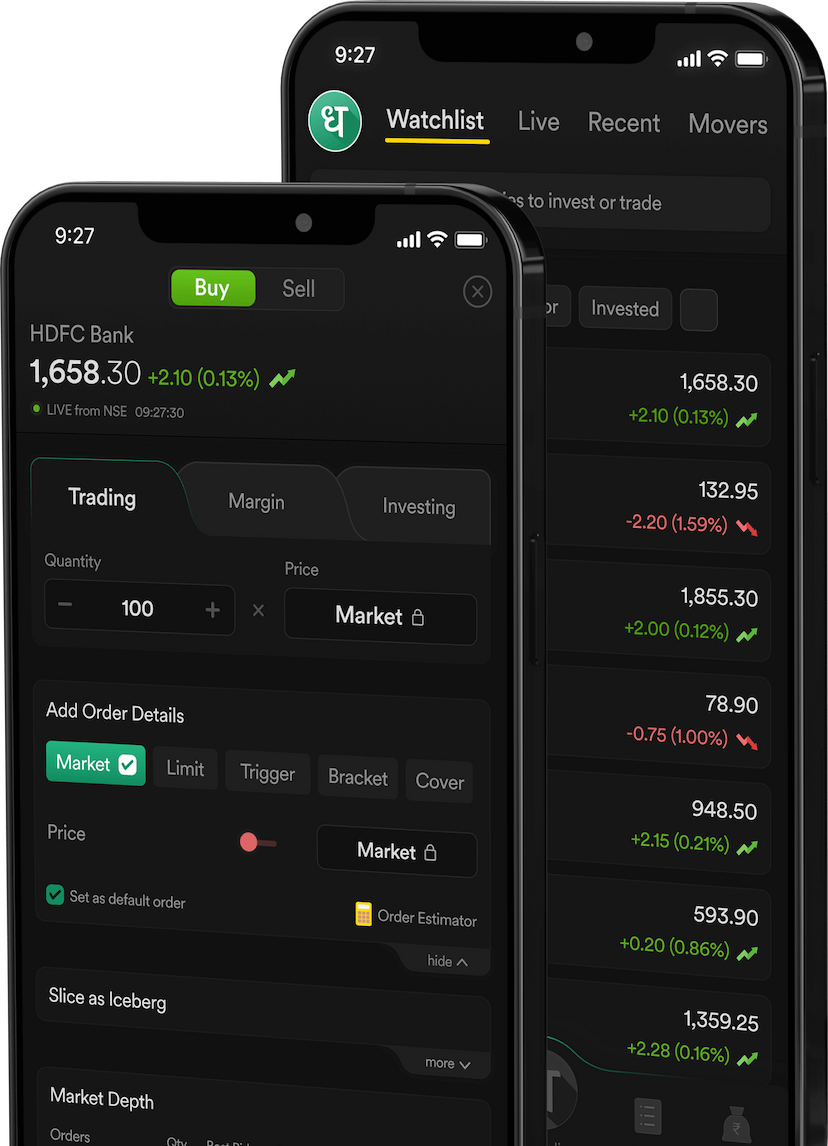
1. Click on "Start Now" and Scan the QR to download the Dhan App.
2. Or, you can Open Demat Account from your desktop in 3 easy steps - Add Mobile Number and Email ID to get verified.
3. Upload the necessary documents required for digital demat account opening.
4. Complete the E-sign.
Once approved, you will receive your demat account details, and you can start investing online - It's that simple!
When you place an order for a stock, it is transferred to your demat account after settlement (T+1 days). Post-settlement, you can choose to sell the stock whenever you want, and based on the liquidity, the sell order is fulfilled by the exchange.
To buy and sell shares using your Dhan online demat account, follow these steps:
1. Log in to your "Dhan" account.
2. Add money to your trading account.
3. Choose the security you want to buy or sell.
4. Enter the quantity and price at which you want to transact.
5. Hit Buy or Sell.
That's it! This is how simple it is to start trading and investing online on Dhan.
Yes, your securities are safe in a Dhan demat account. As a registered depository participant and SEBI-registered stock broker, Dhan adheres to strict security measures and regulations to ensure the safety and integrity of your stocks and other financial securities.
Yes, besides shares, you can hold a variety of other securities in your demat account, such as bonds, government securities, Exchange-Traded Funds (ETFs), and other financial instruments.
Yes, you can transfer shares from one demat account to another. Follow these steps to get your shares to Dhan:
1. Register & Login on CDSL Easiest.
2. Click on “Transaction” and choose “Setup”.
3. Select “Bulk Setup” and then “Transaction”.
4. Enter “Execution date” “Beneficiary owner ID (BOID)”.
5. Tap on “Account ISINs”, choose the stock(s), & hit “Submit”.
6. Verify the request and select “Commit”.
7. Enter your CDSL Easiest PIN.
Invest & Trade with a Trading
Platform That's #MadeForTrade