Top-down vs Bottom-up Investing






Key takeaways
- The top-down investing approach begins with the overall economy and then narrows down the focus towards sectors and individual companies.
- Bottom-up investing begins with examining individual companies, and the focus is mainly on their fundamentals, financial performance and valuations.
- In Top-down investing, more importance is given to macroeconomic and industry trends, whereas the focus is more on business quality and company-specific factors in bottom-up investing.
- There is no one approach that is universally perfect for every investor. Your choice should be based on your investment style, research criteria, risk appetite and investment horizon.
When choosing a stock, investors can start their research from different directions. Some start by learning about the economy and sectors, whereas others start by focusing straight on the strength and value of a particular company.
These are typically called top-down and bottom-up investing approaches. The top-down approach starts from the macroeconomic environment, then goes to sectors and down to companies. The bottom-up approach starts from the company and its fundamentals.
No approach is necessarily better than the other. However, knowing the difference between a top-down vs bottom-up approach to investing can enable you to select a research process that is suited to your investment style, goals and risk tolerance.
What is Top-down Investing?
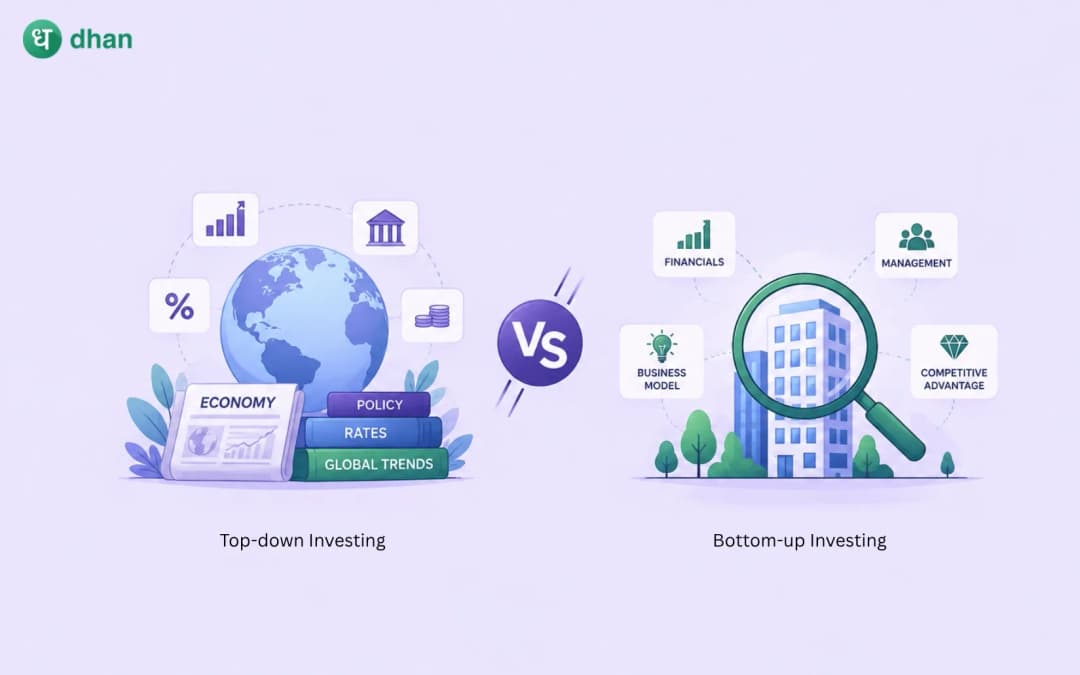
The top-down investing approach begins with focusing on the broader economic and market environment before narrowing the focus to sectors and individual companies. The sequence is: economy → sector/industry → company → stock.
Investors following this approach analyse economic growth, inflation, interest rates, government policies, currency fluctuations and international economic conditions. These factors may impact various industries differently, allowing investors to pinpoint areas that might be advantageous or disadvantageous.
For instance, interest rate fluctuations have the potential to affect borrowing costs, consumer spending and business investment. Likewise, some industries may be more impacted than others by government policies or by a boost in infrastructure investment.
The investor then shifts from the general trend or theme towards specific companies that might be advantaged by the identified sector or economic trend. Nevertheless, the company still needs to be analysed before making an investment decision.
How does Top-down Investing work?
A typical top-down investment process can involve the following steps:
- Analyse the economy: Read and understand indicators like economic growth, inflation, interest rates and government policy.
- Look for promising sectors: Find out which are the industries that could possibly benefit from the ongoing economic environment.
- Shortlist companies: Identify companies within those sectors that might benefit from the identified trend.
- Evaluate company fundamentals: Analyse financial performance, business quality, valuation and more.
- Make the investment decision: Decide if the stock aligns with your investment goals and risk level.
Example: Let us suppose an investor expects infrastructure spending to increase significantly. A top-down investor might first learn about the infrastructure-related sectors and then determine which infrastructure companies might benefit from the rise in demand.
That doesn't imply that all companies in the sector will do well. The end decision demands research and valuation to be done on a company level.
If you know which sector is performing well, you might want to use these stock screener to filter out good stocks easily!
Benefits of Top-down Investing
Top-down investing comes with several strategic advantages for investors.
- Offers a wider market perspective: In this approach, investors first examine the general economy and market conditions and thereafter target sectors and companies.
- Supports the identification of potential sectors: Investors can study the economic conditions and government policies to identify sectors that may benefit from emerging trends.
- Helps make stock selection more structured: Beginning with the economy and sectors helps investors narrow down the big list of stocks and pick out the relevant opportunities.
- Supports diversification: Knowledge of sectoral response to economic conditions can help investors make better-informed diversification decisions.
Drawbacks of Top-down Investing
Although top-down investing has its advantages, investors must be aware of their drawbacks, too.
- Macroeconomic forecasting is challenging: Factors such as inflation, interest rates, economic growth and government policies can change unexpectedly, making accurate forecasts challenging.
- A favourable sector does not mean strong stocks: Despite a sector looking favourable, individual companies within it can have varying levels of growth, profitability, management quality and valuation.
- One might end up ignoring individual opportunities: Sometimes investors can turn down a great company probably because its industry or the overall market isn't appealing.
- Market cycles are hard to time: Predicting when an economic or sector cycle will turn can be challenging and may lead to incorrect investment decisions.
What is Bottom-up Investing?
The bottom-up approach takes the reverse path, where an individual company is used as the beginning point rather than the economy overall. The focus is on learning and comprehending the business, its financial position, the competitive position and valuation.
A bottom-up investor might look at the growth of revenues and earnings, profit margins, debt levels, cash flows, management quality, competitive advantages and the business model. Valuation is also crucial, as a good business may not be a good investment if the stock is overpriced.
The overall economy and industry are not overlooked. But the prime factor behind the investment decision is the individual features of the company and the estimated intrinsic value.
This approach can thus discover opportunities even when an entire sector is not particularly popular. Even if the overall market is unfavourable, a company with good fundamentals, having strong cash flows and a competitive advantage, can attract bottom-up investors.
How does Bottom-up Investing work?
A typical bottom-up process can include:
- Screen companies: Identify companies that meet specific financial or qualitative criteria.
- Study financial statements: Analyse revenue, earnings, margins, debt and cash flows.
- Comprehend the business model: Know how the company makes money and what the growth driver is.
- Assess management and competitive advantage: Examine the quality of the management and the company's competitive position.
- Evaluate valuation: Compare the estimated value of the business to the market value.
- Build an investment thesis: Determine if the risks to the investment are worth the rewards.
Example: For instance, a company can be in a slow-growing sector and still appeal to a bottom-up investor if it possesses strong cash flows, low levels of debt, a competitive edge, or an attractive valuation.
If you have understood bottom-up investing, you might want to pick the right stock. You must use this custom screener to filter stocks easily.
Benefits of Bottom-up Investing
Here are the key advantages of bottom-up investing.
- Focuses on business quality: Investors review a company's financial performance, competitive advantage, management quality, as well as business model, before deciding whether or not to invest.
- Less reliance on economic forecasts: The focus here is more on company-specific fundamentals. Thus, investors do not need to accurately predict the direction of the broader economy.
- Can identify untapped opportunities: Strong companies in less-favoured sectors may offer opportunities if the company fundamentals are favourable and the valuations are reasonable.
- Promotes in-depth research: This approach leads to a more in-depth analysis of a company's financial statements, growth potential, risk, and valuation. This helps to examine how a company is actually doing.
Drawbacks of Bottom-up Investing
Bottom-up investing has its limitations, too.
- More research is required: The process of analysing a company's financial statements, business models, industry conditions and valuations can be time-consuming.
- Companies are still vulnerable to the economy: Even a well-established company can be impacted by fluctuations in interest rates, inflation, consumer demand, or regulations.
- Can overlook general risks: Investors who place a high focus on the fundamentals of a company can be oblivious to wider market or economic risks.
- Needs a balanced approach: It is true that company-level analysis is significant. Nevertheless, investors should also know the industry and economic scenario to make a decision.
Top-down vs Bottom-up Investing
The most basic difference between the two methods, top-down and bottom-up investing, is the starting point for the investment analysis. Bottom-up strategies begin at the company level. On the other hand, top-down strategies begin with the wider market environment and then work toward the sectors and securities.
In practice, the distinction need not be an absolute one. Both can be adopted by investors, and it can be a part of the same investment process.
Which approach is better?
There is no single correct answer as to which is more effective. The choice depends on your investment style, research capability, risk tolerance, investment horizon and understanding of economic and company-level factors.
A top-down approach might be the right fit if you're interested in tracking economic conditions, government policies and sector trends. A bottom-up approach might be better for you if you like to analyse individual businesses, financial statements and valuations.
Your investment time horizon is also important. Long-term investors might benefit from knowing not just the structural trends impacting an industry, but also the inherent worth of the companies that they own. The key thing to remember is that top-down vs bottom-up is not an either-or proposition. When they are used thoughtfully, they can complement each other effectively.
To Conclude
The debate between top-down vs bottom-up investment research comes down to one thing. It is your approach to investment research. Top-down investing starts with the economy and sectors, while bottom-up investing starts with individual companies and fundamentals.
None of these approaches can guarantee better returns and come with respective limitations. Top-down analysis can be used to gain an understanding of the overall investment environment, and bottom-up analysis can be used to discover companies that may be well positioned in that environment.
For the best outcome, it is advisable that before investing, you properly assess your financial goals, investment timeframe, as well as risk appetite. Remember that past performance does not guarantee future returns. The decision to invest should certainly be based on meticulous research, and not on any one economic trend or financial statistic.
FAQs
What is the difference between top-down and bottom-up investing?
Top-down investing starts with the overall economy and filters down to sectors and companies. Bottom-up investing begins with individual companies and focuses primarily on their fundamentals, competitive position and valuation.
Is top-down investing better than bottom-up investing?
There is no approach which can be considered universally better. Top-down investing may be helpful to those who concentrate on macroeconomic and sector drivers, whereas bottom-up investing may be appropriate for investors who prefer to do in-depth research on individual companies.
Which investing approach is better for beginners?
No approach can be considered universally better for beginners. Before making a choice of approach, beginners should have knowledge of basic financial concepts, risk and valuation. A simple mix of general market understanding and a fundamental company-level analysis can give a more balanced starting point.
Can the top-down and bottom-up investing approaches be used in combination?
Yes, both these approaches can be used together. The top-down approach can be used to identify attractive sectors. Then the bottom-up approach can be used to select companies with strong fundamentals and appropriate valuation.
Is bottom-up investing suitable for long-term investors?
It may be appropriate for long-term investors with a willingness to learn about individual companies. But when evaluating an investment, long-term investors should also take into account general economic, industry and market conditions.