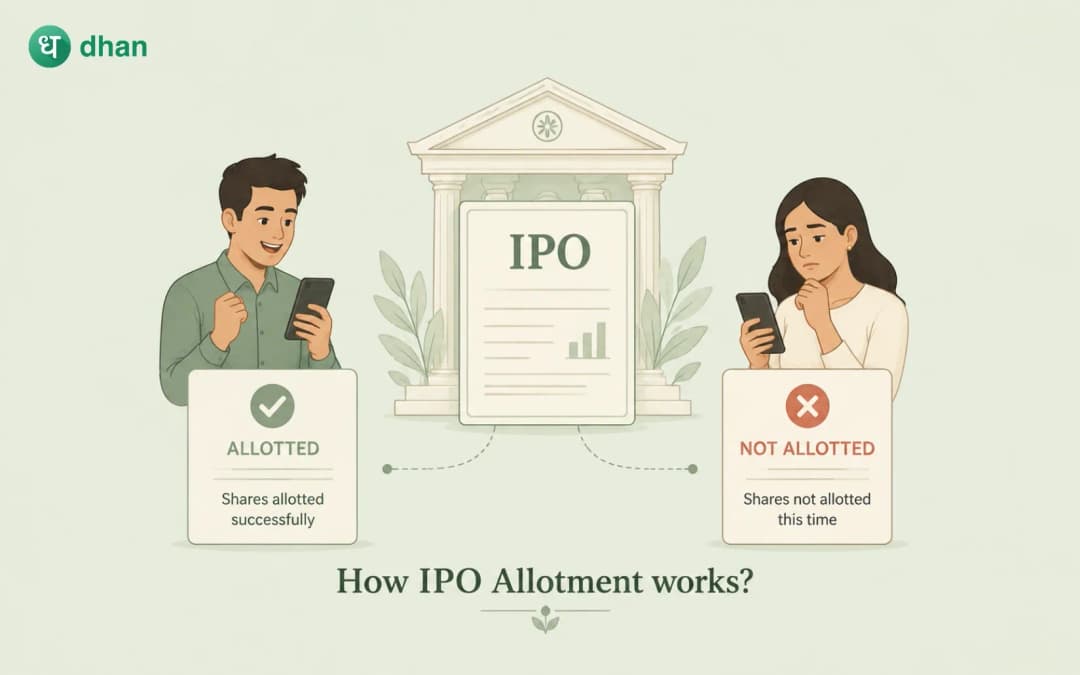
How IPO Allotment Works?









Key takeaways
- IPO allotment takes place after the issue has closed and applications have been reconciled and validated.
- The registrar to the issue has significant involvement in application processing and preparing the basis of allotment in consultation with the issuer and the lead managers.
- When it comes to the retail category, every successful applicant will usually be allotted at least the minimum bid lot, subject to the availability of shares.
- The IPO application amount is blocked in the investor’s bank account via ASBA/UPI and debited only for the number of shares allotted in the IPO.
- Irrespective of the time or the platform, an allotment in an IPO cannot be guaranteed.
When an IPO allotment is announced, it can generate a great deal of excitement among investors. After researching the company, you submit your bid, authorise the UPI mandate and then comes the awaited part: the allotment. But what happens after an IPO closes? Have you ever thought about that? Who gets the shares if thousands or lakhs of people apply? Is allotment entirely a matter of luck? Does the number of lots you apply for make any difference?
Once you understand the process of IPO allotment, you can know what will happen to your application after the IPO bidding closes and why you might or might not get shares.
What is IPO allotment?
The process by which the shares offered in an IPO are distributed among eligible investors after the bidding period closes is referred to as IPO allotment. Retail investors, qualified institutional buyers and non-institutional investors can all apply for an IPO. Every category has a specified portion of the issue, and the allotment is made on the basis as disclosed in the offer document and as per applicable rules.
The registrar to the issue processes the application data received from the exchanges, reconciles the bids and assists the issuer and lead managers in preparing the basis of allotment. This basis is approved by the stock exchange prior to the allotment.
In simple terms, the process looks like this:
How does IPO allotment work step by step?
Here is how it works.
1. Investors submit their IPO applications
In the IPO subscription period, the investors place their bids specifying the number of shares they are interested in purchasing within the price range applicable. Retail investors can generally bid at the cut-off price in a book-built IPO. This indicates they agree to buy at the final issue price decided after the bidding process.
The investor also gives other information like PAN, demat account and payment information. Since the shares for IPO are allotted electronically, a demat account is necessary.
2. The application amount is blocked
If you apply through UPI, your application amount is not immediately transferred to the company. Instead, a UPI mandate is created, and after it is approved, the specified amount is blocked in your linked bank account. The money stays blocked till the completion of the allotment process.
This is a significant distinction between an IPO application and a normal purchase. The total application amount is not paid in advance unless shares are allocated to you. If you get fewer shares than you applied for, the rest of the money is unlocked.
3. The IPO closes, and applications are reconciled
Upon closing of the bidding window, the exchange sends the bidding information for processing. The registrar, after receiving the final bid information, reconciles the same with the banking and UPI data available and identifies the applications which are not valid as per the applicable rules.
The registrar shall also prepare the basis of allotment and co-ordinate the credit of shares and unblocking of funds. This is the reason an IPO application does not lead to an allotment immediately after clicking on “Apply”.
4. The basis of allotment is finalised
The determining factor for allocating available shares to eligible applicants is the basis of allotment. It depends on the investor class and the applicable regulations of the IPO.
With respect to the retail individual investor, the regulations state that the allotment should be at least the minimum bid lot, subject to the availability of shares in the retail portion. The remainder of the shares can then be allocated proportionately. This is where oversubscription comes into play.
How does IPO allotment work when an IPO is oversubscribed?
Let's say there are 1 lakh shares offered in an IPO for retail investors, and the minimum lot of the IPO is 10 shares.
That means, at the minimum lot size, a maximum of:
1,00,000 ÷ 10 = 10,000 investors
can receive at least one minimum lot.
Now suppose that 50,000 proper retail investors apply.
There are more applicants than the number of investors who can receive the minimum lot. In such a situation, eligible applicants for the minimum lot may be selected through a computerised draw of lots.
SEBI's framework has historically specified this mechanism for cases where the number of valid retail applicants exceeds the maximum number of applicants who can receive the minimum bid lot.
A simple example
This is the reason that an IPO which is heavily oversubscribed can have a low probability of receiving even one lot. Importantly, applying for more lots does not guarantee an allotment. In a heavily oversubscribed retail issue where the available shares are insufficient to give the minimum lot to every valid applicant, the allocation of the minimum lot is determined among eligible applicants through the prescribed process.
Does applying early increase IPO allotment chances?
No. There is no benefit in applying on the first day compared to the last day of the allotment application. It does not increase your chances of receiving an allotment. The likelihood of allotment stays the same regardless of when you apply during the IPO window.
What matters more is that the application is valid and filed within the prescribed period, with the UPI mandate accepted as required. Hence, investors should concentrate on making a correct application and not try to apply at a specific time in order to increase the chances of getting an allotment.
What happens to your money after IPO allotment?
The amount is not immediately transferred to the issuer but is first blocked in your bank account.
Once the basis of allotment has been approved:
- If shares are allotted, then the requisite amount is debited.
- The allotted shares are credited to your demat account.
- If fewer shares are allotted, the balance amount is unblocked.
- In case of failure to receive any shares, the blocked amount is released.
NSE's UPI-ASBA process explains that after the basis of allotment is approved, instructions are sent to the sponsor bank for the debit of the required amount and unblocking of excess funds.
How to check IPO allotment status?
Once the allotment is finalised, investors can check whether they received shares.
The details generally required include:
- PAN
- IPO application number
- Demat account details, depending on the platform used
NSE also provides an IPO bid verification facility where investors can verify application information uploaded to the exchange.
What can cause an IPO application to be rejected?
Not every application becomes eligible for allotment. An application can face rejection because of issues such as:
- Wrong demat or PAN information
- Incorrect bid information
- Duplicate applications where not permitted
- Application submitted outside the prescribed timeline
- Failure in approving the UPI mandate
- Linked bank account has insufficient funds
- Technical or reconciliation issues
NSE's investor FAQ specifically highlights the importance of providing correct PAN, demat account and payment details while applying for an IPO.
Therefore, checking the application details before submitting the bid is just as important as deciding whether you want to invest.
What should investors remember about IPO allotment?
So, IPO allotment is not a random process where all applicants have an equal outcome irrespective of the issue structure. It comprises several stages, including application validation, then reconciliation, category-wise allocation, basis of allotment, share credit and fund unlocking.
What matters the most for retail investors is that with heavily oversubscribed IPOs, there can be tough competition for the minimum bid lot.
The allotment process is organised in line with the regulatory framework in force and is not guaranteed to result in the allocation of shares. Therefore, rather than just looking at the odds of receiving an IPO, you first need to ask yourself if the company and its valuation would make sense in your investment strategy.
Conclusion
Having knowledge of how IPO allotment works makes the process much easier to follow. After the IPO closes, applications are validated and reconciled, and the basis of allotment is prepared by the registrar, and then shares are allotted based on the applicable category-wise allotment rules.
Oversubscription can make allotment very competitive for retail investors, and when there are too many shares demanded, the minimum allotment may be determined by a lottery-based process. Most importantly, don't consider the IPO allotment as a sure chance. When considering an IPO, it's important to think about it first as an investment, and second as an allotment opportunity.
FAQs
How is IPO allotment decided?
The allotment of IPO shares is determined on the basis of the allotment for the issue and the applicable SEBI regulations. Once the applications are received, the registrar processes them and reconciles valid applications before preparing the basis of allotment in consultation with the issuer and lead managers.
Is IPO allotment based on luck?
It can involve a lottery or draw of lots for the minimum lot when the number of valid retail applicants exceeds the number of applicants who can receive the minimum lot. The whole allotment, however, is governed by the regulatory framework and category-wise rules.
Does applying for more lots increase the chances of IPO allotment?
Not necessarily. If it is a "heavily oversubscribed retail IPO" (one with more valid applicants than available minimum lots), then applying for extra lots does not mean that you will get the first minimum lot. The allotment is done based on the applicable basis of allotment.
What happens if I don't get an IPO allotment?
In the event of no shares received, the amount blocked in your bank account will be released as per the applicable procedure. If only a portion of applications is received, the amount needed for the shares allotted is debited, and the remaining amount is unblocked.
When are shares listed?
The shares are generally listed within T+3 working days of the IPO. Therefore, if the IPO closes on a Tuesday, the shares will be listed by Friday.