Acko's confidential IPO: Raise $250M at a valuation of $2-2.5 B





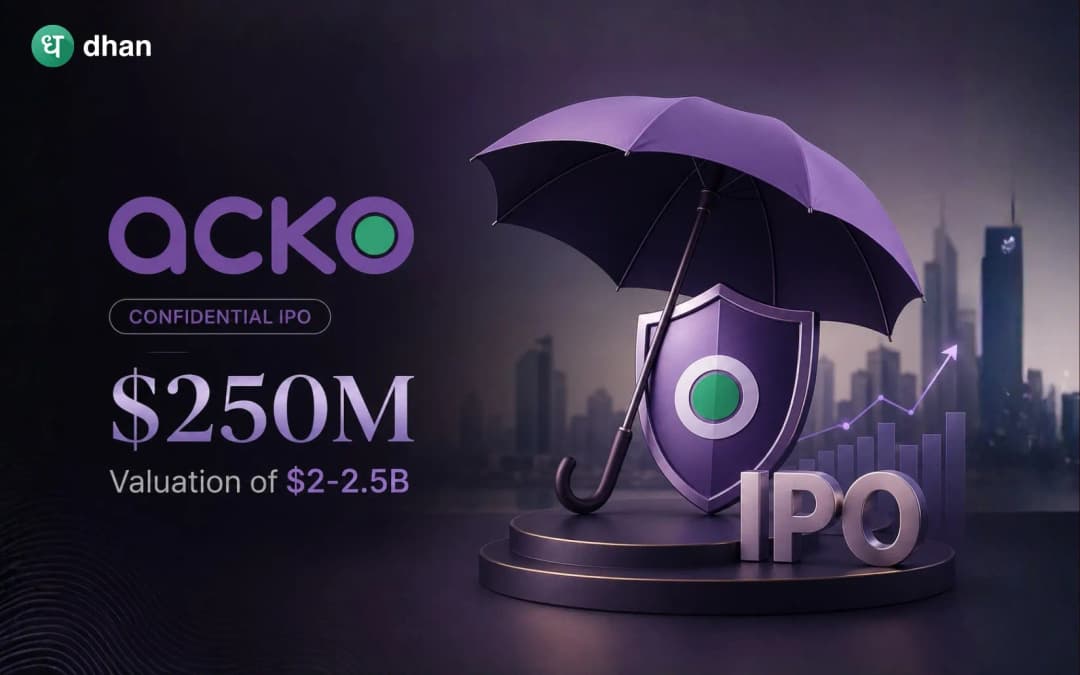




Bengaluru's digital insurance company Acko, a tech venture by Varun Dua, is expected to file its Draft Red Herring Prospectus (DRHP) confidentially with the Securities and Exchange Board of India (SEBI) by June.
The insurtech unicorn is aiming for a $2 billion to $2.5 billion valuation while aiming to raise around $250 million from the primary market. The proposed offer may include both fresh equity issuance and an offer for sale by existing investors interested in cashing out on their early stakes.
In this article, we look at the details about its confidential DRHP filing by Acko, its upcoming IPO process, its strategic restructuring, and the business fundamentals.
What is a confidential IPO filing?
Under SEBI regulations, confidential filing allows companies to submit draft prospectuses to SEBI for an upcoming IPO without making all their financial information and operations public immediately.
This helps the company in gauging investor interest and receiving guidance from the regulatory body, and making suitable alterations to their IPO prospectuses in order to better appeal to their target market, without attracting undue publicity before the official IPO launch process begins.
Due to confidential filing in the event of a sudden change in market sentiments, companies also have the option of withdrawing their IPO from going forward. Therefore, this method has been increasingly utilised by several new-age tech companies recently, including Swiggy, Groww, and Razorpay, who were reluctant to publicise their financials ahead of their official launch in the market.
Acko’s journey behind this IPO
Acko was founded in 2016. The company began its operations in 2018 to provide Indians with an environment where they can buy quick, easy, and hassle-free insurance plans, as for years, Indians were subjected to complex and expensive traditional insurance plans that required going through numerous intermediaries.
Over the past decade, Acko has successfully developed into a comprehensive digital insurance provider. Being a direct-to-consumer business (D2C), the company had no intermediary agents, which helped them significantly lower costs and consequently make motor, health, and travel insurance more affordable for their customers.
Backed by marquee investors such as General Atlantic, Accel Partners, Elevation Capital, and Canada Pension Plan Investment Board (CPPIB), Acko has rapidly expanded and leveraged the embedded insurance model through tie-ups with tech ecosystems like Amazon India, Ola, and Zomato, effectively distributing policies to millions of unique customers.
Preparing for the primary market debut
The decision to bring its IPO to the Indian public markets has been strategically planned by Acko. The company has already selected a list of well-known investment banks to manage its IPO, including top-tier names like Morgan Stanley, Kotak Mahindra Capital, and ICICI Securities.
This clearly reflects that the company is in the active stages of implementing its IPO strategy rather than mere explorations, and it is very likely that we will see a Dalal Street debut by next fiscal year.
Acko’s financial snapshot
The Indian public market has evolved significantly and currently values profitable entities that have a clear future roadmap for the execution of their strategies. Therefore, Acko has been diligently attempting to clean up its bottom line to meet these expectations.
Acko has recorded a total operational revenue of Rs. 2,887 crore in FY25, with a 35% year-on-year growth over FY24. It also reduces its losses through strong top-line growth and tighter control over costs. Acko reduced its net loss by 37% to Rs. 424 crore from the previously reported Rs. 670 crore.
The company has substantial numbers in its core business operations, as it recently insured motor vehicle premiums of Rs. 1,186 crore and health insurance premiums of Rs. 1,235 crore. Though the company continues to post losses, a consistent drop in cash burns signals its disciplined transition toward profitability.
Strategic restructuring
Acko is conducting an internal restructuring process in April 2026 to optimise its business activities ahead of its IPO. To achieve this, about 60 employees out of the total of 1200 staff members were laid off, representing 5% of the entire workforce.
This significant reshuffling has been triggered by a large internal shift towards Artificial Intelligence (AI). The company has started deeply integrating AI across its operations, right from underwriting, claims processing, to customer service, where automation is gradually replacing traditional human workflows, hence making some of the current roles redundant.
Apart from the staffing changes, there were significant changes in leadership roles, too. As CMO, Ashish Mishra made way for veteran Nitin Khanna to lead the brand. To potential investors, these changes at Acko signify one important thing: the company is willing to ensure its $2.5 billion valuation is validated by concrete steps and an institutional framework to achieve sustainable profitability in its business operations.
Why does this IPO matter?
The Acko IPO is undoubtedly going to be one of the key IPOs of the Indian insurtech space. As insurance penetration continues to be extremely low in India at barely 3.7%, thus, there lies an enormous scope for growth.
Compared to its rivals, which rely more on business agents for profitability, Acko follows a purely digital approach. A successful listing of Acko would validate its digital D2C business model on a large scale and would also create new avenues for similar businesses preparing for their public listing.
The bottom line
Acko's confidential IPO filing is indeed an important event for the Indian insurtech sector. Its endeavor to raise $250 million represents a prudent approach toward its listing on the Indian primary markets. For the broader investing community, this IPO will be a testament to the evolution of the Indian startup ecosystem as it continues to achieve a balance between ambitious technological goals and strict financial discipline.