Silver rate trends in India over the last 50 years





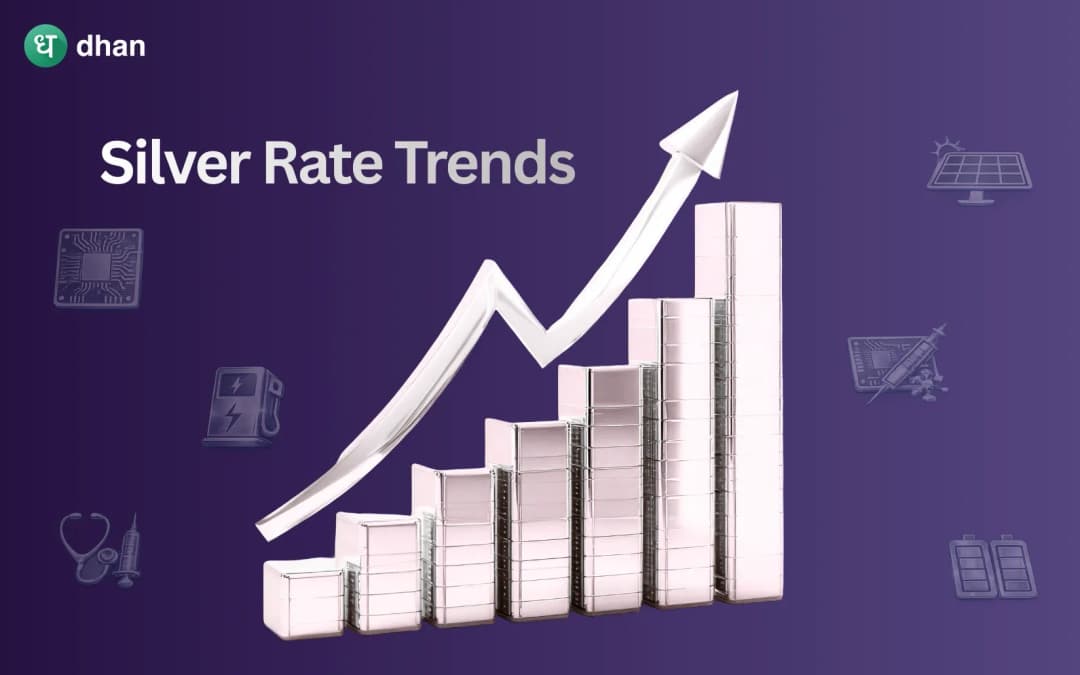


These changes are influenced by different economic factors, changes in currency values, the demand from industries, and investment preferences. The recent surge in silver prices during 2025-2026 has again attracted the attention of investors, emphasising the dual nature of silver as a financial commodity and a strategic industrial material.
Overview of current silver prices in India
In early 2026, silver prices in India reached record levels. On January 27, 2026, there was a sharp increase in silver prices, with prices soaring to Rs 3,70,000 per kg, reflecting strong international trends and domestic demand. The rally in silver prices is backed by the weakening of the Indian Rupee and the silver prices crossing ₹3,00,000 per kg for the first time in history.
Historical significance of Silver
In India, silver has a dual personality, both as a safe haven asset and as an industrial material. Historically, it was the backbone of the currency system of India before the system changed over to fiat paper money. Culturally, it still retains an important position in festivals such as Dhanteras and Akshay Tritiya. But in the contemporary world, its importance has changed from being used as an ornament to being used as an industrial material in 21st-century products.
Unlike gold, which is essentially a hedge against inflation and a safe haven asset, the dual nature of silver as a safe haven asset and an industrial material gives a distinct identity to silver among other precious metals.
What are the industrial uses of silver?
Silver is not only a precious metal, but it has also become a green metal. The industrial footprint of silver has grown considerably in segments such as:
- Solar Energy: It forms a major part of the production of photovoltaic cells.
- Electric Vehicles: Used in battery manufacturing and electrical control units.
- 5G Technology: An essential part of 5G semiconductor chips and infrastructure.
- Medical: It is used in antimicrobial coatings and medical devices.
- Electronics: Found in nearly all switches, connectors and circuit boards due to high conduction properties.
Silver rates over the last 25 years
Silver rate trends over the last 50 years
The following table shows the average annual price of silver in India for the past five decades.
This table shows the long-term uptrend in silver prices, especially in the last decade, as silver’s industrial demand has grown exponentially.
Turning points of silver price movements
Silver prices in the last 50 years have been shaped by several factors. The following timeline illustrates the key turning points in the silver prices from 1970 to 2026.
1970–1980
This decade was characterised by the Hunt Brothers, two American billionaires who tried to corner the global silver market. By purchasing around a third of the global silver supply, they drove silver prices to new heights in 1980, before the bubble burst and led to a crash known as Silver Thursday.
1980–1990
However, after the crash, the 1980s were a period of slow recovery for silver, with prices hovering between the range of ₹2,500 and ₹6,000. Silver prices were influenced by the stringent control on imports before liberalisation, which maintained a tight supply, making silver more expensive in India.
1990–2000
The 1991 Economic Liberalisation was a watershed moment for silver prices. The easing of import norms integrated the Indian markets with the global trends. Despite this, silver prices were range-bound (₹6,000 - 8,000) because the world was focused on the dot-com boom and equities rather than commodities.
2000–2010
In the 2000s, silver started to benefit from increases in industrial demand and a growing Indian economy. By the late 2000s, higher industrial consumption and renewed investor interest were adding further upward pressure on silver prices. Silver prices rallied after the financial crisis of 2008. This decade served as the foundation for silver as an investment option beyond its ornamental usage.
2010–2020
The 2010s were characterised by continued growth in industrial metals demand, due to the increasing use of silver in new technologies, and thus rising silver prices. The decade ended with the onset of the COVID-19 pandemic, which reignited safe-haven demand, pushing silver prices to new heights.
2020–2026
The period from 2020 onwards experienced aggressive growth in silver prices. Global fiscal and monetary stimulus after the Covid-19 pandemic, supply chain constraints and strong industrial demand led to a sharp increase in silver prices. By 2025 and early 2026, silver prices shot up from Rs 90,000 to above Rs 3 Lakh per kg due to limited mining output vs explosive demand for silver from the Solar sector and EV sector.
Driving factors for the Silver price increase
Some of the major drivers for the long-term increase in silver prices are:
- Supply deficit: For the fifth consecutive year, global silver demand has outstripped its supply. Silver is being used at a faster rate than it is being mined.
- Green tech revolution: Due to the high conductivity of Silver, it becomes an important component for the manufacturing of solar photovoltaic (PV) cells and electric vehicles (EVs). Also, the global drive for net zero by 2050 is driving the silver demand.
- Geopolitical instability: Continuing tensions in the Middle East and trade wars (US tariffs) have spooked investors, driving them toward safe-haven investments such as silver.
- Rupee depreciation: Since silver is imported, a weaker Rupee against the US dollar drives higher silver prices in India.
- Easy accessibility: Due to the availability of silver exchange-traded products, participation in the silver growth has become easy and accessible for investors seeking to invest in silver without owning physical silver.
Why Silver is a good investment option in 2026
Silver's dual role as both an industrial metal and a store of value positions it with unique investment characteristics in the year 2026:
- Price momentum: Silver's strong gains through 2025 and early 2026 make it one of the best investment option among commodities.
- Industrial demand growth: Fast-growing solar, electronics and EV industries are driving increased demand for industrial usage of silver.
- Diversification: As part of a diversified portfolio, silver offers diversification benefits as an inflation hedge along with core holdings in equities and bonds.
Conclusion
Silver’s price trajectory in India from ₹500 to ₹3,00,000 over the past five decades is correlated with the broader global economic trends, increasing industrial demand, currency fluctuations and changing investor behaviour. Silver has transformed from a traditional store of wealth metal to a strategically important industrial metal.