Iron Butterfly Strategy






Key takeaways
- The iron butterfly is a neutral defined-risk options strategy built using four option contracts.
- It works best when the underlying asset is expected to remain close to a specific strike price until expiry.
- Maximum profit is limited to the net premium received at trade entry.
- Maximum loss is capped because of the protective long call and long put positions.
- Time decay generally works in favour of the strategy, while sharp price movement works against it.
Options strategies usually sound more complicated than they actually are. Strategies like iron condor, straddle, strangle, butterfly spread, and calendar spread may look like advanced structures meant only for experienced derivatives traders. But once you break them into components, many of these strategies become far easier to understand.
The iron butterfly is one such strategy. It looks complex at first because it involves four option contracts. But its logic is fairly straightforward. It is a defined-risk options strategy typically used when a trader expects limited movement in the underlying asset before expiry.
Meaning, the strategy benefits when the market stays relatively stable and does not make any sharp directional move. In this article, we will understand how the iron butterfly works, how it helps traders to evaluate whether a neutral income-focused strategy fits their market view and risk tolerance.
What is the Iron Butterfly Strategy?
The iron butterfly is a neutral options strategy which profits when the price of the underlying asset remains close to a specific strike price until expiry.
The strategy combines both call and put options to create a defined risk and defined reward setup. It has the following structure:
- Sell one at-the-money (ATM) call
- Sell one at-the-money (ATM) put
- Buy one out-of-the-money (OTM) call
- Buy one out-of-the-money (OTM) put
The Iron Butterfly strategy is a net credit strategy as it involves selling two ATM options and buying two OTM options with the same expiration date. This means the trader receives a premium upfront when entering the trade. The iron butterfly is essentially a risk-defined version of a short straddle. The protective long options cap potential losses if the market moves sharply in either direction.
Why traders use the Iron Butterfly
In the market, you will not see a continuously trending market. Sometimes the market moves within a range before resuming a trend. These situations usually occur when the market is going through a low volatility phase, consolidation before an event, or expiry periods with muted expectations.
In such conditions, time decay works in favour of options sellers. The iron butterfly strategy is used to benefit from:
- Limited price movement
- Time decay (theta)
- Falling implied volatility in some cases
- Defined maximum risk
This strategy is suitable for traders who prefer structured risk rather than unlimited exposure.
Payoff structure of an Iron Butterfly
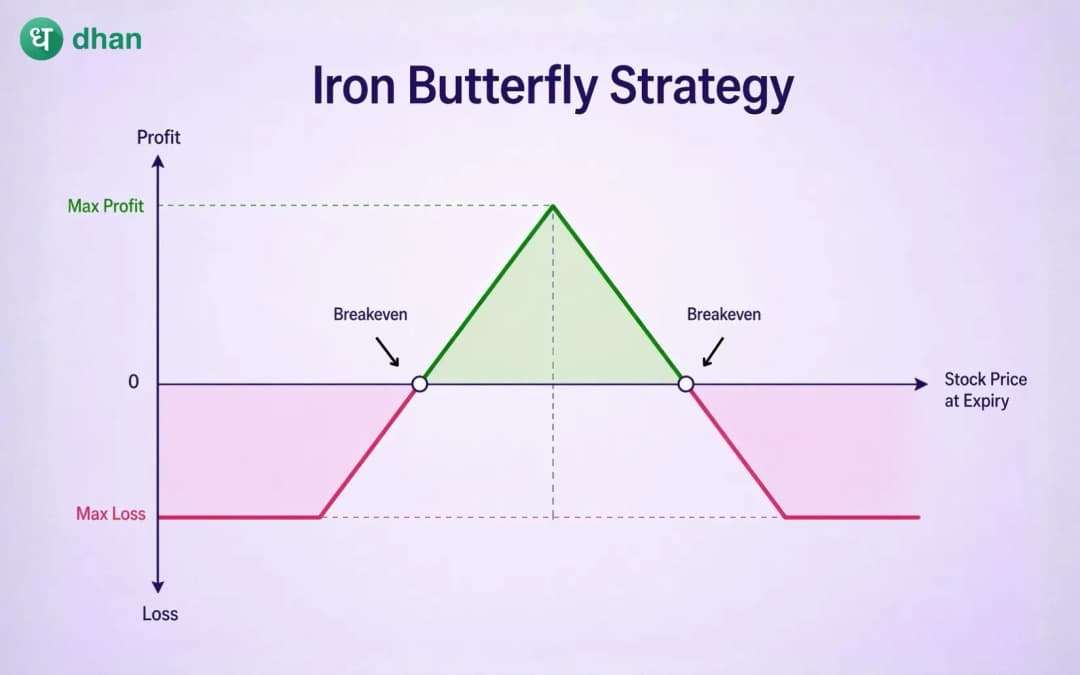
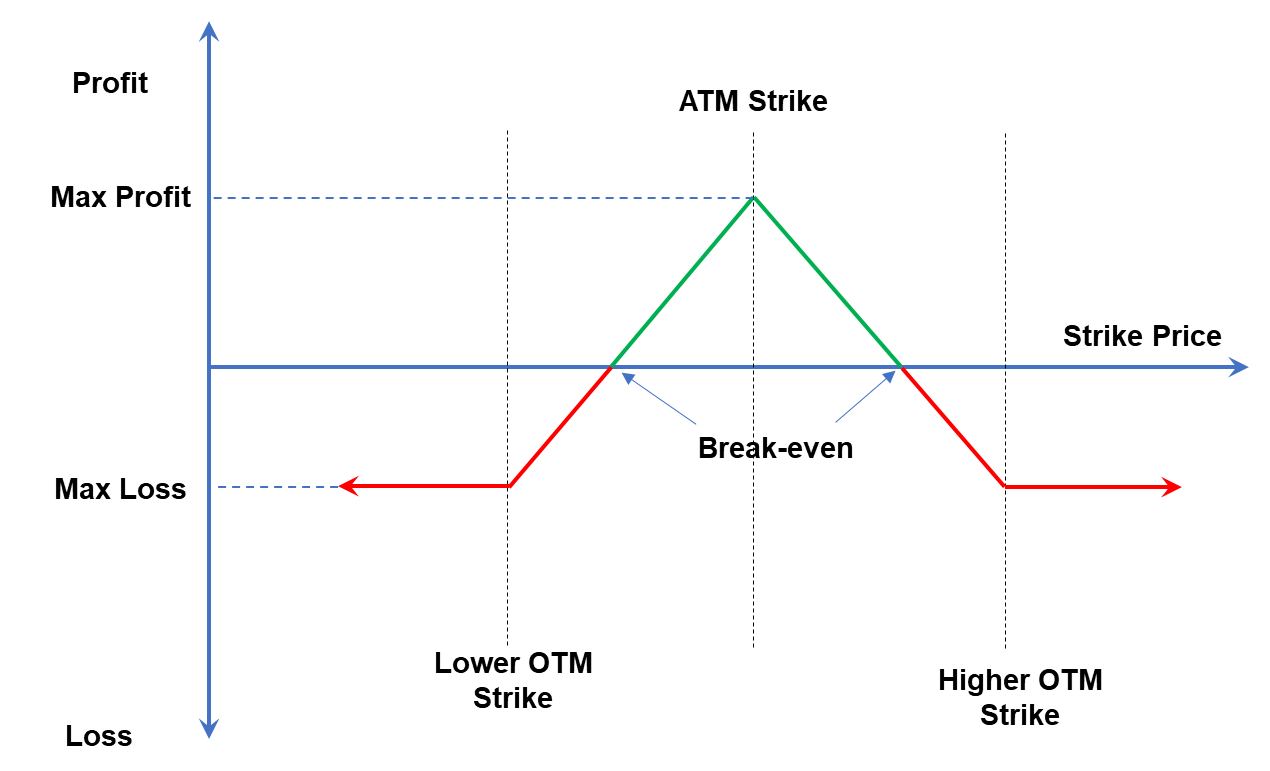
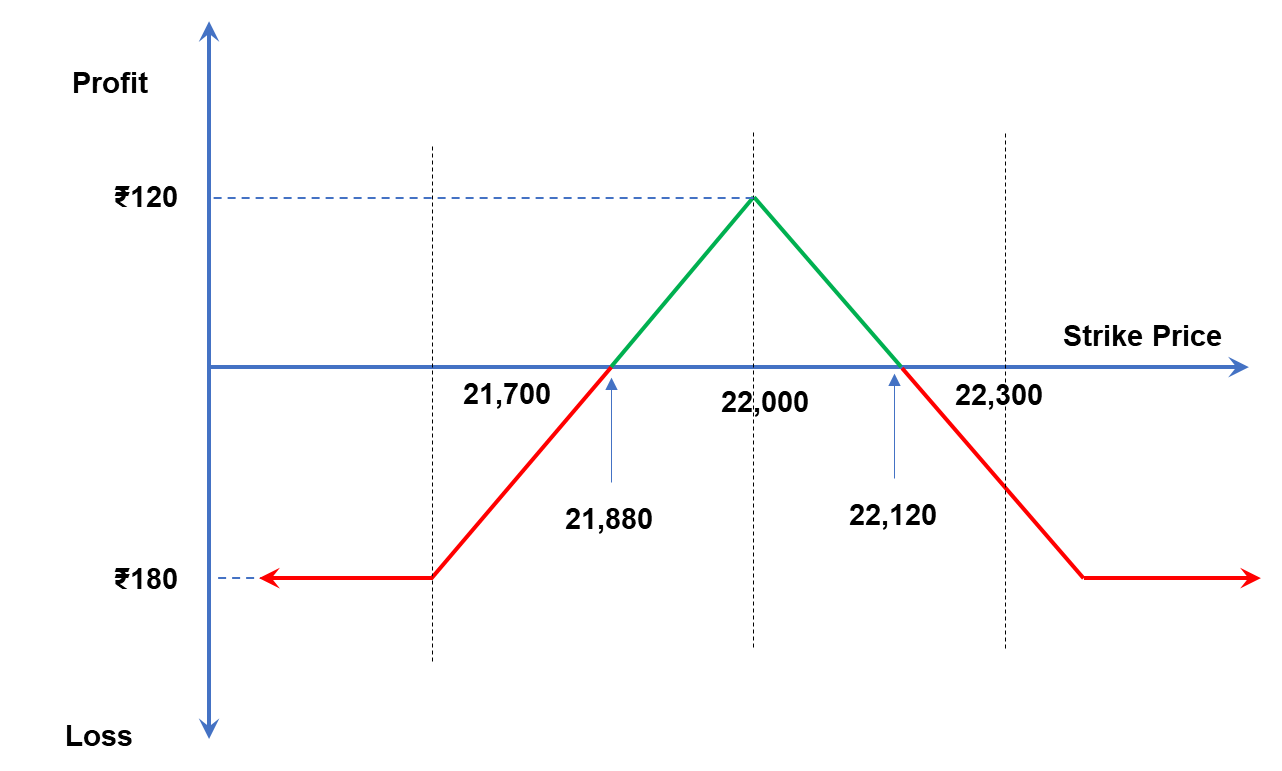
The figure shows the pay-off diagram for the iron butterfly strategy. You can see that the one call option and one put option are sold at the ATM strike price. You will receive a premium by selling those options. To cap the upside and downside, you buy one OTM put option and an OTM call option. These OTM options are relatively cheaper than the ATM options, hence you will receive the extra money.
The green trifle represents the profit zone. You will have the maximum profit if the market stays exactly at the ATM strike at expiry. As the price moves away from the ATM strike in either direction, your profit decreases until it hits zero.
The blue horizontal line represents the zero-profit/zero-loss mark. The two points where the diagonal lines cross this horizontal line are your break-even points.
If the market goes beyond these points, losses will start to build. It is indicated by the red line. If the price touches any of the OTM prices, you will have the maximum loss, and beyond those points, your losses will be covered.
You can calculate the maximum profit with the following formula:
Maximum Profit= recieved by selling ATM options - Premium paid to buy OTM options
Use the formula below to calculate break-even points:
Lower Break even = ATM strike - Net premium received
Upper Break even = ATM strike + Net premium received
Maximum loss can be calculated with the formula below:
Max Loss = (Higher OTM Strike - ATM Strike) -Net Premium Received
Practical example for an iron butterfly
We will try to understand the iron butterfly strategy through a simple example. Suppose an index is trading at 22,000. A trader expects the price to stay near this level over the next expiry cycle. To apply the iron butterfly strategy:
- Sell 22,000 call
- Sell 22,000 put
- Buy 22,300 call
- Buy 21,700 put
Assume the trader receives a net premium credit of ₹120. This is the maximum possible profit with this setup.
Let's consider the scenarios below:
Price stays at ₹22,000 at expiry
The trader will have maximum profit, which is equal to the ₹120 (Net premium received).
Price moves beyond ₹22,300 or ₹21,700
The trader will have to bear maximum loss if the price goes beyond these levels. In this case, the maximum loss is calculated with:
Max loss = Wing width – Net premium received = 300 - 120 = ₹180
Breakeven points
For the above example, the breakeven points are calculated as follows:
Upper breakeven = 22,000 + 120 = 22,120
Lower breakeven = 22,000 - 120 = 21,880
Profits occur if expiry remains between these levels. Losses begin outside them.
When does the Iron Butterfly work best?
The Iron Butterfly strategy works better in range-bound markets. If the price remains near the centre strike, time decay works efficiently. If the price makes repeated directional swings beyond breakeven levels, then the effectiveness of the strategy decreases.
Along with range-bound market conditions, a stable or falling implied volatility improves its effectiveness. Sharp volatility expansion can work against the trade.
Risks involved in the iron butterfly
Although the strategy offers defined risk, it does not translate to low risk. The risks involved in the iron butterfly strategy are:
- Big price swing is the primary threat. If price trends aggressively upward or downward, short options lose value quickly. Protective wings cap losses, but damage still occurs.
- Rising implied volatility can inflate the premiums. This can hurt the positions even before expiry.
- The strategy has a very narrow profit zone. Maximum profit occurs in a relatively tight range. Even moderate movement can reduce returns significantly.
Advantages of the Iron Butterfly Strategy
The Iron Butterfly strategy offers the following advantages.
- The key advantage of this strategy is that it offers limited loss. You can choose the strike prices as per your risk tolerance.
- Another big advantage is time decay. As the strategy involves selling of the options, it benefits from the time decay.
- The strategy collects the upfront premium. This creates a measurable reward framework.
- It offers a systematic way to express a non-directional view. This makes it useful for specific market environments.
Limitations of the iron butterfly strategy
The iron butterfly strategy has the following limitations:
- The strategy has a very narrow profit zone. This requires precise predictions to make profits.
- The iron butterfly is very sensitive to volatile shifts. Rising implied volatility can hurt open positions.
- The strategy needs active monitoring and needs to adjust the positions as the market changes.
Wrapping up
The Iron Butterfly strategy is a limited risk, limited profit strategy. It is used when the market is range-bound. The strategy involves selling one at-the-money call, selling one at-the-money put, and buying one out-of-the-money call and put, each at nearly equal distances from the centre strike price, with the same expiry dates.
The strategy allows you to make profits even when the market is not moving much. Still, the strategy needs active monitoring, and the poor timing, volatility expansion, or directional movement can quickly pressure the trade.
FAQs
What is the iron butterfly strategy in options trading?
The iron butterfly is a neutral options strategy. It involves selling one at-the-money call, selling one at-the-money put, and buying one out-of-the-money call and put for protection.
What is the maximum profit in an iron butterfly strategy?
The maximum profit is limited to the net premium received while entering the trade. This occurs when the underlying asset expires exactly at or very close to the short strike price.
When should traders use the iron butterfly strategy?
The iron butterfly is typically suitable when traders expect low volatility or range-bound price action.
Is the iron butterfly strategy bullish or bearish?
The iron butterfly is primarily a neutral strategy, not specifically bullish or bearish. It performs best when the underlying asset stays within a limited price range.
Is the iron butterfly strategy risky for beginners?
While the strategy has defined maximum risk, it still requires a clear understanding of options pricing, implied volatility, and expiry behaviour. Beginners should first understand how multi-leg strategies work before using them in live trading.