IOC meaning in Share Market







There are times when you place a trade, and it shows the “pending” status for minutes or even hours. This is one of the biggest challenges in trading, and the problem lies in execution.
IOC orders are suitable for traders looking for speed and precision with no waiting time. Instead of letting your order wait in the system, anticipating a match, IOC ensures that whatever can be executed instantly gets done, and the rest gets cancelled.
In real-world trading scenarios, IOC orders can be extremely effective when you use them in the right way.
In this guide, we have comprehensively explained what IOC orders are and how they work. Read on to understand the ideal situations to use it, along with its advantages and limitations.
What is an IOC in the stock market?
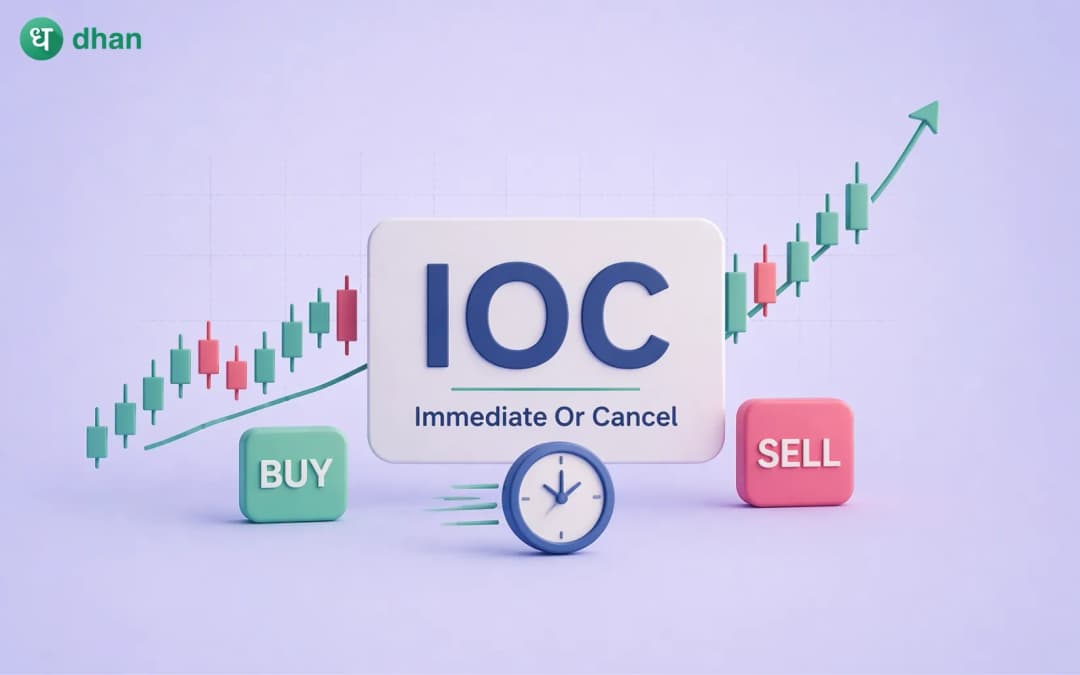
The IOC meaning in share market is “Immediate or Cancel”. In this type of order, execution must take place immediately. In case the system doesn’t find a match for your order instantly, the unexecuted portion gets cancelled automatically.
However, here’s something important traders must understand. IOC does not require full execution, as it allows orders to be partially executed, too. This means the quantity that is available now gets executed. The remaining quantity gets cancelled instantly.
This difference makes IOC different from other types of orders, like limit orders or day orders, which may remain pending in the system.
How do IOC orders work?
Now, let’s understand how IOC orders work step-by-step, so that you can use them while placing real trades.
Placing the IOC order
When you place an IOC order, you need to choose the quantity of the trade, the price in the case of a limit IOC, and the order type. For instance, you can place an order to buy 1,000 shares at INR 250 using IOC.
Immediate matching with market orders
When the order hits the exchange, the system checks the order book. It looks for sellers willing to sell at INR 250 or better. It takes only milliseconds for this matching to take place. The execution begins immediately if matching orders exist.
Partial or full execution
At this stage, the most practical part takes place. There are three possible outcomes: full execution, partial execution, and no execution. If all the shares are available at INR 250, your order will be fully executed. If only 600 shares are available at that price, those shares will be executed. However, if no seller matches your price, the entire order gets cancelled.
Automatic cancellation
The automatic cancellation feature makes IOC unique. Any portion that is not executed immediately is automatically cancelled. You do not have to modify the order, cancel it manually, or wait for the market, as everything happens instantly.
Final outcome
Once the process is over, you’re left with only the executed shares and no pending orders. Active traders prefer IOC orders due to this clarity.
IOC vs other types of order
Now, let’s check out how IOC orders compare with other commonly used types of orders.
Therefore, IOC orders come between market and limit orders. It gives you better control over price and speed, but without requiring you to wait.
When should you use IOC orders?
Here are a few practical situations when IOC orders must be used. Let’s understand the use cases of this type of order.
During high volatility
When markets move rapidly during the opening hours or following news events, prices can change within seconds. With IOC orders, your order can get executed instantly at the desired price. Or else, it doesn’t get executed at all.
When you want instant confirmation
Sometimes you don’t want uncertainty during trading. You either want the trade to be executed immediately or prefer not to go for that trade at all. IOC helps you gain that confirmation.
For intraday trading
Speed and accuracy matter heavily during intraday trading. Your orders cannot afford to wait in the system. In these situations, IOC helps you enter trades quickly, exit positions instantly, and avoid delays.
While trading low liquidity stocks
When you trade low-volume stocks, orders may remain pending for a long time. IOC can prevent this as it cancels quantities that don’t match immediately.
When testing price levels
As a trader, you may use IOC to check whether a certain price level has enough liquidity. It works like a quick “test order”.
Advantages of IOC orders
IOC orders offer several practical benefits. Particularly, if you’re an active trader, you can benefit from these orders in different ways.
Speed of execution
The speed at which IOC orders are executed is its biggest advantage. There’s no waiting time involved for traders. Your order either gets executed instantly or it gets cancelled.
No pending orders
Sometimes, pending orders can lead to unexpected trades later. This risk is completely eliminated by IOC orders.
Better price discipline
With IOC orders, you set your price, which prevents accidental execution at unfavourable levels. This helps you maintain better discipline with price.
Ideal for fast markets
When markets are volatile or fast-moving, IOC orders help you act quickly without hesitation.
Reduced exposure to the market
As the orders do not stay active, your exposure to sudden changes in price gets minimised.
Limitations of IOC orders
Although IOC orders offer several benefits, traders must also be aware of these potential drawbacks of these orders.
Risk of partial execution
As a possibility of partial execution exists, you may not get the full quantity you want. If your strategy requires complete execution, this can be a problem.
Missed opportunities
In case the order does not match instantly, it gets cancelled. This can happen even if the desired price becomes available seconds later.
Not suitable for investors
Long-term investors usually don’t need instant execution. Instead, they prefer limit or GTT orders.
Requires understanding of the market
You need to understand several concepts, like the depth of the order book, liquidity, and market conditions, to use IOC effectively. Without proper knowledge, IOC can lead to confusion.
IOC orders for different types of traders
Now that you have a proper understanding of the IOC meaning in the share market, it’s time to understand how different types of traders can use these orders.
Intraday traders
Intraday traders need quick entry and exit strategies. As speed matters more than waiting, they use IOC orders in their trades.
Scalpers
Small movements in price matter for scalpers. They heavily depend on instant execution, which makes IOC a perfect option.
Institutional traders
Institutional traders use IOC to avoid revealing the full order size. These orders also reduce the impact on the market and are executed selectively.
Swing traders
Swing traders use IOC occasionally during entry or exit points. However, they may not use these orders too frequently.
Beginners
Beginners should use IOC cautiously. First, it’s important to understand these orders before experimenting with them.
How IOC orders help in risk management
IOC orders help traders manage risk in several ways.
- Since only the available quantity is executed, you don’t accidentally take larger positions.
- It prevents slippage of control, as your order doesn’t get executed at unfavourable prices later.
- IOC orders reduce uncertainty in the market as no pending orders are left.
- It brings clarity in decision-making as you instantly know whether your trade worked or not.
- When markets are volatile, waiting can be risky, and IOC helps you avoid unwanted exposure.
Conclusion
It’s important to understand the IOC meaning in the share market to improve how you execute your trades. It’s about placing your orders with a specific strategy to gain speed and control over prices. However, it’s equally important to use them in the right situations.
If you’re an active trader and particularly use intraday or short-term strategies, IOC orders can be a tactical approach. Consider observing how IOC orders work in live markets and use them in small quantities. In fast trading, execution is everything, and IOC orders help you gain control over that.
FAQs
What does IOC mean in the share market?
The full form of IOC is Immediate or Cancel. It means that your order must be executed instantly. The unexecuted portion, if any, gets cancelled.
Can IOC orders be partially executed?
Yes, IOC orders can be executed partially. The remaining quantity gets cancelled immediately.
Is an IOC order better than a limit order?
An IOC order doesn’t necessarily have to be better than a limit order, as they are used for different purposes. IOC is better for speed. However, limit orders are suitable when you want to wait for a specific price.
Do IOC orders remain pending?
No, IOC orders never remain pending. They either get executed instantly or cancelled.
Who should use IOC orders?
IOC orders are suitable for intraday traders, scalpers, and experienced traders who want quick execution and better control over prices.