What is Revenge Trading and how to stop it?





Key takeaways
- Revenge trading usually happens when a trader tries to recover a loss quickly.
- Taking a break after a loss can help prevent an emotional decision.
- A fixed loss limit can stop one bad trade from turning into several.
- Traders should review losing trades instead of immediately trying to win the money back.
- A trading plan with clear entry, exit and risk rules can make emotional trading easier to control.
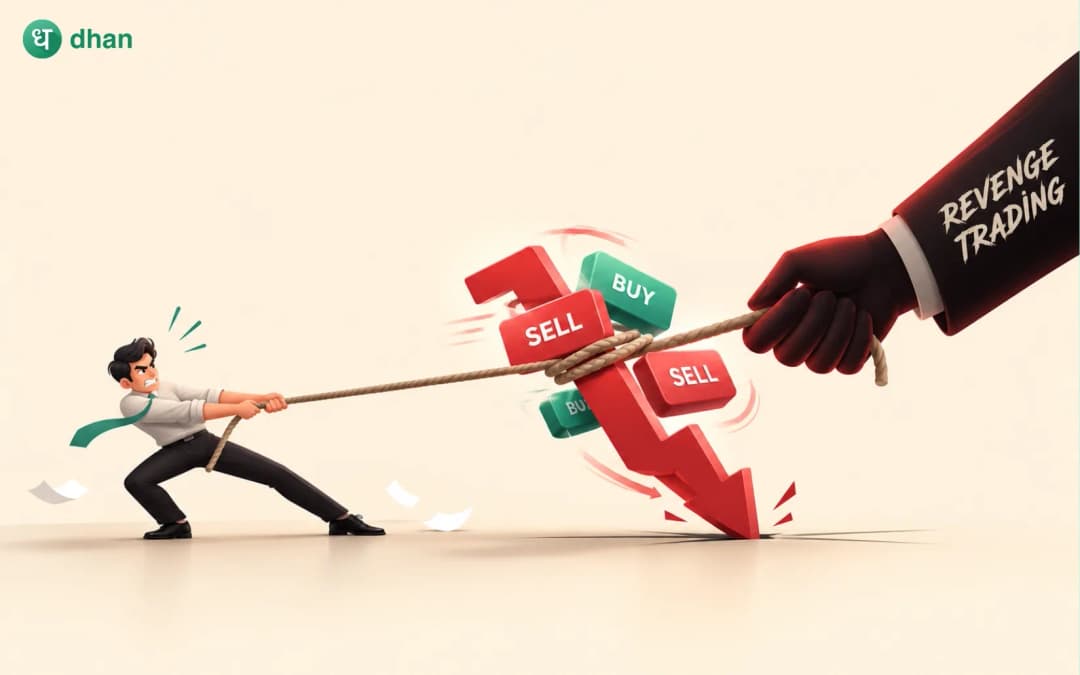
Trading losses can be difficult to accept, especially when a trader feels the loss could have been avoided. After a bad trade, it is common to want to enter another position quickly and make the money back. This reaction is often called revenge trading.
The problem is that the next trade is no longer based only on the market. The trader may be trying to recover the previous loss, prove that they were right or simply get back to where they started. This can lead to larger positions, rushed decisions and more losses.
Stopping revenge trading is less about controlling every emotion and more about having clear rules for what to do after a losing trade. A trader who knows when to step away has a better chance of making decisions based on the market rather than the previous result.
What is Revenge Trading?
Revenge trading happens when a trader enters another trade mainly because they want to recover money lost in an earlier trade. For example, suppose a trader loses Rs 2,000 on a trade. Instead of waiting for the next suitable setup, they immediately enter another position. They may take a larger position because they want to recover the Rs 2,000 quickly.
If that trade also moves against them, the trader may enter again. The focus slowly shifts from finding a good trading opportunity to getting back the money that was lost.
The market does not know about the earlier loss. A new trade still needs to be judged on its own setup, risk and potential reward.
Why do traders Revenge Trade?
A losing trade can bring out strong emotions. Frustration, anger, disappointment and the fear of ending the day with a loss can all affect the next decision.
Some traders also find it difficult to accept that their analysis was wrong. They may enter another trade because they believe the market will soon give them a chance to recover.
There can also be pressure to finish the day in profit. A trader who started the day with Rs 5,000 in gains and then lost Rs 3,000 may feel that they need another trade to return to the earlier profit level. These thoughts can make a trader act differently from their normal strategy.
Signs that you may be Revenge Trading
It is not always easy to recognise revenge trading while it is happening. A few signs can help.
Increasing your position size after a loss
Taking a larger trade simply because the previous one lost money is a warning sign.
Entering without a proper setup
You may take a trade even though it does not meet your usual conditions.
Trading immediately after a loss
Taking another trade is not automatically revenge trading. The problem starts when the main reason for entering is to recover the money.
Moving your stop-loss
Giving a losing position more room because you do not want to accept the loss can increase the damage.
Ignoring your trading plan
If you start breaking rules that you normally follow, emotions may be influencing your decisions.
How to avoid Revenge Trading?
Here are 9 things you can do to avoid revenge trading.
Take a break after a loss
One of the simplest ways to avoid revenge trading is to create some distance between a losing trade and the next decision.
The break does not have to last for the entire day. It could be 10 or 15 minutes, depending on the trader and the market. During this time, step away from the trading screen instead of immediately looking for another trade.
Once some time has passed, it becomes easier to look at the market without trying to recover the previous amount. For some traders, taking a longer break after a large loss may be more appropriate.
Set a daily loss limit
A daily loss limit can put a clear boundary around how much a trader is willing to lose in one trading session. For example, a trader may decide that if losses reach Rs 5,000 in a day, they will stop trading for the day.
The exact amount depends on the trader's capital, strategy and risk tolerance. The important part is deciding the limit before emotions take over.
Once the limit is reached, continuing to trade can make it tempting to increase the position size or take weaker setups. Stopping at the predetermined level removes that decision from the moment.
Do not increase your position size to recover a loss
A common revenge trading mistake is increasing the size of the next trade. Suppose a trader normally risks Rs 1,000 on a trade but loses Rs 2,000. They may decide to risk Rs 3,000 on the next trade so that one successful position can recover the earlier loss.
This can make the situation worse. If the second trade also loses, the amount that needs to be recovered becomes even larger.
The size of a trade should come from the trading plan and risk limits, not from the size of the previous loss.
Go back to your trading plan
A trading plan can be especially useful after a losing trade.
Before entering a position, the trader should know what they are looking for, when they will enter and when they will exit. The plan should also include the amount they are prepared to risk.
After a loss, go back to those rules. Ask yourself:
- Does the current setup meet my entry conditions?
- Is the position size within my normal limit?
- Where is my stop-loss?
- What is my reason for taking this trade?
- Would I still take this trade if I had not just lost money?
That last question can be particularly useful. If the answer is no, the trade may be driven by the previous loss rather than the current opportunity.
Accept that losses are part of trading
No trading strategy wins every time. A losing trade does not automatically mean that the strategy is bad or that the trader needs to make the money back immediately. Some trades simply do not work.
Trying to avoid every loss can make trading more difficult. A trader may hold losing positions for too long, move stop-losses or enter poor-quality trades to compensate.
The goal is not to win back every rupee lost on the same day. The focus should remain on following a strategy over a larger number of trades.
Review the losing trade
Instead of immediately placing another order, take some time to understand what happened.
Look at the original entry and ask whether the trade followed the plan.
The trade may have been valid but simply failed. Or the entry may have been too early, the position too large, the stop-loss poorly placed, or the trade taken without proper confirmation.
If the trade followed the plan and still lost, there may be nothing that needs to be fixed. If the trader broke their own rules, that is something to work on before taking the next position.
Keep a trading journal
A trading journal can help identify patterns in behaviour. Record the trade, entry price, exit price, position size and reason for entering. It can also be useful to note how you were feeling before and after the trade.
After several trades, the journal may show that certain situations lead to poor decisions. A trader may notice, for example, that they increase their position after two consecutive losses or trade more frequently after a large loss.
Once these patterns are visible, it becomes easier to create rules around them.
Avoid trying to finish every day in profit
Trading does not need to end in profit every day.
Some days may produce good opportunities, while others may not. A trader who feels that every losing day must be turned into a winning day may keep trading even when there are no suitable setups.
That can lead to unnecessary trades. A better goal is to finish the session knowing that the trading decisions followed the plan. The result of one day does not tell you whether a strategy will work over time.
Create a rule for your next trade
A simple rule can make a big difference.
For example, a trader could decide - after a losing trade, I will take a break and will not enter another position until I find a setup that meets every condition in my trading plan.
Some traders may also choose to stop trading after a certain number of consecutive losses. Others may use a daily loss limit. The important thing is to decide the rule before the next loss happens.
Common mistakes that lead to Revenge Trading
A few habits can make revenge trading more likely. These include:
- Without clear rules, emotions can easily influence the next trade.
- A loss does not need to be recovered immediately.
- Larger trades can make an already difficult situation worse.
- Taking several trades in a short period can happen when a trader is focused on recovering a loss.
- Holding a losing trade for longer can turn a manageable loss into a much larger one.
How long should you stop trading after a loss?
There is no fixed amount of time that every trader needs.
A short break may be enough after a normal losing trade. After a large or unexpected loss, taking the rest of the trading session off may be a better choice.
The main thing is whether you are calm enough to follow your trading plan again. If you are still thinking about recovering the previous loss, feeling angry about the trade or looking for any opportunity to make the money back, it may be better to stay away from the market.
To conclude
Revenge trading usually starts with one simple thought: make the money back. But once the previous loss starts influencing new trades, decisions can move away from the original strategy. Position sizes may increase, rules may be ignored, and trades may be taken without a proper setup.
The most useful way to deal with revenge trading is to have rules in place before a loss happens. A daily loss limit, a short break, fixed position sizes and a clear trading plan can help keep one bad trade from turning into a series of emotional decisions.
Losses in trading cannot always be avoided. However, a trader can only control their responses to them.
FAQs
What is revenge trading?
Revenge trading is when a trader enters new positions mainly to recover money lost from an earlier trade. The decision is often driven by frustration rather than the normal trading strategy.
How can I stop revenge trading?
Start with a clear rule for what happens after a loss. Take a break, review the trade and only enter again if the next setup meets your usual trading conditions.
Should I stop trading after a loss?
Not necessarily. A single loss does not mean you need to stop for the day. However, if you feel angry, frustrated or focused on getting the money back, taking a break or ending the session can help.
Is increasing trade size after a loss a form of revenge trading?
It can be. If the position size is increased mainly to recover the previous loss, it is a common sign of revenge trading. Position size should normally be based on your risk plan rather than the result of the previous trade.
Can a trading journal help prevent revenge trading?
Yes. A journal can help you see when revenge trading happens and what usually triggers it. Over time, this can help you create specific rules for handling losses and avoid repeating the same behaviour.