Industry PE vs Stock PE





Valuation is one of the most important metrics for investors while making their investment decisions. No matter how strong the fundamentals of a company are, the stock price that investors pay for buying the shares of a company ultimately determines their returns.
That's where the comparison between industry PE and stock PE comes in. The difference between the two gives investors valuable insight into the position of the company in the market relative to its peers, if it can deliver a superior return than other companies, the risk is higher or not, or whether the pricing can present future challenges. Understanding this gap can help investors make more informed decisions and avoid common mistakes in stock valuations. In this blog, we will explore industry PE vs stock PE.
What are stock PE and industry PE?
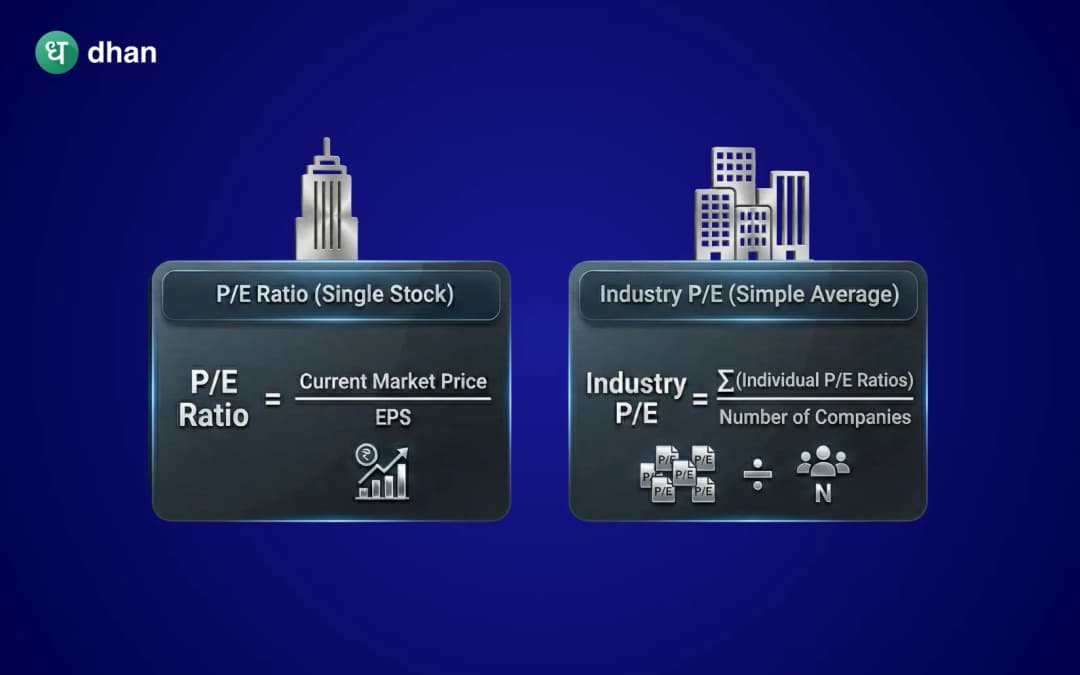
A stock's PE ratio is calculated by dividing the current market price of a share by the earnings per share (EPS). It provides insights like how much investors are paying for every rupee of earnings that the company generates. A higher PE indicates higher expectations of growth, while a lower PE indicates modest expectations or perceived risks.
An industry PE ratio, on the other hand, is the median PE of companies operating in the same sector. Since businesses in the same industry often experience similar demand cycles, cost structures, and regulations, industry PE serves as a benchmark point of reference for comparison.
Comparing a stock's PE to its industry PE helps investors answer a fundamental question: Is the stock fairly priced when compared to its peers?
The difference between industry PE and stock PE reflects the market’s collective judgment of that particular company. This gap exists because not all companies in an industry operate and drive equal sales. Factors like the management quality, strength of the balance sheet, growth visibility, and the competitive positioning affect how much investors are willing to pay for earnings.
The large PE gaps often represent an opportunity or a warning. The challenge lies in interpreting correctly which one it is.
When a stock trades for a premium to the industry PE
A stock that trades for a higher PE than the industry PE is said to be trading at a premium. This means that investors are expecting the company to perform well in the future and deliver superior returns in comparison to others. The reasons for premium PE are:
- Strong earnings growth: Companies that have strong and more consistent earnings growth are often worth more and therefore have higher valuations.
- Market leadership: Market leaders with strong brand presence or large market share tend to trade at a premium.
- Better profitability: Higher margins and return ratios justify investor confidence and support premium valuations.
- Quality management: Companies that have strong and transparent governance, along with a past track record of proven leadership, are valued higher.
- Lower business risk: Steady revenue models and predictable cash flows lead to lower risk.
However, a premium PE also comes with higher expectations. If the earnings are not growing, or if there are competitive pressures, the stock may undergo sharp valuation corrections. Higher stock PE than the industry PE is justified if the company continues to outperform its peers consistently.
When the stock PE is lower than the industry PE
A stock that has a stock PE below the industry PE is often considered to be undervalued, but this is not always the case in every company. A lower PE may indicate market concerns like:
- Slower growth prospects: If the company fails to match the growth of its competitors, it will be assigned a lower valuation multiple by the investors.
- Lower margins or declines in profitability: Poor profit margins, increased expenditures, and decreased earnings can reduce investors' confidence.
- High debt and weak balance sheet: When companies have high leverage and weak cash flows, their stock prices are relatively low compared to other companies.
- Management or corporate governance issues: Problems with management, corporate governance, or management integrity might lead to valuation discounts.
- Cyclical or shrinking exposure: Businesses tied to cyclical or shrinking sectors may attract lower valuations.
In some cases, the market might be pessimistic, creating a genuine opportunity for investors to buy the undervalued stock with a low stock PE. If the problems faced by the company are temporary and the company has strong fundamentals, a re-rating of the stock prices can provide attractive returns to investors.
However, not all low PE stocks are bargains. Some are value traps in which there are structural issues that are beyond recovery, and that will not allow earnings to recover. Therefore, before investing, distinguishing between temporary headwinds and permanent problems is essential for investors to make better investment decisions and avoid falling into the value traps.
The role of market cycles in PE comparisons
PE ratios are not static; they change over time as the market cycles evolve. During bullish phases, the PEs of industries tend to increase as investors are bullish about future growth. In bearish or uncertain environments, the PE ratio contracts as a result of increased risk aversion.
Cyclical industries like metals, real estate, or capital goods tend to have wide fluctuations in their PE ratios. Comparing stock PE to industry PE in these sectors works best when done over the course of a complete business cycle, as opposed to peaks or troughs, providing valuable insights to investors.
Defensive sectors such as FMCG or pharmaceuticals tend to have more stable industry PEs, which means valuation gaps are better indicators of relative attractiveness.
Common errors in using industry PE comparisons
The most common error is to consider a low PE as a sign of undervaluation. PE fails to consider the debt level, quality of the cash flow, and sustainability of the earnings. The other mistake is the comparison of PEs with other industries, and the growth rates and risk profiles are not the same in all industries; they differ in each industry.
Another aspect that is being overlooked by investors is the management credibility and competitive advantages, and they look only at numerical valuation discrepancies. This may result in bad investment results.
How investors should make good use of the PE gap
The difference between the stock PE ratio vs industry PE should be a starting point, not a final metric to make investment decisions. Once a valuation gap is identified, investors should dig in more deeply about:
- Consistency of Earnings Growth
- Balance sheet strength
- Business model durability
- Competitive positioning in the industry
A premium PE requires strong justification in the form of fundamentals, while a discounted PE demands clarity about whether risks are due to a temporary or structural issue.
Conclusion
The gap between industry PE and stock PE is an indicator of the market expectations. It reveals how investors perceive a company as either a leader, a laggard, or a turnaround candidate in its industry.
However, investors should not consider a valuation gap metric in isolation. PE comparison of companies, when combined with in-depth fundamental analysis and market cycle comprehension, may assist investors in recognising attractive opportunities, strong risk management, and avoiding valuation traps.
Ultimately, it is not about the cheapest or the most expensive stock that will lead to successful investing, but about understanding why the market values a company the way it does.
FAQs
What is a good PE ratio in comparison to a stock against its industry?
No single PE ratio can be considered good across multiple stocks and industries. A good PE is justified by the company’s growth rate, profitability, and risk profile in comparison to the industry. A company with a higher PE value than the industry can still be worth investing in if it delivers superior earnings growth and returns, whereas a low PE company can be a risky investment when its fundamentals are weak.
Is a lower stock PE than the industry PE necessarily an indication that the stock is undervalued?
No. When the stock PE is lower than the industry PE, it does not necessarily imply that the stock is undervalued. The discount could be a result of slow growth, high debt levels, governance issues, or declining business prospects. Before making the investment decision about a stock that is undervalued, investors must examine their financial performance, future prospects, and qualitative factors.
Why do some industries have consistently higher PE ratios than others?
These are industries that often trade at higher PE ratios due to their predictable earnings, high demand, and a lower business risk, i.e., FMCG. Conversely, cyclical sectors such as metals tend to have lower PE ratios due to earnings volatility and sensitivity to economic cycles.
Should investors rely only on the PE gap for investment decisions?
No. PE gap must not be viewed as the only decision-making factor, and it should be a comparative and screening tool along with other factors. PE analysis and other metrics like earnings growth, return ratios, debt levels, cash flows, and industry outlook should all be used together by investors to make informed investment decisions.
What is the impact of the earnings growth on the understanding of the PE gap?
Earnings growth is an important aspect in interpreting the PE gap. A higher PE is often justified if a company is expected to grow faster than its peers. On the other hand, a low PE stock with a weak or declining earnings growth may not be attractive, even if it appears undervalued relative to the industry.