Stock Split: What it means & why it happens





A company’s journey in the stock market involves making important strategic decisions that can affect its share structure and investors. One such important decision is a stock split, which can often be misunderstood by investors.
While it might seem like a complex financial term, understanding a stock split is crucial for any investor looking to make informed decisions. In this blog, we’ll explore what a stock split is, why companies choose to go for it, and what it means for investors.
What is a Stock Split?
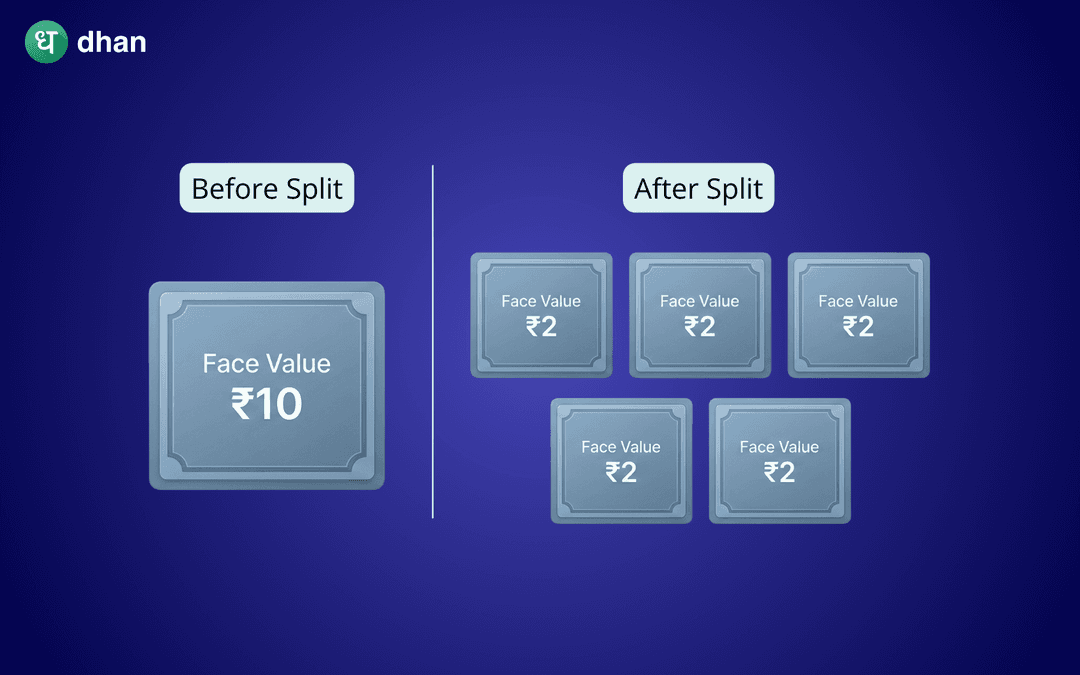
A stock split occurs when a company issues additional shares to its current shareholders in a predetermined ratio, such as 2-for-1, 3-for-2, or even 10-for-1. A stock split increases the number of outstanding shares for investors, without affecting the company's overall market value or the value of shareholders' investment.
A stock split lowers the price per share and makes a stock widely accessible to investors.
For example, each shareholder who previously owned one share at ₹1,000 will now own two shares at ₹500 each, in a 2-for-1 split. Although the entire investment value is still ₹1,000, this stock split makes the stock more affordable for new investors.
Why do companies announce Stock Splits?
Companies announce stock splits for various reasons. Some of those are:
Improving liquidity
When a company's share price rises significantly, the stock becomes less affordable, especially for retail investors. By splitting the stock and reducing the share price, companies increase liquidity, making it easy to buy and sell shares, which can lead to higher trading volumes and narrower bid-ask spreads.
Signaling confidence
A stock split is often interpreted as a signal from management about optimism for future growth. If a company splits its stock, it implies that management expects the stock price to rise further and aims to keep it in a trading range that appeals to the market.
Broadening investor base
Lower share prices attract smaller investors and employees, enabling wider ownership. This can help companies encourage investor participation from diverse demographics, including those who were turned off by expensive per-share pricing, and can boost employee stock ownership plans (ESOPs).
Psychological impact
Stock splits can create a sense of affordability. Existing and prospective investors may feel encouraged seeing familiar or round price levels (such as ₹500 instead of ₹1,000 per share), which can stimulate the stock demand among new investors even though the company's fundamentals remain unchanged.
Maintaining an optimal trading range
Another reason companies announce stock splits is to keep their stock price within a preferred trading range. Extremely high share prices can reduce both retail and institutional investors' interest in the stock, while excessively low prices might imply risk or instability.
By maintaining shares within a desirable price window, companies ensure their stock remains attractive to a broad spectrum of investors and meets market conventions.
How Stock Splits Affect Shareholding, Stock Prices, and Liquidity?
When a company announces a stock split, the number of shares that investors own is adjusted along with the share price to maintain the overall value of investors’ holdings. That means, for investors’ holdings, there are no changes in value.
For example, Tata Investment Corporation Ltd. declared a 1:10 stock split in October 2025, in which if an investor previously held 100 shares with a face value of Rs. 10, then after the split, the investor will now have 1,000 shares of stock with a face value of Rs. 1.
After a stock split, the stock price adjusts downwards in proportion to the ratio of the split. For example, if the share price of a company is at Rs 2000 before the 1:2 split, it will trade at approximately Rs 1000 after the split.
The reduced price per share allows more investors to participate in buying the stock, often leading to higher trading volumes. Additionally, stock splits improve market liquidity by increasing the number of shares and making them more affordable. This increased participation enhances market depth and narrows bid-ask spreads, making it easier for investors to enter or exit positions.
On a final note
A stock split is a corporate action that makes shares affordable for investors and improves the trading liquidity of the stock without changing the company’s market value or shareholder wealth. Although the reactions and psychology surrounding stock splits can temporarily affect share prices, the fundamentals stay the same.
Investors should consider stock splits as signs of confidence from management and the longer-term business prospects, alongside this action, before making any investment decision.