What is Nasdaq 100? Explained in the simplest way





Synopsis:
- The Nasdaq 100 tracks 100 of the largest non-financial companies listed exclusively on the Nasdaq exchange, launched in 1985 as a modified market-capitalisation-weighted index with quarterly rebalancing.
- It is heavily tilted towards technology, consumer discretionary, healthcare, and communications, featuring giants like NVIDIA, Microsoft, Apple, Amazon, and Alphabet, with weight caps limiting any single stock to 14%.
- Unlike the broader S&P 500, it excludes financial companies and NYSE listings, making it more volatile and growth-oriented, prone to sharper rallies and corrections.
- Indian investors can access it through ETFs like QQQ, index mutual funds, futures, or international funds of funds.
In the news, you'll often read about the Nasdaq 100. But what is the Nasdaq 100, exactly? It's a stock market index that tracks 100 of the largest non-financial companies listed on the Nasdaq exchange.
Think of it as a scoreboard for the world's most influential technology and innovation-driven businesses. It extends to various sectors such as AI, cloud computing, semiconductors, e-commerce, and biotechnology.
Let's explore what this index is, how it works, and why it matters to investors globally.
What is Nasdaq, and how is it distinct from other exchanges?
Whereas regular exchanges were operated in a face-to-face fashion, Nasdaq was operated exclusively on computer-based systems. This made it an obvious location for tech companies to go public.
More than 3000 companies are listed on the Nasdaq today in different sectors. It is the stock exchange where the likes of Apple, Microsoft, NVIDIA, Amazon, and many others have decided to go public. The Nasdaq Composite and the Nasdaq 100 are two different things. The Composite follows the market of all stocks trading on the Nasdaq exchange. The Nasdaq 100 is a smaller index that includes only the top 100 non-financial stocks that trade on the Nasdaq.
What is the Nasdaq 100, and what does it actually track?
The NDX or Nasdaq 100 index was created in 1985. It tracks the performance of 100 of the biggest companies listed on the Nasdaq exchange (excluding the financial sector). This index does not include financial companies such as banks and insurance companies. That segment is tracked in a separate index, the Nasdaq Financial-100.
The Nasdaq 100 is more heavily tied to tech companies than to other areas like consumer discretionary, healthcare, and communications. This makes it broader than a pure tech index, though the technology tilt remains significant.
How does the Nasdaq 100 work?
Below is a simple explanation of the structure and maintenance of the index.
Market capitalisation weighting
The weighting of each company in the index is based on its market cap relative to the total market cap of all 100 companies in the index. Larger companies have a heavier influence and weight in the movement of the index.
Modified weighting caps
Based on a modified market capitalisation methodology. The maximum proportion of the overall index weight for any single company is no more than 14%. In case the top 5 companies together account for more than 40% of the index, then their weights will be recalculated to be 38.5%. This acts to limit the influence a single stock can wield in the index.
Quarterly rebalancing
The index is updated and rebalanced quarterly (March, June, September, and December). These reviews are made by the changing of the company's weights. Companies that no longer meet the eligibility criteria can be removed, and new qualifying companies can be added.
Fast Entry pathway
There has been a new Fast Entry rule since May 2026, so that very large newly listed companies have a faster entry into the index. The evaluation is based on the Nasdaq 100's largest companies (based on current market cap) according to their market cap ranking, and it is conducted seven days after trading. This update is intended to make the index current with major new listings without waiting for the next quarterly update.
Eligibility criteria
In order to qualify as a member company, it must be listed on the Nasdaq exchange only. It should have a minimum average daily trading volume of 200,000 shares. It should also qualify where subject to finance reporting requirements, and be excluded from the financial sector company definition.
Which companies are in the Nasdaq 100?
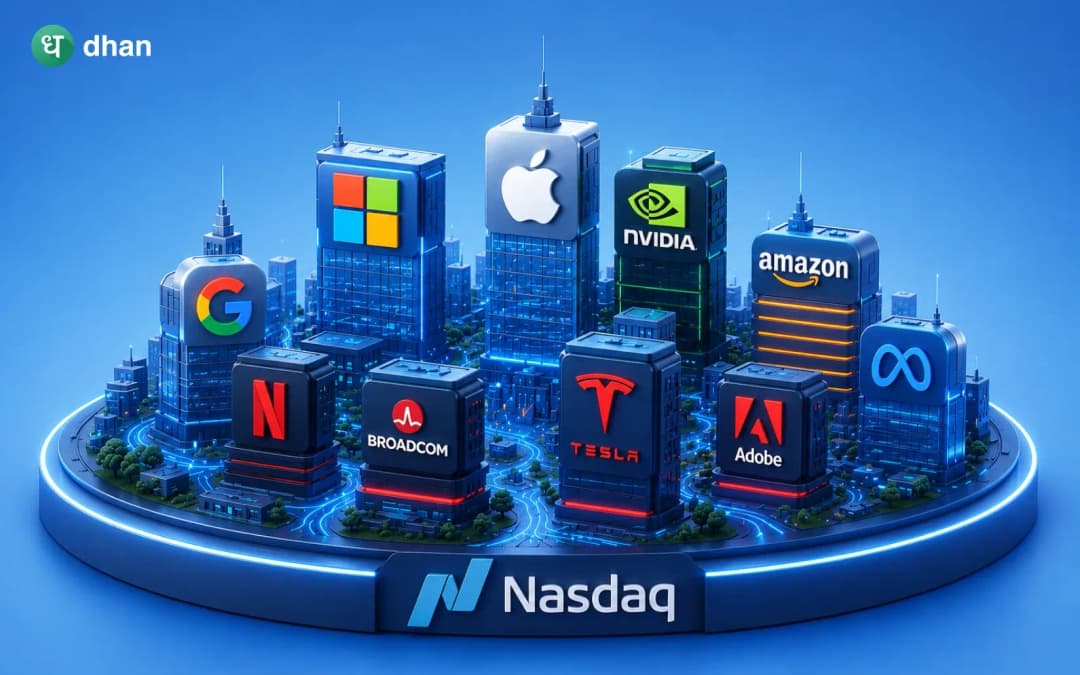
The index comprises some of the world's best-known companies. NVIDIA, Microsoft, Apple, Amazon, and Alphabet are among the company's biggest holdings at the time. These five companies account for a big share of the overall index weightage. Other prominent companies to find themselves on the list are Meta, Tesla, Broadcom, Netflix, and Costco.
The Index includes various industries in the non-financial sector, such as:
Technology
Semiconductors, software, cloud platforms, and cybersecurity
Consumer discretionary
It covers e-commerce, streaming, and EV.
Healthcare
Biotechnology and medical devices
Communications
Digital advertising and social media platforms
How is the Nasdaq 100 different from the S&P 500?
This is one of the most common points of confusion for new investors.
The Nasdaq 100 tends to be more volatile than the S&P 500 because of its concentrated tech exposure. It can outperform significantly during tech-led rallies. It can also fall harder during sector corrections.
How can investors track or invest in the Nasdaq 100?
The investor does not purchase the Index itself, but instead purchases and holds a product that replicates the Index.
ETFs
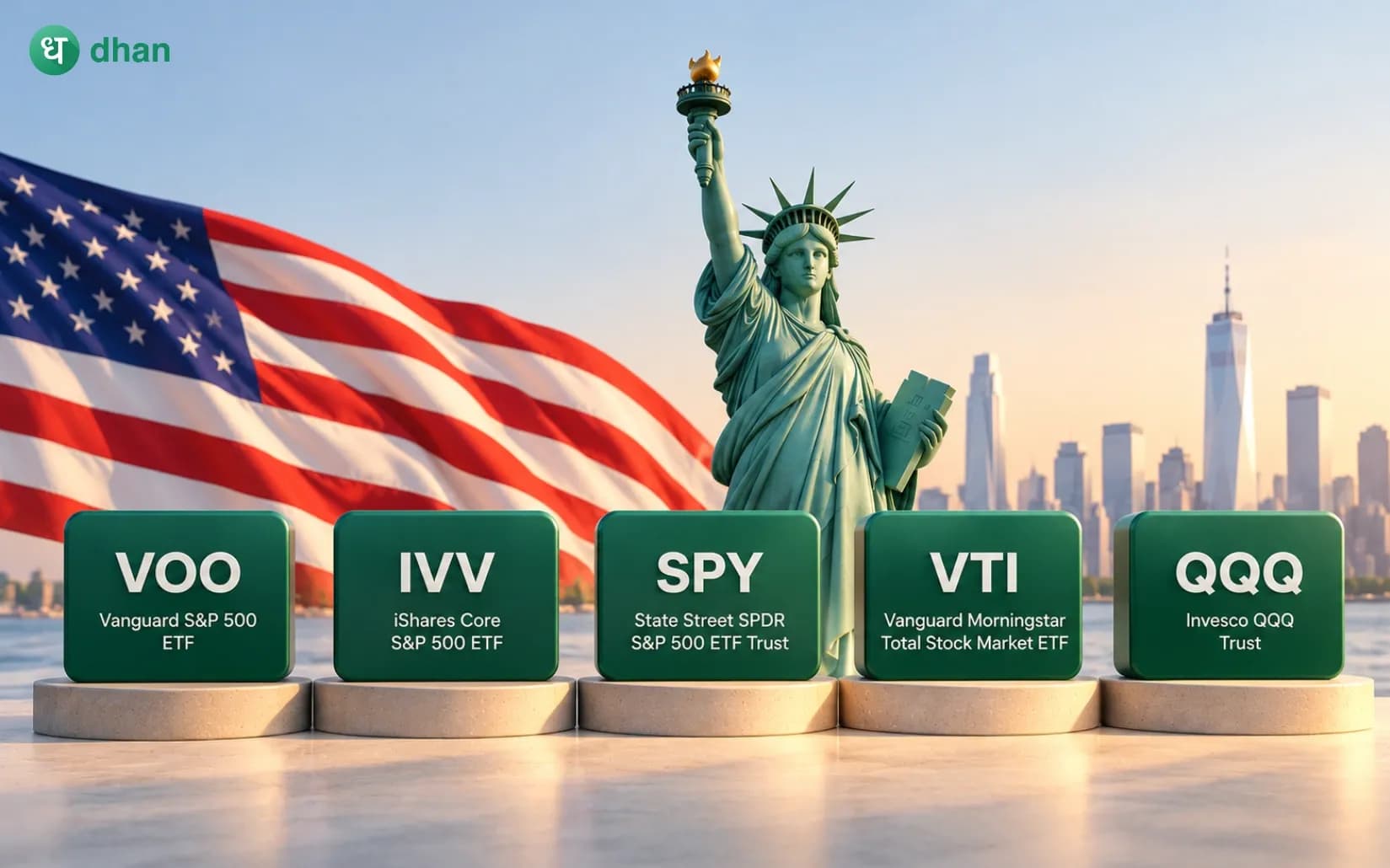
Invesco QQQ ETF is the most popular Nasdaq 100 ETF worldwide. They can be accessed by Indian investors through US stock investing websites.
Index mutual funds
There are several fund houses that provide mutual fund investing schemes that mimic the returns of the Nasdaq 100.
Futures and derivatives
Futures markets are used by institutional and advanced retail traders to make trades, particularly the E-Mini Nasdaq 100.
International funds
There are also funds of funds and international mutual funds that buy into Nasdaq 100-linked instruments in India.
Why does the Nasdaq 100 matter to global investors?
The Nasdaq 100 is regarded as the global index representing technological advancement and innovation as the cornerstones of economic growth. As AI adoption grows, or cloud spending increases, or semiconductors experience a surge in demand, the Nasdaq 100 is likely to lead the way. It boasts firms developing the mechanisms for the modern digital economy.
To assess the level of exposure for Indian investors to the US market, it is important to understand what the Nasdaq 100 is. The index provides access to a range of other companies that fall at the frontier of technology and many that do not have their direct counterparts on Indian exchanges.
Build your Nasdaq 100 knowledge before you invest
Understanding what Nasdaq is and what the Nasdaq 100 tracks removes a lot of the mystery around US market investing. The index is a focused, rules-based measure of 100 large non-financial companies on the Nasdaq exchange. It is tech-heavy, growth-oriented, and rebalanced regularly to stay current.
For anyone building a global investment perspective, the Nasdaq 100 is one of the most important benchmarks to understand. Study its composition, track its key sectors, and use that knowledge to make more informed decisions about international portfolio exposure.