Commodity trading strategies For Traders




Commodity trading has become one of the most popular ways to gain a profit because commodity prices move frequently due to global demand and supply. From gold to silver, from crude oil to agricultural goods, traders find many opportunities in market swings.
But the key to success is to employ smart, tried-and-tested strategies that will balance risk with reward. You need the right approach if you want to trade confidently and make better trading decisions.
In this blog, we will explore five commodity trading strategies on which traders truly rely in the Indian financial markets.
5 most favoured commodity trading strategies among traders
Below are 5 broadly used commodity trading strategy you will find across commodity markets, such as gold, crude oil, and base metals:
1. Trend-Following Strategy
This is the first commodity trading strategy we are going to talk about. The trend-following strategy is one of the most preferred methods in commodity trading since it focuses on moving with the market instead of guessing its direction.
Traders only need to identify whether a particular commodity is in an uptrend or a downtrend to take positions.
For example, a trader could go long after a minor pullback if the trend in crude oil has been strongly rising from ₹6,800 to ₹7,400 per barrel with strong trading volumes, anticipating further upside momentum.
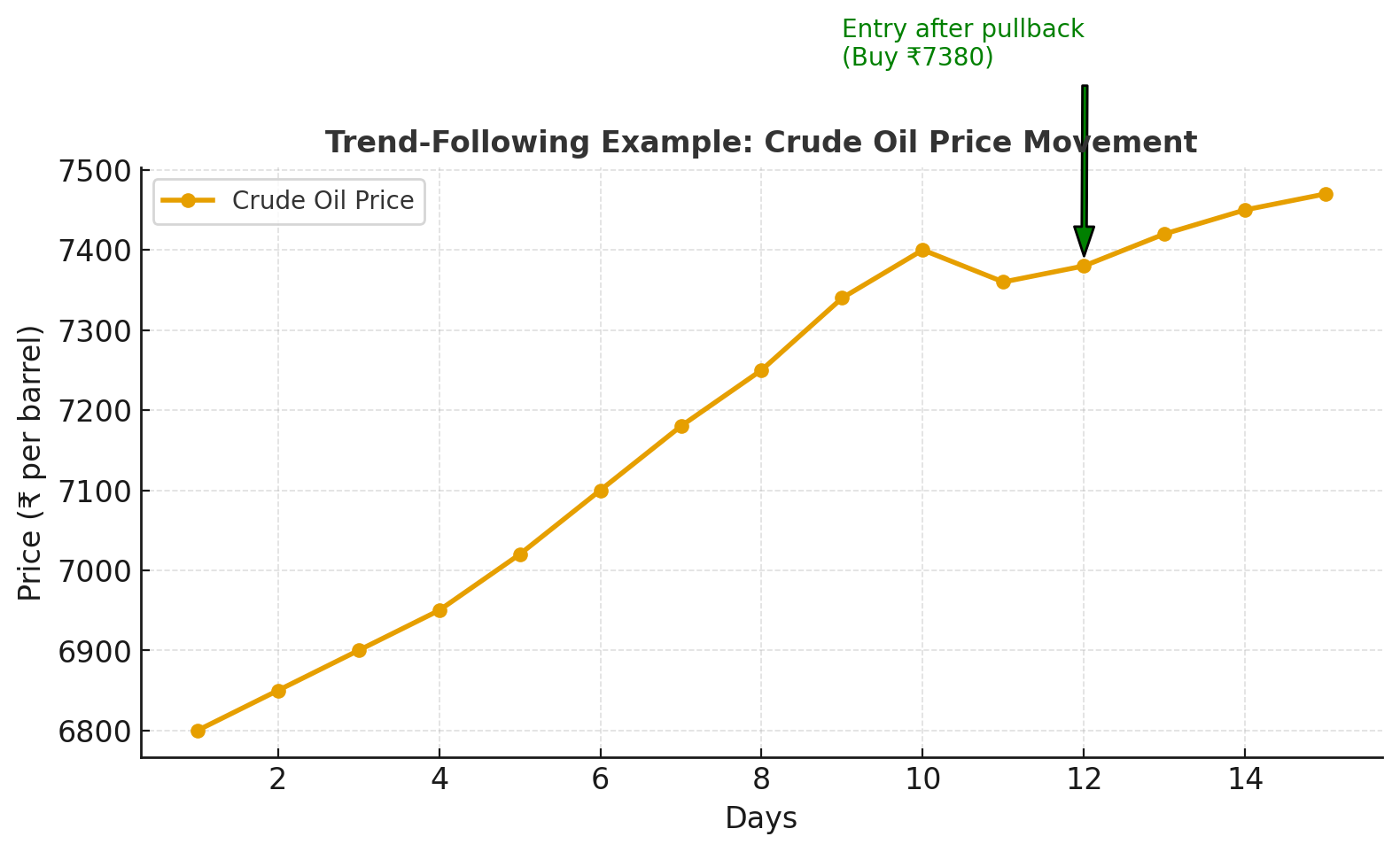
The above chart shows a trend-following setup where the price of crude oil keeps moving upward from ₹6,800 to ₹7,470. The trader then enters the long position at ₹7,380 after a brief pullback, expecting the upward trend to continue.
This works well when the markets have a clear direction, and traders usually confirm their entries and exits with moving averages or breakout signals.
2. Mean Reversion Strategy
The mean reversion strategy works on a very simple idea: prices in the commodity market don't move in one direction forever.
When a commodity is trading much above or below its usual range, it will come back toward its average price once emotions in the market have cooled down. This concept is used by traders to identify points where the prices look overstretched and may reverse.
For example, if gold suddenly jumps from ₹ 70,000 to ₹ 74,000 in a few sessions without any strong economic justification, many traders would expect it to ease back towards its normal level of around ₹ 71,000–₹ 72,000.
They go short at the high, placing stop losses a little above the recent peak, with the aim of making a profit when prices return close to the average.
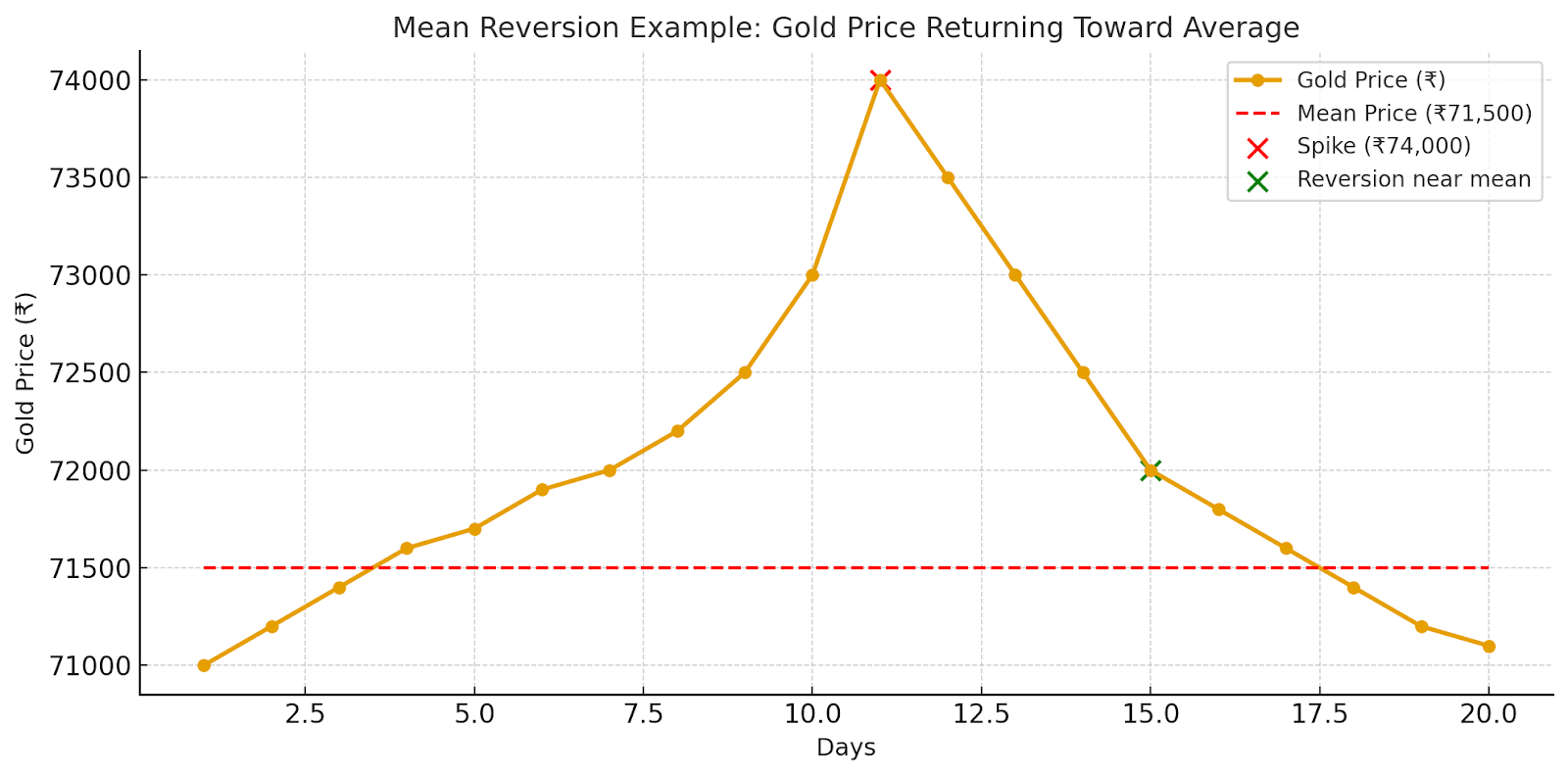
The above graph illustrates how the price of gold temporarily rises from ₹ 71,000 to ₹ 74,000 and bounces back to its average of ₹ 71,500. It visually illustrates the concept of mean reversion, which involves prices reverting to their usual range after a temporary hike.
3. Breakout Strategy
A breakout strategy is one of the most practical commodity trading strategies for traders when markets are moving out of a long consolidation phase. It focuses on identifying those points where the price of a commodity breaks above resistance or below support with strong volume, signalling the start of a new trend.
For instance, if crude oil has traded within a range of ₹6,500 and ₹6,700 for a few weeks and then suddenly closes above ₹6,700 with a high volume, then it may be the beginning of an upward move.
A disciplined trader would enter a long position at this point and place a stop-loss just below the breakout point to manage the risk effectively. Here is the graph for the breakout strategy example.
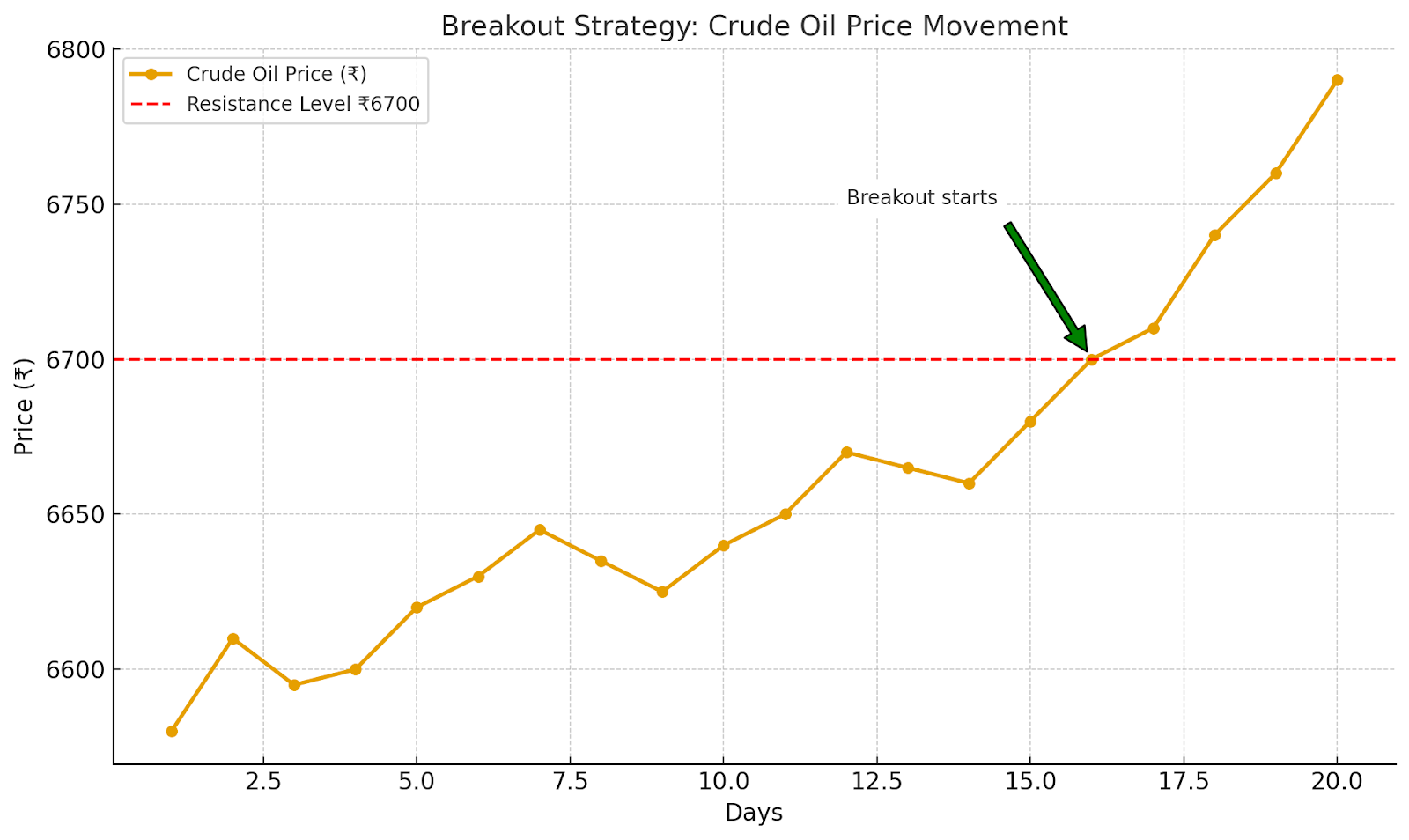
This shows how the prices of crude oil remained below the resistance level of ₹6700 for many days and then started a strong breakout from day 16 onward, which could signal an entry for a trend-following trade.
4. Range Trading Strategy
When commodities move within a clearly defined price band for a period of time, traders use the range trading strategy to profit from repeated reversals between support and resistance levels.
For example, if gold consistently bounces between ₹58,000 and ₹60,000, a trader may choose to buy near ₹58,000 and sell as it approaches ₹60,000.
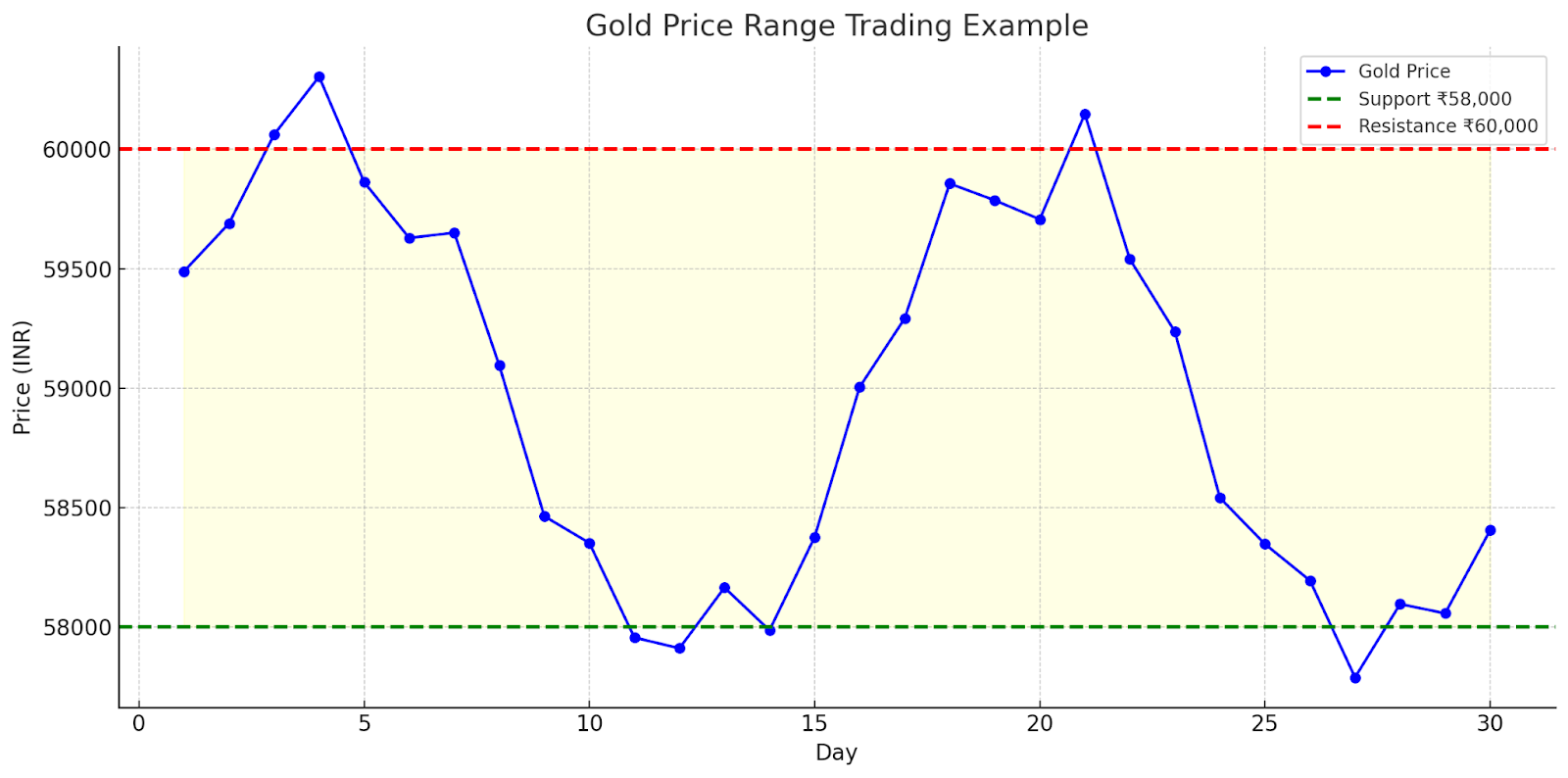
The image above shows how range trading works in commodity markets. It illustrates gold prices moving between a support level of ₹58,000 and a resistance level of ₹60,000, where traders typically buy near the lower boundary and sell near the upper boundary until a breakout occurs.
This method works best in non-trending markets where prices fluctuate in a sideways manner.
5. Spread Trading Strategy
Instead of taking a one-sided position in a commodity, spread trading involves buying one futures contract while simultaneously selling another to profit from the price difference between the two.
This helps reduce the risk linked with sudden price swings in a single contract. For example, if a trader believes that the March crude oil contract will rise faster than the June contract, they can buy the March contract and sell the June one.
If the price of March crude moves from ₹6,500 to ₹6,900 while June rises only to ₹6,750, the trader earns from the widening spread of ₹150.
Here is the graph showing the spread trading example.
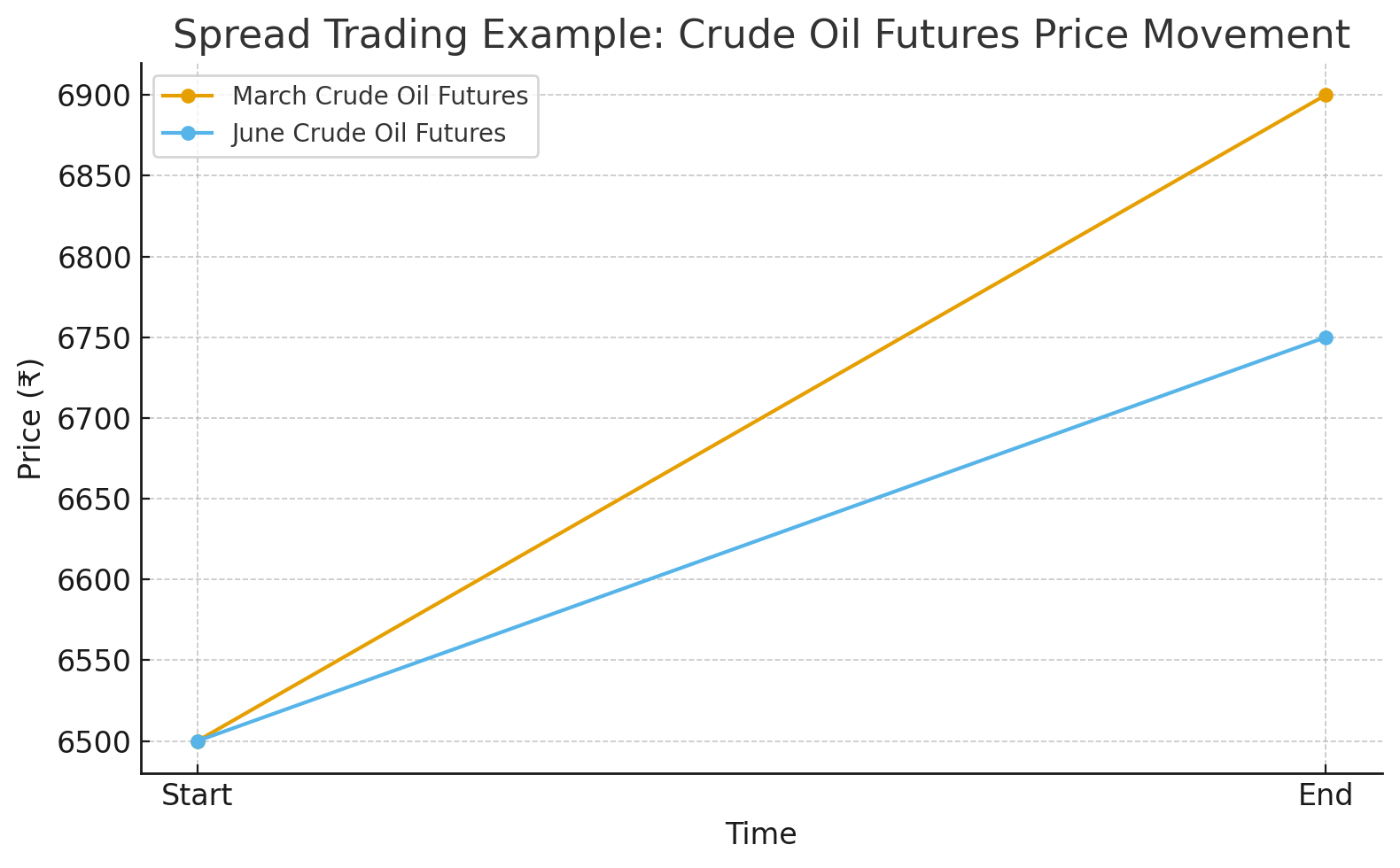
March crude oil futures rose from ₹6,500 to ₹6,900, whereas June crude oil futures increased from ₹6,500 to ₹6,750.
The widening difference between the two contracts (₹400 vs ₹250) creates a profitable spread opportunity for the trader.
How Dhan enhances commodity trading execution?
When trading commodities, timing, margin flexibility and seamless execution matter the most. Dhan offers a unified platform where you can trade futures and options on commodities, view detailed charts and option chains, and access instant margin by pledging your existing shares as collateral.
All of this comes together in one account, so you don’t have to switch between different apps or manage multiple logins. That simplicity gives you back time to focus on your strategy and lets you act quickly when a breakout, trend or reversal happens.
Here is how some of its features translate into benefits for commodity traders:
Conclusion
Trading commodities can be a meaningful opportunity for traders if it is implemented with a well-thought-out plan, discipline, and market insights. You can improve your chances of success by picking one of the five strategies mentioned above and sticking with it.
Along with this, it is equally important to use a platform built for this task that ensures fast execution, real-time data, and robust risk controls. Stay focused, stay disciplined, and let your strategy be your guiding light.
FAQs on Commodity Trading Stratergies
1. How do I choose the right commodity contract to trade?
Look for high liquidity in the contract, showing tight bid-ask market behaviour; clear expiry dates; and strong supply-demand fundamentals of the underlying. Check on margin costs, rollover risks, and seasonal patterns also before committing.
2. Can spread-trading in commodities reduce my risk compared to outright futures?
Yes. A spread trade buys one contract and sells a related one, changing your exposure from directional to relative value. Many non-directional strategies make use of this.
3. What role does seasonality play in commodity trading strategies?
Most commodities are affected by seasonal demand, harvest cycles, and weather. A strategy that anticipates these patterns can help with entry and exit timing.
4. How important is stop-loss and position sizing in a commodity strategy?
Extremely important. Because commodities can move sharply, taking proper position sizing and implementing stop-losses will help keep losses manageable and protect your capital.
5. Does fundamental analysis matter if I’m using technical commodity strategies?
Yes. Even technical setups are stronger when supported with supply-demand data, seasonality, or geopolitical themes. Combining both analyses improves the odds.