How Inflation Affects the Price of Commodities






Key takeaways:
- Commodity prices can rise due to inflation, but individual prices also depend on supply and demand.
- Inflationary pressure can be outweighed by interest rates, currency movements, and economic growth.
- Investors should evaluate specific conditions related to commodities, portfolio risks, and valuations before investing.
Did you notice that gold prices sometimes rise during high inflation? During the same period, prices of crude oil and industrial metals may fall. As an investor, you may find the relationship between inflation and commodity prices quite interesting.
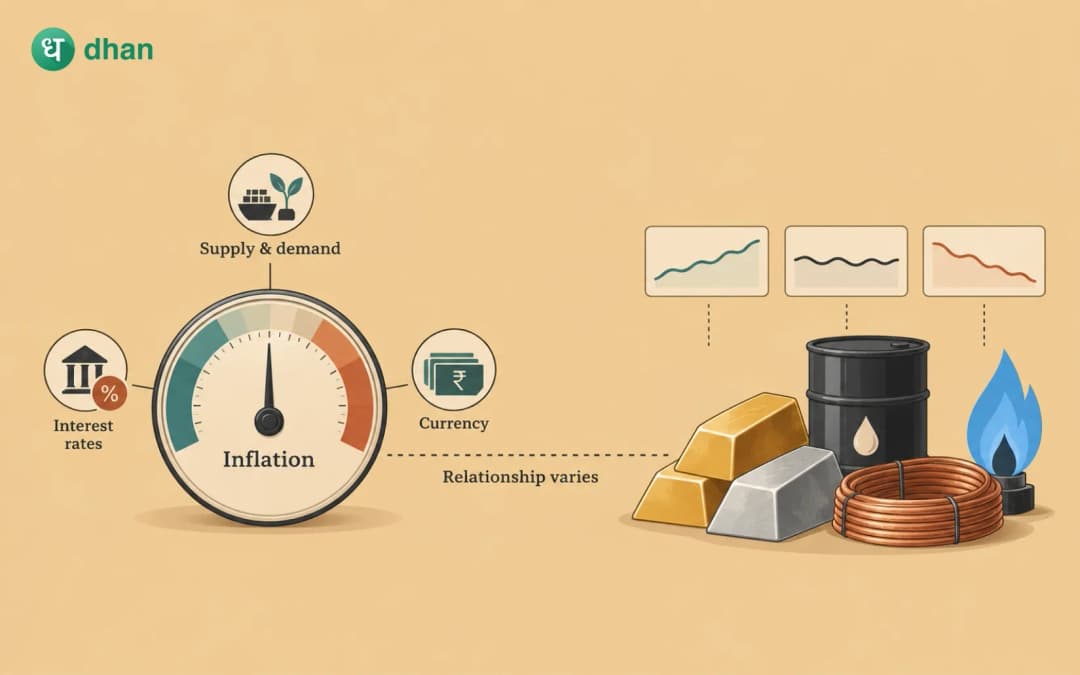
Different factors influence commodity prices from time to time. These include rising costs of production, differences in consumer demand, and changing interest rates. Even changes in global supply and currency values affect prices of commodities. We have discussed the impact of inflation on commodity prices in this guide, which can help you assess price movements and investment risks.
Why inflation and commodity prices influence each other
Prices of commodities share a two-way relationship with inflation. When commodity prices rise, the economy may experience inflation. Inflation, on the other hand, can affect production costs and the demand for commodities.
For instance, take the case of crude oil. When its prices rise, businesses need to pay more for fuel, transportation and electricity. Naturally, the cost of manufacturing and delivering goods rises due to these expenses. Some of these additional costs are passed on to consumers by companies. In these situations, prices of commodities tend to rise.
Agricultural commodities also witness a similar effect. When wheat, edible oils, and other essential food items become expensive, food manufacturers and retailers may increase their prices. In India, food and energy account for a significant share of household spending. This is why overall inflation in the economy is influenced by their prices.
This relationship also works in reverse. With rising inflation, producers face higher expenses for labour, fuel, fertilisers and equipment. To recover these costs, they may raise their selling prices. In situations where demand remains strong, and the economy witnesses a shortage in supply, prices of commodities may rise further.
How does inflation increase commodity prices?
Now, let’s understand how inflation affects commodity prices in different ways. The specific commodity under consideration, economic conditions, and available supply determine the effect.
- Rising production and operating costs
It takes fuel, electricity, labour, machinery, and transportation to produce commodities. When these input costs rise, producers face higher costs. For example, farmers depend on diesel-powered machinery, fertilisers, irrigation and transportation. Higher expenses can increase the cost of producing and distributing food.
- Strong demand and limited supply
At times, inflation coincides with strong economic activity. When households spend more amid expanding businesses, the demand for energy, metals and agricultural products may increase.
For example, higher spending on infrastructure can increase the demand for steel, copper and aluminium. If production fails to scale quickly, prices tend to rise as buyers compete for available supplies.
- Currency movements and global pricing
Many commodities are traded internationally in US dollars. That’s why currency movements are particularly relevant to buyers in India.
In situations where the rupee weakens against the dollar, the cost of importing the same quantity of a commodity is generally high in terms of rupees. That’s why buyers need to fork out more money as they purchase crude oil, industrial metals, and imported agricultural products.
The final prices of commodities may also be influenced by import duties, freight charges, and domestic taxes.
- Inflation expectations and the demand for investment
Commodity markets may also be influenced by expectations. If investors believe that inflation rates are likely to be high, they may increase their exposure to assets that they consider useful to preserve their purchasing power. In these conditions, gold often appeals to investors. Historically, this precious metal has been used to preserve its value.
Why some commodity prices fall even during inflation
Even if an economy experiences high inflation, every commodity does not necessarily become expensive. The following conditions explain why some commodities may see a drop in prices during high inflation.
Individual markets
Due to changes in supply, demand, inventories and financial conditions, individual markets can move in the opposite direction. Let’s assume that a disruption in supply leads to a rise in the prices of crude oil. If producers eventually increase their output and the demand weakens at the same time, the prices may fall. This is possible even when expenses related to food, rent, and healthcare continue to rise.
Inventories
A business may hold sufficient stocks of a particular commodity. When supply drops, it may not have to compete aggressively for fresh supplies. Prices can come under pressure if inventories increase, but demand remains subdued.
Economic growth
During an economic slowdown, manufacturers may reduce their production and postpone their expansion plans. The demand for industrial commodities like copper and aluminium can weaken in these situations. As a result, prices are pushed down although the economy experiences inflationary pressure.
Higher interest rates
At times, economic activities are slowed down due to higher interest rates. On the other hand, a stronger US dollar can bring commodity prices dependent on international markets under pressure. Buyers purchasing the commodities using other currencies would find them more expensive.
How inflation affects different commodities
Different categories of commodities are affected to a different extent by inflation. The reason is that the supply and demand conditions and uses of these commodities vary.
Gold and silver
Investors are attracted to gold when inflation rises in the economy. Precious metal prices fluctuate based on geopolitical developments and purchases made by central banks.
However, gold prices do not always rise with inflation. With an increase in interest rates, interest-bearing investments may become more attractive compared to gold, which does not pay any interest.
Silver, on the other hand, is used both as a precious metal and in industries. The price of silver responds to industrial activities as well as financial markets.
Crude oil and natural gas
When the prices of crude oil rise, costs related to fuel, transport and manufacturing tend to rise. This creates inflationary pressure in the economy.
However, external factors like global consumption and inventories also influence crude oil prices. If there’s a slowdown in a major economy, the demand for crude oil and natural gas can weaken. At the same time, higher supply of these commodities can ease prices.
The prices of natural gas are influenced by regional supply networks, weather, storage levels, and demand from households and industries. Therefore, its price movements may differ from those of crude oil.
Industrial metals
The progress of manufacturing, construction, infrastructure and energy projects depends on the availability of industrial metals like copper and aluminium. With an expansion of economic activity, the demand for these materials may increase.
Industrial metals may witness a spike in prices if production fails to keep up. Some of the other factors contributing to the pressure include higher costs associated with electricity, labour, and mining.
Agricultural commodities
The prices of agricultural commodities depend on harvests, weather conditions, availability of fertilisers, costs of fuel, storage and transportation. A poor harvest can push prices higher due to a shortage in supply. Rising costs of fertilisers and diesel may also increase the expense of producing and distributing crops.
The prices of agricultural commodities can become moderate if weather conditions remain favourable and harvests are strong. The Indian market is also influenced by Government policies, export restrictions and international trade conditions.
How interest rates and decisions made by central banks affect commodity prices
Commodity prices may be influenced by decisions made by central banks from time to time. These decisions can change costs of borrowing, economic demand, currency movements, and preferences of investors.
When inflation rates remain above the target of a central bank, it may raise interest rates or maintain restrictive monetary conditions. With borrowing costs rising, people are less likely to spend money or invest it. When economic activity slows down, the demand for energy and industrial metals can weaken. This puts pressure on their prices.
Gold can also be affected by interest rates. Investments in gold do not generate income through interest. So, when interest-bearing investments offer more attractive returns, the relative appeal of gold is likely to decline. This relationship depends on real interest rates to a certain extent, which account for inflation.
The Dollar plays a key role in international commodity trading. That’s why the US Federal Reserve also matters significantly. The global borrowing conditions may be affected by changes in US monetary policy. When the dollar becomes stronger, it may put downward pressure on dollar-denominated commodity prices. This effect, however, can be offset by disruption in supply or strong demand.
The decisions made by central banks do not produce immediate results. The impact can vary across economies, and policy changes take time to impact spending and production.
What rising commodity prices mean for investors
Movements in commodity prices can impact investments in different ways, depending on whether a business produces a commodity or uses it as an input.
Some upstream oil producers can benefit from an increase in crude oil prices, depending on their pricing arrangements and production costs. However, airlines and transport companies may face higher expenses. Unless they can pass these costs on to customers, their profitability can suffer.
Higher selling prices may benefit metal producers when their costs remain relatively stable. The profit margins of manufacturers purchasing steel, copper or aluminium may come under pressure.
You may invest in commodities like gold to diversify your portfolio. However, these assets may not always rise during inflation. Commodity prices can be volatile, and their movements may not suit your financial needs.
How investors can assess commodity price movements during inflation
You need to examine several indicators together as you assess commodity markets more effectively. Simply relying on inflation data is not sufficient.
- Track relevant inflation data
Look at the aspects leading to inflation, including food and fuel. These categories can help you identify the commodity markets that are under pressure.
- Watch currency and interest rates
Indian import costs are affected by changes in the rupee-dollar exchange rate. Therefore, the economic demand may be influenced by domestic and US interest rates.
- Separate temporary changes from longer-term trends
Even if a disruption in supply is short-lived, it can cause a sharp increase in price but doesn’t create a lasting shortage. The effect of persistent demand growth or a prolonged shortfall in production can be different.
Conclusion
Inflation and commodity prices are influenced by each other, but the relationship isn’t automatic. Prices can rise due to rising production costs, strong demand, and a weakening rupee. At the same time, better supply, weaker consumption, and higher rates of interest can pull them lower.
Different commodities like gold, silver, crude oil, industrial metals and agricultural commodities respond to various factors. As an investor, you need to examine these differences and determine how inflation influences their prices. If you trade commodities, track inflation data alongside supply and demand for each commodity rather than relying on one signal.
FAQs
Does gold always perform well during high inflation?
No, gold attracts investors when they worry about inflation or economic uncertainty. But gold prices also depend on real interest rates, currency movements, and investor sentiment.
Why can crude oil prices fall when inflation is high?
Prices of crude oil can fall with an increase in production. At times, inventories build up, or global demand falls. Fuel consumption may be reduced by economic slowdown even as the prices of food and services continue to rise.
How does a weaker rupee affect commodity prices in India?
A weakening rupee makes imports priced in dollars more expensive in Indian currency. The final domestic price also depends on international prices, import duties, freight, taxes, and conditions of the local market.
Can commodity ETFs help investors manage inflation risk?
Commodity-based ETFs can provide you with exposure to particular commodities or related assets. They help to diversify a portfolio, but may not provide protection against inflation or losses. You must check the underlying assets, expenses, liquidity and tracking method of the fund.
Which economic indicators should investors watch when analysing commodity prices?
Some of the relevant indicators to watch when you analyse commodity prices include inflation data, interest rates, currency movements, industrial activity, commodity inventories, production reports and demand forecasts.