Various Charges Involved in Intraday Trading





Key takeaways:
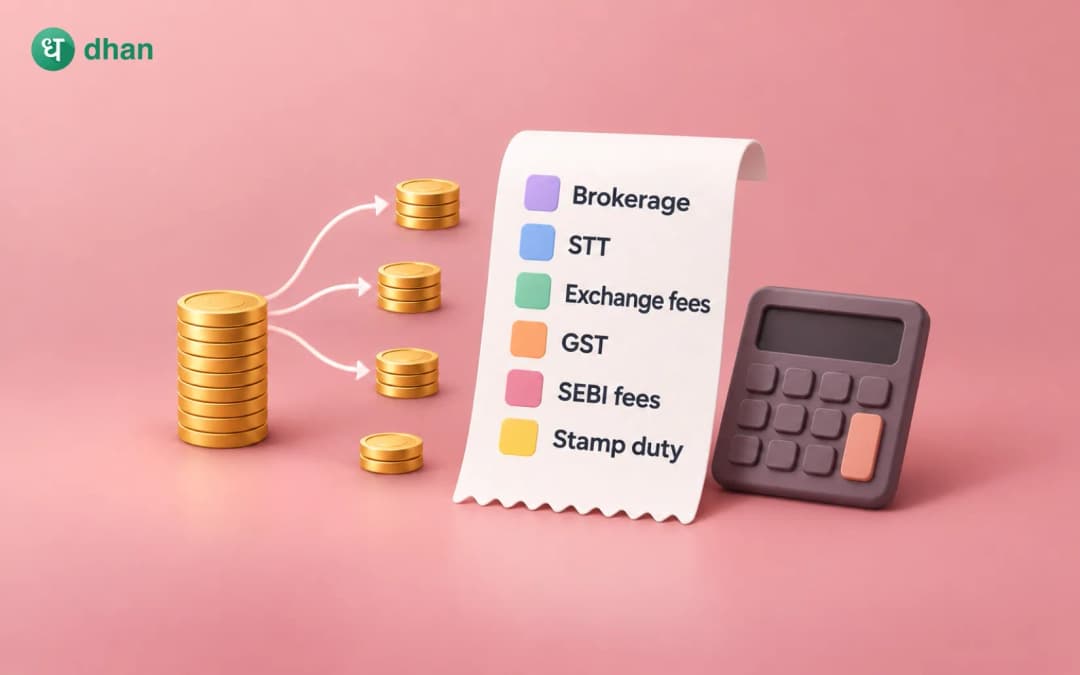
- Every intraday trade attracts some statutory and broker charges such as brokerage, STT, transaction charges, SEBI turnover fees, GST, IPFT contribution, and stamp duty.
- STT for intraday equity trades is levied at 0.025% on the sell transactions only, significantly lower than the 0.1% applied on both buy and sell transactions for delivery trades.
- GST at 18% applies to brokerage, transaction charges, SEBI turnover and IPFT/ Other tax combined. It does not apply to STT or stamp duty.
- Stamp duty for intraday equity trades is 0.003% on the buy transactions only.
- IPFT is a charge levied by NSE at 0.0000001% of the turnover on equity intraday and delivery trades.
- DP charges do not apply to intraday trades, since no shares are actually credited to or debited from the demat account in an MIS position.
- Among all the charges listed here, brokerage is the only cost that varies across brokers. STT, transaction charges, SEBI turnover fees, GST, IPFT and stamp duty are statutory and identical across all brokers.
Intraday trading involves buying and selling securities within the same trading day, and it is one of the most active segments of the Indian stock market. In intraday trading, day traders aim to capture small price fluctuations over a few minutes or hours using intraday margin (MIS).
Intraday traders incur fees on every entry and exit, making intraday trading charges especially important for market participants. In this blog, we will cover every charge applicable to intraday equity trades in India, how they differ from delivery trade charges, how they add up in a real trade, and what traders can do to manage their cost of intraday trading.
What are intraday trading charges?
Intraday trading charges are the fees and statutory levies deducted from a trader's account each time an intraday trade is executed. They include both charges collected by the broker for their services and statutory charges collected on behalf of the government, SEBI, and the exchanges.
Unlike delivery trades, where a trader holds shares in a demat account, intraday trades use the MIS (Margin Intraday Square-off) product type, where no actual shares change hands in a demat account. Here are the various charges that are deducted during an intraday trade:
Brokerage
Brokerage is the fee charged by the broker for executing the trade on the exchange. It is the only intraday trading cost that can be influenced by the trader's choice of trading platform and varies between brokers.
The majority of discount brokers in India have a brokerage of ₹20 per executed order on both buy and sell intraday orders. So, if a broker charges ₹20 per executed order, a complete intraday trade involving one buy and one sell order may attract ₹40 in brokerage. On Dhan, the charges are the lower of 0.03% of the trade value per executed order or ₹20.
Brokerage is deducted directly from the trading account and is reflected in the contract note issued after the trade is executed.
Securities Transaction Tax (STT)
STT is a tax imposed by the central government on the trading of equity shares and some other securities on the recognised stock exchanges of India. It came into effect in 2004 and is deducted at the time of execution of the trade.
STT is applicable at 0.025% on the transaction value of the sell transactions for intraday equity trades. STT is not applicable to the buy leg for intraday trades. This is significantly lower than delivery trade STT, which is 0.1% on both buy and sell trades.
STT is a compulsory tax. Traders cannot avoid it by routing the trade to a different exchange, negotiating it away, or choosing a different broker. The rate is the same for both NSE and BSE.
Transaction charges
The stock exchange on which the transaction takes place (NSE or BSE) charges transaction charges for providing the trading platform and infrastructure. The charges are applicable to both the buy and sell leg of the trade and are based on the total turnover of the trade. For intraday equity trades, the applicable rates are:
The rates are determined by the exchanges, and the difference between NSE and BSE rates is negligible in small-volume trades, but it becomes significant in large-volume trades. The rates above are for the standard equity cash segment and differ for the futures and options segment.
SEBI turnover fees
In order to regulate and develop the Indian securities market, SEBI imposes a small regulatory fee on all securities transactions. The current rate is 0.0001% of the turnover value. SEBI turnover fees apply uniformly across equity delivery, equity intraday, and derivatives segments.
Goods and services tax (GST)
GST at 18% is charged on the total of brokerage, transaction charges, SEBI turnover fees and IPFT/Other tax. It is important for traders to remember what GST applies to and what it does not apply to:
- GST is applicable to: Brokerage + transaction charges + SEBI turnover fees+ IPFT/Other tax
- GST does not apply to: STT or stamp duty
This distinction is important in reality. The multiplier effect is limited because GST doesn't apply to STT, which is usually the biggest charge apart from brokerage in an intraday trade. On trades where the brokerage is high (e.g. percentage brokerage from full-service brokers), GST adds a meaningful additional cost.
Stamp duty
Stamp duty is a state government levy applicable on the transfer of securities. For intraday equity trades, stamp duty is 0.003% of the transaction value and applies only to the buy transactions.
For example, if you buy shares worth ₹1,00,000 in an intraday trade, the stamp duty would be ₹3. The collected stamp duty is transferred to the respective state government on the trader's behalf.
IPFT contribution
The Investor Protection Fund Trust (IPFT) is an initiative by the National Stock Exchange of India (NSE). The IPFT was established to compensate investors in situations where a trading or clearing member defaults and their assets are insufficient to meet investor claims. The trust also funds investor education, awareness, and research programmes.
Every trade executed on NSE attracts an IPFT charge, which is collected by NSE and deposited into the trust. The charge applies to both the buy and sell transactions and is calculated on total turnover. For equity intraday trades on NSE, the IPFT charge is 0.0000001% of the turnover.
DP charges - not applicable for intraday
Depository Participant (DP) charges are levied by the depository (CDSL or NSDL) and broker; they apply only when shares are debited from traders' demat account (such as when they sell delivery shares or transfer them out).
For intraday MIS trades, DP charges do not apply. This is because the intraday trade positions are squared off within the same session and no shares are credited to or debited from the demat account; thus, no DP charges.
How intraday charges compare with delivery charges
The table below summarises how the charge structure differs between intraday and delivery equity trades:
What does an intraday actually cost?
Suppose you buy 200 shares at ₹500 and sell them at ₹505 on NSE on the same day. The buy value is ₹1,00,000, the sell value is ₹1,01,000, and the turnover is ₹2,01,000, so the gross profit is ₹1,000. To see how these charges add up in practice, here is the calculation of this intraday trade on NSE (data as of 27th November 2026):
*: According to SEBI STT rules, STT is rounded off to the nearest rupee.
Note: Brokerage is ₹20 per order because 0.03% of each order value (₹30 and ₹30.30) is higher than ₹20.
Therefore, these charges have taken approximately 8.3% of the gross profit. The same types of charges apply to a losing trade as well.
How to reduce intraday trading charges?
While statutory charges cannot be avoided, traders can manage some of these costs through better planning. Here are some practical tips to manage these charges:
- Choose a broker with transparent and competitive brokerage charges.
- Avoid overtrading, as intraday trading charges are incurred on every order regardless of whether or not that order results in a profit or loss.
- Use limit orders where appropriate to reduce slippage.
- Calculate the total cost per trade before entering a position.
- Maintain a trading journal to track charges and net profitability.
Final thoughts
Intraday trading charges are an important part of the overall trading cost. Some of the charges, like brokerage, can be controlled by selecting the right broker, while others like STT, stamp duty and SEBI turnover fees are statutory charges which can't be avoided.
Therefore, being aware of every charge, knowing whether this charge is applicable on the buy or sell transaction, and calculating the total charge up front can help traders make better decisions and maximise their net returns.
FAQs
What is the STT rate for intraday trading in India?
For intraday equity trades in the cash segment, STT is charged at 0.025% of the transaction value on the sell transactions. STT is not applicable on the "buy leg" for intraday trading.
Does GST apply to STT and stamp duty?
Only the sum of brokerage, transaction charges, SEBI Turnover and IPFT/Other taxes will be subject to 18% GST. STT and stamp duty are not included in the GST calculation.
Are DP charges applicable on intraday trades?
No. Depository Participant (DP) charges will be applicable only if shares are debited from the demat account during the sell transaction of a delivery trade. In intraday trading, trades are squared off during the same session; thus, no shares are credited to the demat account or debited from the demat account. Hence, DP charges are not applicable in intraday trades.
Are intraday trading charges the same on NSE and BSE?
Brokerage, STT, stamp duty, SEBI turnover fees, and GST are statutory and identical regardless of which exchange the trade is executed on. However, the transaction charges differ slightly between NSE (~0.0030699%) and BSE (~0.00375%) for equity intraday trades. Additionally, IPFT Contribution is only applicable to trades executed on NSE.
Can intraday trading charges be claimed as a tax deduction?
Yes. Since intraday equity trading income is classified as speculative business income, the charges incurred to earn that income are deductible as business expenses against the trading income. These include brokerage, market research subscription charges, computer/laptop depreciation, internet and telephone bills, etc., in accordance with the provisions of the Income-tax Act.