Dividend vs Growth vs Value Investing


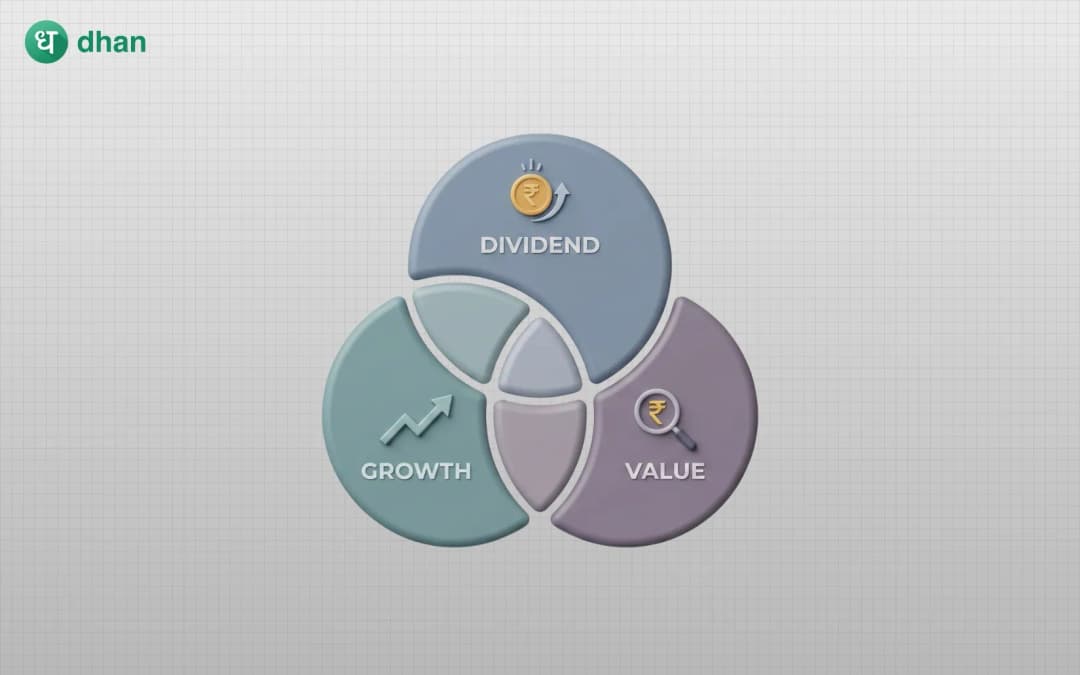




Dividend, growth, and value investing are different strategies people opt for based on what suits their portfolio. Understanding these three strategies will help ensure that you make more informed decisions based on your financial goals and risk tolerance. In this article, let’s break them down so you can choose what fits you best. Read on to learn more!
What is dividend investing?
Dividend investing is when you buy shares of companies that pay you dividends, a portion of the company’s profits shared with shareholders regularly, often quarterly or annually.
When you hold shares in companies that consistently share earnings as dividends, even if the stock price doesn’t move much, you get paid. It’s like a steady income stream. Dividend yield is a key metric here. Dividend yield helps us understand what percentage of earnings the company will share with us. You can calculate it by dividing the annual dividend of a stock by the stock price, shown as a percentage.
Features of dividend stocks
- Dividend stocks usually belong to mature, stable companies.
- Dividend stocks provide steady cash flow.
- They tend to have less price volatility compared to growth stocks.
- Provide the (DRIP) Dividend Reinvestment Plan feature, which can help investors to average the buying cost of the stock.
Pros and cons of dividend investing
What is growth investing?
Growth investing focuses on companies expected to rapidly expand their earnings, resulting in a sharp rise in share price. These companies might not pay dividends because they reinvest profits to fuel expansion.
These companies have high future earnings potential and strong management. They often have high Price-to-Earnings (P/E) ratios because investors expect growth ahead. The Price-to-Earnings-to-Growth (PEG) ratio is also used to ensure the company isn’t overvalued.
Features of growth stocks
- Growth stocks have high P/E ratios.
- These stocks pay little or no dividends.
- Growth stocks often operate in expanding industries like technology or consumer innovation.
- These stocks are riskier but provide higher reward potential.
Pros and cons of growth investing
What is value investing?
Value investing refers to finding stocks priced lower than their actual worth, based on fundamentals like earnings, assets, and cash flow. You buy when the stock is undervalued, expecting the market to correct and push prices up.
When finding value stocks, you should look for low P/E or Price-to-Book (P/B) ratios, strong financial health, and consistent dividends. Value investors focus on companies with a margin of safety, aiming to buy quality at a discount.
Features of value stocks
- Value stocks tend to have low P/E and P/B ratios.
- They often pay consistent dividends and belong to companies with stable business models.
- These stocks tend to be less volatile than growth stocks.
Pros and cons of value investing
Dividend vs Growth vs Value: Key differences
Dividend stocks often shine in uncertain markets. Growth stocks boom in bullish trends. Value stocks can outperform when the market corrects inflated prices.
Investment philosophy and approach
- Dividend investors seek steady cash flows now or to reinvest and compound over time.
- Growth investors chase future wealth by betting on expanding companies.
- Value investors look for safe bargains to buy quality companies at discounts, expecting price appreciation.
Risk vs. return comparison
- Growth investing is higher risk with higher possible returns.
- Dividend investing offers lower risk with regular income.
- Value investing balances moderate risk with potential for both income and capital appreciation.
Performance in different market conditions
- Dividend stocks provide stability in uncertain markets.
- Growth stocks perform well in strong bull markets.
- Value stocks tend to do better when markets correct overpriced stocks.
Suitable investor profiles
Dividend investors want steady money now or to reinvest for compounding. Growth investors seek future wealth by investing in scaling businesses. Value investors seek bargains with safety and long-term growth. So, as per your profile, choose:
- Dividend: If you want income and lower volatility.
- Growth: When you can handle risk and aim to build wealth long-term.
- Value: You prefer bargains, dividends, and less risk
How to choose the right strategy
While looking for the right investing strategy one should keep Here is how to choose the right strategy.
Factors to consider
When it comes to choosing between dividend vs growth vs value investing, consider your goals, risk tolerance, and time horizon. If you're looking for a steady income and low risk, dividend investing may be a suitable option for you.
If you seek significant growth and accept volatility, growth investing is the way to go. If you want stability with some upside, value investing will be a good fit.
Can you combine dividend, growth, and value investing?
Yes, you can combine all three. For example, you can invest 40% of your money into dividend stocks for stability, 40% into growth stocks to create wealth, and 20% into value stocks to find bargains. Here’s how you can allocate your funds based on your goals and profile:
- Conservative: 60% dividend, 20% value, 20% growth.
- Balanced: 40% dividend, 40% growth, 20% value.
- Aggressive: 70% growth, 15% value, 15% dividend.
Practical examples and portfolio allocation scenarios
If you have ₹10 lakh to invest, how you divide this money will depend on how much risk you can handle and what your financial goals are.
- Conservative Investor: Prioritises safety and steady income. You might put ₹6 lakh (60%) in dividend stocks, ₹2 lakh (20%) in value stocks, and ₹2 lakh (20%) in growth stocks.
- Balanced Investor: Seeks a mix of income and growth. You could invest ₹4 lakh (40%) in dividend stocks, ₹4 lakh (40%) in growth stocks, and ₹2 lakh (20%) in value stocks.
- Aggressive Investor: Focused on capital appreciation and can tolerate risk. Here, ₹7 lakh (70%) goes into growth stocks, ₹1.5 lakh (15%) into value stocks, and ₹1.5 lakh (15%) into dividend stocks for some income stability.
You can adjust allocations over time as your goals or market conditions change.
Lessons from past market cycles
Market cycles show that no single investment strategy works all the time. Growth stocks perform well during good economic times but can drop sharply during downturns.
Dividend stocks offer steady income and help cushion losses in bear markets. Value stocks often do well when the market corrects overpriced investments, rewarding investors who are patient.
Investors should adjust their portfolios based on market conditions. They focus on growth when times are good and switch to dividends and value stocks during uncertain times. Key strategies include staying disciplined, diversifying investments, and understanding your risk tolerance.
Conclusion
Dividend investing provides steady income and safety. Growth investing seeks significant wealth but comes with higher risk. Value investing looks for good deals and usually has moderate risk. Choose the option that suits you best, and happy investing!
FAQs
1. Is dividend investing safer than value or growth investing?
Generally, yes. Dividend stocks are usually from mature and stable companies with steady cash flow. This is what also makes them less volatile than growth stocks.
2. Can I mix all three strategies in investing?
Absolutely. You can combine dividend, growth, and value stocks to help balance income, growth, and safety in your portfolio.
3. How do I identify stock types for each style?
Dividend stocks have high dividend yield and stable payouts. Growth stocks have high P/E ratios and focus on expansion. Value stocks have low P/E or P/B ratios and appear undervalued.
4. How to research companies for dividend investing?
Check a company’s dividend history, payout ratio, and cash flow stability. Reliable dividend payers maintain or grow payouts over time.
5. How to evaluate growth and value stocks effectively?
Growth stocks require strong revenue/earnings growth, as well as future prospects. Value stocks require looking for low valuations and strong fundamentals, like debt levels and return on equity.