How to value a stock in India







Investing in stocks can be highly rewarding, but the biggest challenge for any investor is knowing whether a stock is worth buying at the market price. Blindly following tips, market news, or sentiment often leads to costly mistakes.
Understanding how to value a stock allows investors to distinguish between overvalued, undervalued, and fairly priced shares. In this blog, we’ll explore practical approaches for valuing Indian stocks and tips to make smarter, informed investment decisions.
Why stock valuation matters?
India's equity markets are growing at a rapid pace, driven by increasing retail participation, foreign investor inflows, and structural reforms. However, the market price of a stock changes every day based on demand and supply, news, and investor sentiment. Hence, to know a stock’s real value, intrinsic value is important.
How to calculate Intrinsic Value of a stock
The intrinsic value reveals the fundamental, underlying worth of a company’s stock independent of these short-term swings. It estimates what a stock is really worth based on its expected future cash flows, growth potential, and risks, providing a stable benchmark against market noise.
Intrinsic Value = [CFi / (1+r) ^1] + [CFii / (1+r) ^2] +…..+ [TV / (1+r) ^ n]
Where,
- CF = yearly cash flow
- r = discount rate
- TV = Terminal value
- n = No. of periods
Buying a stock below its intrinsic value offers a margin of safety against losses, while buying above intrinsic value exposes to losses, even if the company performs well later. As Warren Buffett said, "Price is what you pay. Value is what you get."
How to value a stock
Investors use different methods to calculate stock value. Some of those methods are discussed below:
Discounted Cash Flow (DCF)
Discounted Cash Flow (DCF) is a valuation method of estimating the current value of an investment based on the projection of its future cash flow and discounting it to the present day with a specified discount rate.
Investors can use this current value to see if the future cash flows from an investment or project exceed the initial investment's value. If it is, the investment is worth considering.
DCF Formula = DCF = [Cash flow for the 1st year / (1 + r)1] + [Cash flow for the 2nd year / (1 + r)2] + [Cash flow for the 3rd year / (1 + r)3] + .. + [Cash flow for the nth year / (1 + r)n]
For example, let's say an investor plans to invest Rs. 1 lakh in a business for a period of 5 years. This company's WACC (Weighted Average Cost of Capital) is 6%.
Then the estimated cash flows for five years will be:
- 1st year = Rs.20,000
- 2nd year = Rs.23,000
- 3rd year = Rs.30,000
- 4th year = Rs.37,000
- 5th year = Rs.45,000
Putting this value into the formula,
DCF = [20,000 / (1 + 0.06)1] + [23,000 / (1 + 0.06)2] + [30,000 / (1 + 0.06)3] + [37,000 / (1 + 0.06)4] + [45,000 / (1 + 0.06)5]
Total DCF = Rs. 1,27,460
The net present value (NPV) will be Rs. 27,460 after deducting the initial investment of Rs. 1 lakh from the total DCF of Rs. 1,27,460. The investor’s investment in this business will be profitable because the net present value is positive.
Relative Valuation (Comparables)
Relative Valuation (or Comparables) stock valuation is the method of valuing the stock of a company with its peers in the same sector. For relative valuation, investors can use Dhan Scanx stock valuation screeners, like P/E or EV/EBITDA, to identify a stock with strong fundamentals among its peers.
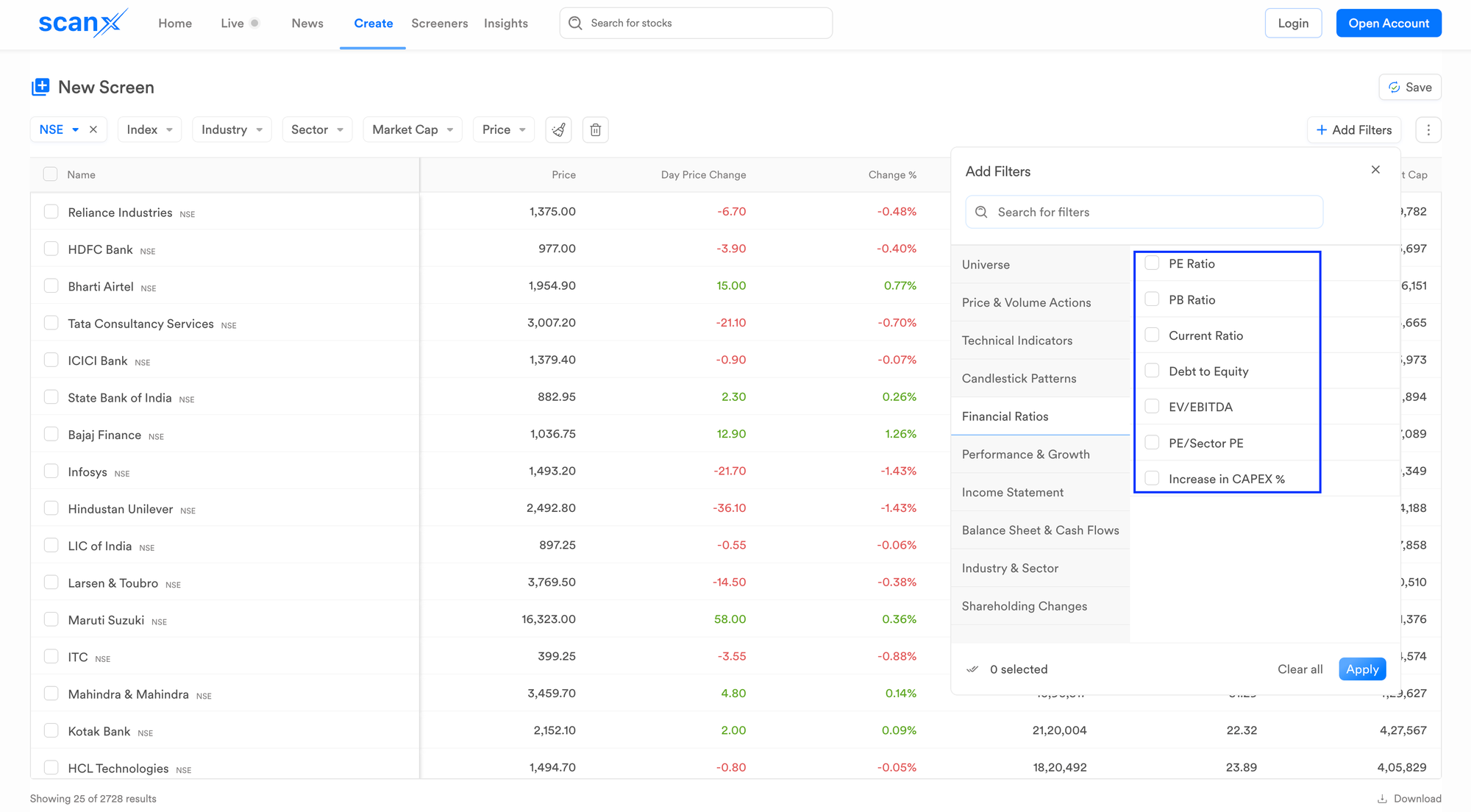
This helps determine the overvaluation or undervaluation of a stock in relation to its peers, but requires choosing similar companies and taking market conditions into account.
When the multiple of the target company is below its peers, then it can be undervalued; when it is higher, it can be overvalued.
For example, an investor wants to invest in company A, and its P/E is 15 while the industry average is 20. Then company A is undervalued in comparison to its peers, providing an attractive investment opportunity.
Margin of Safety
The Margin of Safety (MOS) method is a value investing approach in which a stock is bought at a price lower than its estimated intrinsic value, in order to provide a buffer against potential losses.
This buffer protects against valuation errors, market volatility, and unexpected negative events, and the percentage of the margin is decided by the investor and the perceived risk of the investment.
The Formula:
Margin of Safety (MOS) = (Intrinsic Value - Market Price) / Intrinsic Value x 100%
A smaller market price relative to the intrinsic value results in a larger margin of safety.
For Example, the intrinsic value of a company’s stock is Rs. 600 per share. However, its current market price is Rs. 400 per share.
Then MOS:
MOS = (600−400/600)×100
MOS=33.33%
This indicates that the stock has a 33% margin of safety and is currently trading at a 33.33% discount to its intrinsic value.
Final thoughts
Stock valuation is not about predicting tomorrow’s price. It’s about understanding the true worth of a company. In India, where the stock market is growing quickly but also prone to volatility, a structured valuation framework helps investors distinguish between noise and genuine investment opportunities.