Applying for IPO? Only specific UPIs are allowed to pay for IPOs









Key takeaways:
- Not all UPI apps let you pay for an IPO. For IPO applications, only UPI apps authorised by NPCI and banks enable the IPO mandate procedure.
- Your bank must be an eligible SCSB. The bank linked to your UPI ID should be a SEBI-approved Self-Certified Syndicate Bank (SCSB) to block funds under the ASBA framework.
- UPI IDs must meet regulatory requirements. The UPI ID should be linked to a fully KYC-compliant bank account in the investor's name. Wallet-based or unsupported UPI IDs are generally not eligible.
- Technical integration is required. Before UPI apps may enable IPO transactions, they must include the security measures, fund-blocking mechanism, and IPO mandate process of the NPCI.
India’s Unified Payments Interface (UPI) has become the backbone of retail payments, processing over ₹314 lakh crore in FY2025-26. Regulators now require individual investors to use UPI for IPO bids (up to ₹5 lakh per bid) under the ASBA framework.
This blog explains the SEBI/NPCI rules, how the UPI-based ASBA process works, what technical/security features UPI apps must have, etc.
Why are some UPI apps not allowed for IPO payments?
You cannot apply for an IPO using every UPI application. These are the primary reasons:
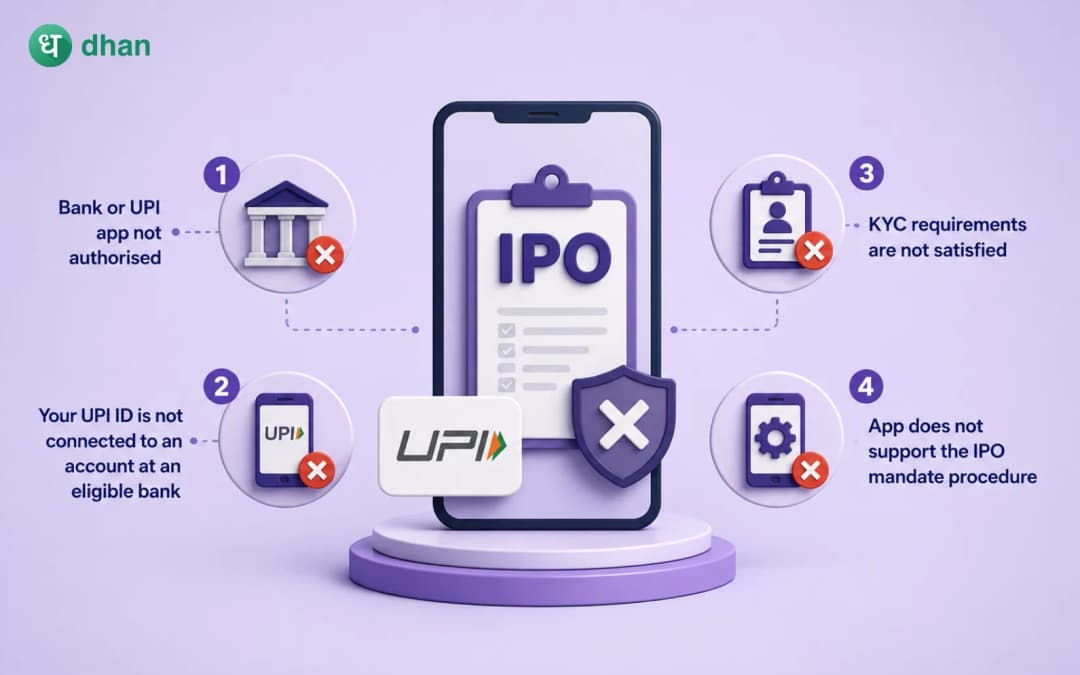
1. Bank or UPI app not authorised
Only banks sanctioned by NPCI and UPI apps have the authority to handle IPO applications. Your UPI ID won't be accepted when submitting an IPO application if your UPI app or the connected bank isn't on the authorised list. The app may not allow IPO payments even if it runs perfectly for sending or receiving money.
2. Your UPI ID is not connected to an account at an eligible bank
Your UPI ID for IPO applications has to be connected to your own savings or current account with a SEBI-approved Self Certified Syndicate Bank (SCSB). Usually, wallets or unsupported accounts linked to UPI IDs cannot be used for IPO payments.
3. KYC requirements are not satisfied
IPO applications involve blocking funds in your bank account, so strict KYC rules apply. If your UPI account isn't fully KYC-compliant, is linked to a wallet, or isn't in your name, it might not be qualified. Likewise, since many NRI accounts follow a different ASBA procedure, they are unable to utilize the UPI path for IPO applications.
4. App does not support the IPO mandate procedure
Some UPI applications have regular payment support but lack the technical capabilities required for IPO applications. The app has to feature the UPI mandate feature, which stops the application amount until the allocation process is over, in order to handle an IPO. The app cannot be used to pay for IPOs if this functionality is missing.
Approved UPI apps and providers for IPOs
As of mid-2026, NPCI (via its BHIM UPI portal) publishes the list of “UPI apps live on IPO”. The list currently includes around 39 apps/handles. Major examples are:
- BHIM UPI (@upi) – NPCI’s own app (Android & iOS).
- Google Pay – handles like @okhdfcbank, @oksbi, etc., are allowed.
- PhonePe – handles such as @ybl (Yes Bank), @axl (Axis), @ibl (IndusInd) are enabled.
- Paytm – Paytm’s UPI handles (@ptyes, @ptaxis, @pthdfc) are approved.
- MobiKwik – the MobiKwik UPI app handle (@ikwik) is approved.
- FreeCharge UPI – handles like @freecharge are on the list.
- Citi Mobile – Citi Bank’s UPI (@citi, @citigold) is approved.
- Kotak Mobile Banking App – Kotak Bank’s UPI handle (@kotak) is enabled.
- DBS (DigiBank) – handles (@dbs) for DBS are allowed.
- IDBI Bank GO Mobile+ – IDBI’s UPI (@idbi) is listed.
- IndusInd Bank (IndusPay) – handle @indus is on the list.
- Axis Bank UPI (Axis Pay) – handle @axisbank (Android) is on the list.
- Bandhan Bank UPI, PNB UPI, SBI Pay (only Android), Yes Bank UPI, AXIS Bank UPI, etc. – many banks’ native UPI apps are included.
- Dhanlaxmi Bank (DhanSmart) – handle @dlb is present.
How to check if your UPI ID is eligible for IPO applications?
Before applying for an IPO with the use of UPI, make sure your bank and UPI app have this facility.
- To begin, confirm that the bank linked to your UPI ID is one of the Self Certified Syndicate Banks (SCSB) that can block IPO funds under the ASBA procedure. If it is not one of these banks, you cannot use your UPI account for this purpose.
- Then, move on to check that your UPI handle or application is valid for IPO purposes. Supported applications include the most used ones anyway, but you will have to verify this with your bank. You can find the official information on this on the website of NPCI or BHIM UPI or by asking your broker directly.
- Usually, your broker’s platform displays all handles that can be used by clients of your broker at the moment you are applying for an IPO.
Conclusion
The UPI-based IPO application process has made investing faster and more convenient for retail investors. However, make sure your bank is an approved SCSB and your UPI application accepts IPO instructions before applying.
Both should be accepted to complete the application digitally by authorising the UPI mandate on time.
If not, you can still submit your application using the ASBA function your bank offers. Checking your eligibility in advance guarantees a smooth, safe, and easy investment experience for the IPO.