


₹30,000 Crore IPO: Is the NSE's 5 Lakh Crore valuation justified?





Key takeaways
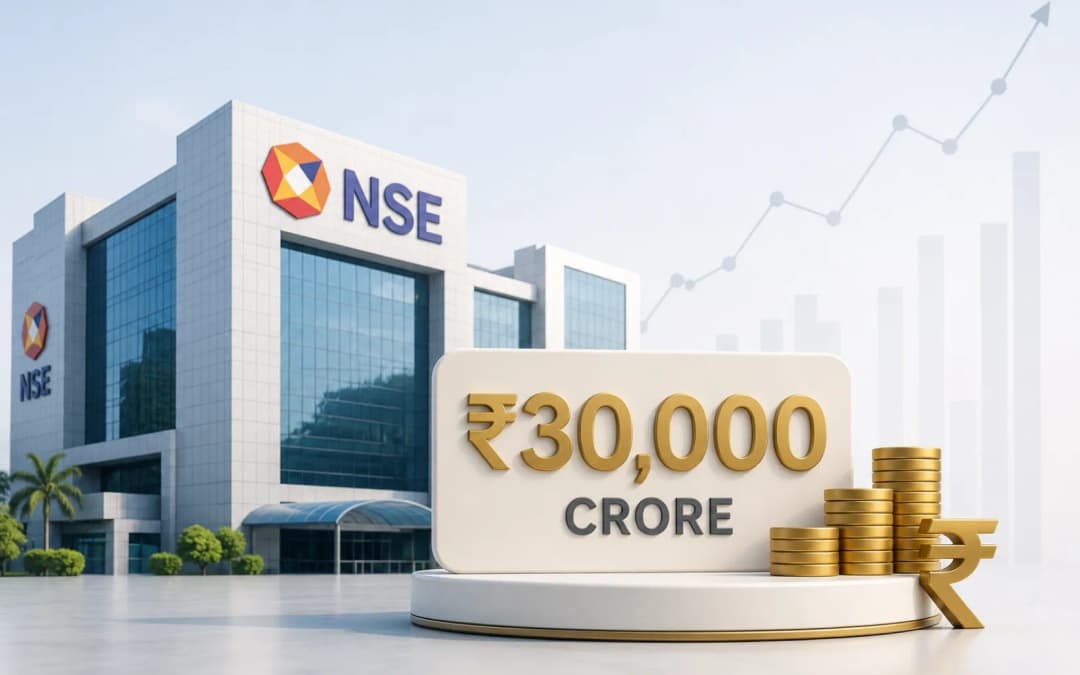
- NSE filed its DRHP with SEBI on 17 June 2026 for an estimated ₹30,000 crore IPO, valuing the exchange at ₹5 to 5.3 lakh crore after a decade-long delay tied to the co-location controversy.
- NSE dominates Indian markets, handling over 90% of cash volumes and near 100% of equity futures, with 13.1 crore unique investors as of May 2026.
- The IPO is a 100% Offer for Sale, so NSE itself raises no fresh capital; all ₹30,000 crore goes to exiting shareholders like SBI and LIC.
- FY26 revenue and profit both declined, and the implied P/E of 48 to 58x is well above the Nifty 50 average of 20x.
- Bulls cite NSE's monopoly and scarcity value, while the final verdict hinges on SEBI's pending review and the still-unannounced price band.
₹30,000 crore NSE IPO. That's the number that has been a major part of all the conversations at Indian trading desks, deal rooms, and financial news channels. The National Stock Exchange submitted documents for what may be the biggest public issue in Indian history, with SEBI on 17 June 2026. A development that has made market players wait for almost 10 years.
But there's more to what it seems in this complex story, a company that's sold exclusively on the basis of selling already held shares. A valuation that some say is warranted and others say is overvalued, and a bunch of numbers that might not always be on terms with each other.
It's worth noting, though, that before you make a position call, you must understand exactly what you're valuing, and why this debate isn't close to being concluded.
What is NSE, and why does its valuation matter?
NSE claims that it is a homegrown brand with a global vision and that it was the largest multi-asset class exchange in terms of the number of trades in cash equities and contracts traded in equity derivatives during Fiscal 2026.
The first attempt was made in 2016
NSE got going on listing the way in 2026. The exchange had first submitted draft offer documents back in 2016, for a significantly smaller Offer for Sale, of about ₹10,000 crore.
This effort was wasted away by the emergence of claims that certain brokers were given access to the servers of the NSE earlier than others from 2010 to 2014, which was dubbed the co-location controversy.
The settlement with the Securities and Exchange Board of India (SEBI)
The legacy cases were years in the making to be resolved. In October 2024, NSE settled the misuse of the TAP case for ₹643 crore, and in June 2025, it made the highest settlement ever with SEBI in the co-location and dark fibre cases, which came to a whopping ₹1,387.39 crore. The two settlements combined paid the regulator a sum of over ₹2,030 crore.
The process of clearing the way in 2026
30 January 2026 marks the date of the No Objection Certificate issued by SEBI to NSE, prior to which no market infrastructure institution is allowed to file for an IPO. The Delhi High Court cleared the hurdle to DRHP filing on 16 February 2026 in a subsequent court challenge to the clearance.
A breaking down of the ₹5 Lakh Crore valuation
To understand if the ₹5 lakh crore valuation is reasonable, one should take a look at the scale of the market the NSE operates in and the scale of the investor and listing data, as provided by SEBI.
Number of companies listed on NSE
Till the date of 2 February 2026, 2781 companies traded on the NSE, with 534 companies on the NSE EMERGE SME platform and approximately 2247 companies on the mainboard.
BSE, a strong contender, comes off bigger in terms of the number of companies listed, but NSE still performs better in terms of trading volume and turnover. Reports from March 2026 confirm that the combined market capitalisation of all the companies listed on the NSE was around ₹411 lakh crores.
How many investors have been accounted for?
In September 2025, NSE registered 12 crore investors, and in April 2026, it saw an increase to 1 more crore. Talking about May 2026, this number has increased even more. In the same month, India also maintained more than 20 crore demat accounts, of which 18 crore were with CDSL and 4 crore with NSDL. The bull case hinges on this growth curve as more accounts and trades equate to more NSE transaction fee revenue.
What do the issue structure and financials tell you?
The IPO is a 100% OFS of up to 14.89 crore shares in the market valued at ₹30,000 crore, with the proceeds going to existing shareholders like SBI, LIC, and Stock Holding Corporation of India (SHCIL) and not NSE.
FY26 revenue declined 3% year on year to ₹16,601 crore, while net profit dipped about 15% to ₹10,302 crore, which included a one-off gain of ₹1,200.9 crore from NSE's NSDL stake sale. That puts the P/E ratio at around 48-58 times the FY26 earnings at the ₹5 lakh crore valuation, higher than the Nifty's average of 20-ish times and peers ICICI Bank and TCS at 16-19 times.
Do analysts agree? A fair assessment of the valuation debate
The sentiment of market participants is truly mixed, and there are good arguments on both sides.
The bull case's premium valuation
NSE's near monopoly is cited as a reason for its support. It has a defensible moat with pricing power as it handles 90% of the cash market volume and nearly 100% of the equity futures business.
The asset-light nature of the business, its great free cash flow, and the fact that every additional demat account and additional transactions equate to additional transaction revenue, benefit the business structurally as India's retail participation is increasing.
Sceptics remain cautious, why?
The sceptics are interested in the trend of earnings and not in the story. Revenue and profit for FY26 were down, contrary to the valuation of implying growth stock multiples. All of the ₹30,000 crore raised will be used to pay off existing shareholders, including some who bought their shares for under ₹1 a long time ago.
There are also recent large Indian IPOs that listed below the issue price, when the investors felt that the pricing was too aggressive and the regulatory risk was not completely eliminated, say the critics.
What position does it leave investors in?
None of these perspectives is unfeasible singly. The actual price band, which is yet to be approved by SEBI, and the market pricing of a monopoly infrastructure asset in the backdrop of lower near-term earnings will be crucial to the final judgment.
Investors looking to evaluate the IPO near its launch should be on the lookout for three things: the confirmed price band after the SEBI approves the DRHP, return in profit growth in FY27, and the reception of the issue compared to similar large-cap issues in the year.
What's next after the NSE IPO?
The DRHP filing is just the first step. Whether the ₹5 lakh crore is a fair price or a stretched one will depend on SEBI's observations, the final price band, and the actual response to the subscription.
The truth is that the bull and the bear cases are both based on real and proven numbers and not on speculation; that's the reason this is one of the more honest valuations in recent Indian market history.
Investors who are interested in investing should stay tuned to the observations by SEBI, read the final Red Herring Prospectus after it is filed, and carefully consider the pricing while taking into account the monopoly position of NSE and its performance over the last few years and months before making a decision.