Juniper Green Energy IPO - Should you apply?





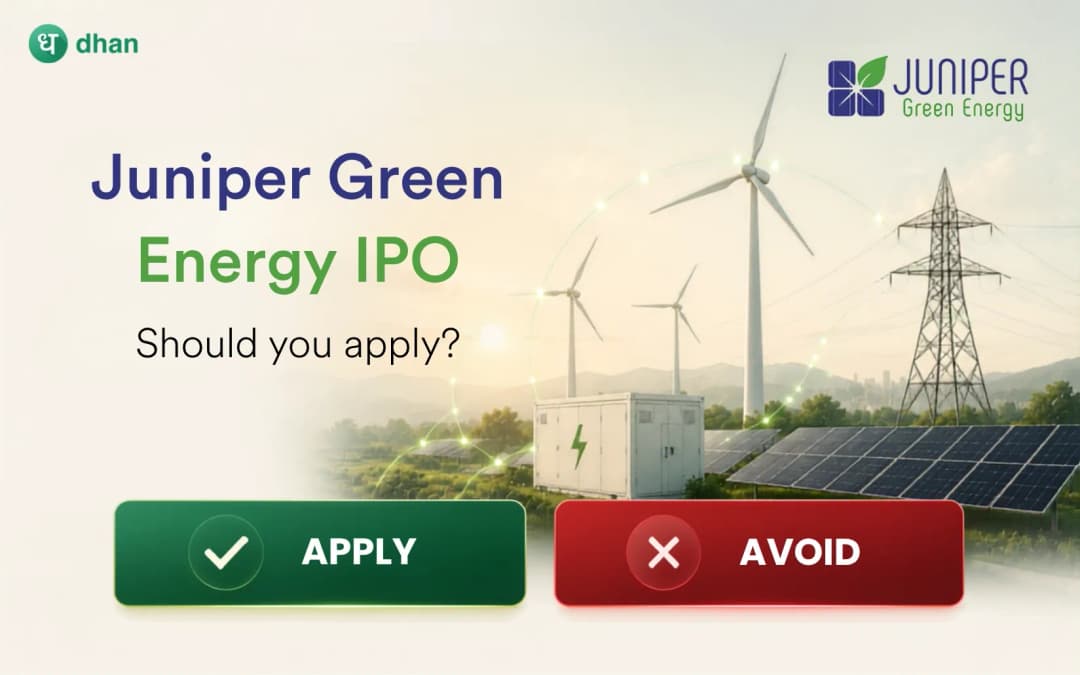




Key takeaways:
- The goal of the IPO is to raise ₹1,800 crore through a fresh issue, which would have around 8 crore shares.
- The band price of the IPO ranges between ₹214 and ₹225 per share, and the bidding is scheduled from 30th July to 3rd August. The IPO is likely to be listed on August 6, 2026.
- Juniper Green is a renewable independent power producer, with a portfolio including a mix of solar, wind, and hybrid storage-backed projects. These are sold under long-term power purchase agreements.
- The company has recorded steady growth in revenue, although its profits have been irregular. Considering current earnings, the valuation of Juniper Green Energy looks rich.
The renewable energy sector in India is bracing up for a new listing, as Juniper Green Energy Ltd. is about to launch its maiden public issue on the stock market.
Investors will be able to subscribe to Juniper green energy IPO from Thursday, 30th July 2026. The subscription for this IPO will be open till Monday, 3rd August, 2026. It is a book-built issue worth roughly ₹1,800 crore, which comprises around 8 crore equity shares.
The price band for Juniper Green Energy ranges from ₹214 to ₹225 per share. The minimum size of a lot for which investors can bid is 66 shares. Further bids can be made in multiples of 66.
The shares are likely to be allotted around 4th August, 2026, and shareholders can expect the stocks to be credited to their demat accounts by August 5. The Juniper Green Energy shares are scheduled to be listed on the NSE and the BSE on 6th August, 2026.
The issue is being steered by a banking syndicate involving four members. These include ICICI Securities, HSBC Securities and Capital Markets (India), JM Financial, and Kotak Mahindra Capital Company. KFin Technologies has been appointed as the registrar.
Let’s take a look at what the company does, what its numbers show, and whether you should subscribe for the IPO.
Juniper Green Energy IPO details
Juniper Green Energy is one of the top 10 largest renewable independent power producers in India in terms of total capacity. The company runs the full renewable value chain in-house, which includes bidding for auctions and scouting land. Its operations also include engineering, procurement, construction, and eventual operations and maintenance.
The first solar plant of Juniper Green Energy went live in March 2020, and it’s a 100 MW facility. After the initial launch, the portfolio of the company significantly expanded. In June 2026, it was recorded at 7,910.20 MW capacity.
Although solar energy remains the key focus for the company, it has increasingly ventured into wind assets and more complex formats like wind-solar hybrid energy systems. Its portfolio also includes firm dispatchable renewable energy (FDRE) projects that pair with battery storage. This is an area where it ranks as the second-largest winner of tenders awarded between April 2021 and March 2026.
One of the key features of the business is the durability of its revenue that it looks to earn through contracts. Around 97.68% of its capacity is backed by long-term agreements for power purchase, which would be running for around 25 years.
Interestingly, some of the buyers of these green energy reserves include government bodies like SECI, NTPC, and NHPC and state utilities like GUVNL and MSEDCL. Even private players like Tata Power are among its buyer list. This mix of buyers, along with the contract tenures stretching across decades, gives the company a long runway to earn visible cash flows. Among listed peers, the company also records one of the shortest receivable cycles, which demonstrates its disciplined collections.
Juniper Green Energy has also established its reputation for speed. Many of its projects have gone live well ahead of schedule. In some cases, they have gone live even before a year. This is the result of fast land acquisition and sound grid connectivity in states like Rajasthan and Gujarat that offer plenty of resources.
Financials of the company
The business's financial growth looks sound. The total income of Juniper Green Energy grew from ₹424.45 crore in FY24 to ₹804.93 crore in FY26, which shows a healthy upward trajectory. However, net profit of the company has been modest, moving from ₹40.06 crore to ₹36.48 crore and back up to ₹40.46 crore over the same three years. This inconsistency is mostly due to the nature of the business. Renewable assets come with heavy costs related to depreciation and interest in their early years even as operating cash flows remain healthy. That debt load is significant: consolidated borrowings rose from ₹2,671.70 crore in FY24 to ₹5,502.53 crore in FY25 to ₹12,920.54 crore as of 31 March 2026. The ₹683.24 crore earmarked for repayment addresses only a small part of it. What supports the valuation despite thin profits is the operating model EBITDA margins run around 86%, reflecting the high operating leverage typical of renewable IPPs with long-term fixed-tariff PPAs.
The company has plans to use about ₹683.24 crore coming in through the issue to pay off its existing borrowings. The business also has plans to channel ₹728.69 crore to fund investments in its subsidiaries. The balance has been earmarked to be used for general corporate needs.
Should you apply for this issue?
Considering the long-gestation infrastructure of the business, investors should weigh the scope of subscribing to Juniper Green based on its earning potential.
Pros of investing in Juniper Green Energy
- Scale and speed: Juniper Green Energy is placed among the top 10 Indian companies in renewable IPPs. It has a decent track record of commissioning projects ahead of their schedule. This is one of its greatest strengths, particularly when delays are common in the renewable energy sector.
- Long-term contracted revenue: Most of the capacity of the business has been locked into long-term contracts lasting for up to 25 years. The buyers are distributed across the government and private sectors. This gives a visible cash flow for the company for decades.
- In-house EPC and O&M capability: Juniper Green Energy maintains internal teams for construction and maintenance functions and doesn’t outsource them. Thus, it retains margins that would otherwise be channelled to third-party contractors. This also helps them control timelines and quality.
- Land and connectivity: The business already has a sizable land bank and secured grid connectivity in states carrying high potential. This gives an edge to the company at a time when fresh approvals for connectivity in those regions are gradually becoming scarce.
- Rising demand for power: The growing consumption of electricity from data centres, AI infrastructure, and corporate decarbonisation commitments directly benefits the key business of the company.
Cons of investing in Juniper Green Energy
- Rich valuation against current earnings: The issue is priced at a post-issue P/E of nearly 317 times FY26 earnings, with a post-issue return on net worth of just 1.18%. These multiples leave little room for error, and the business is heavily dependent on its future earnings to catch up.
- Inconsistent net profits: Over the last 3 years, the net profit of the company has moved up and down even as revenue has continued to grow. This is largely due to depreciation in prices and finance costs associated with its expanding asset base.
- Sizeable contingent liabilities: As of March 31, 2026, the contingent liabilities of Juniper Green Energy stood at ₹2,210.51 crore. Considering the overall scale of the company, this figure is worth watching.
- No track record of dividends: Historically, Juniper Green Energy has not distributed dividends. It adopted a formal dividend policy in June 2025.
- Risk related to execution and policy: Renewable projects often face delays in acquiring land, grid connectivity, and module or turbine supply. Changes in government policy related to tariffs and subsidies also determine this risk.
- Peer comparison is imperfect: Some of the listed competitors of the business, like Acme Solar, NTPC Green, and Adani Green, trade at different multiples. There’s no scope to directly compare the business based on scale, ownership, or asset mix.
Wrapping up
Juniper Green Energy comes with a long book of contracted revenue to the table, which is important in a sector where India increasingly sets ambitious goals.
At the same time, the valuation of the company is demanding relative to current profitability. The last three years recorded significant swings in net profit, which serves as a reminder that earnings take time to mature along with assets in such capital-intensive businesses.
If you’re comfortable staying invested through the initial years where depreciation may be heavy, you may consider applying for the Juniper Green Energy IPO. Those willing to look past a steep near-term P/E in the expectation of a sustainable cash flow over multiple decades can also invest in its shares to be issued in the stock market.