Margin trading: Key advantages and opportunities


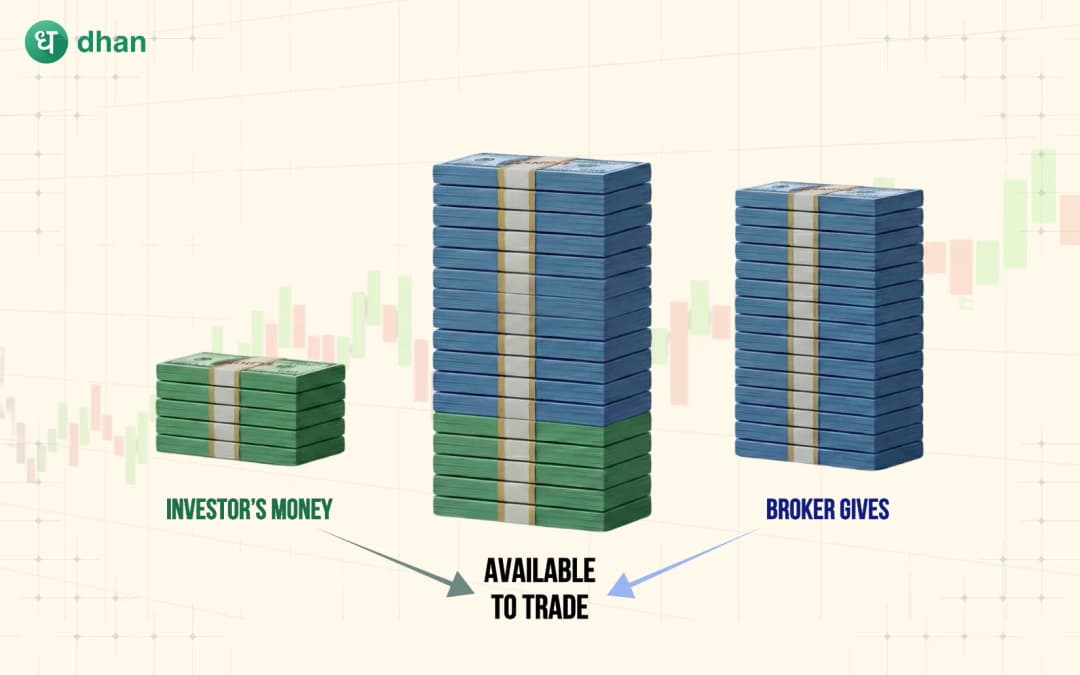


Margin trading plays an important role in helping traders manage positions efficiently.
It allows traders to take leveraged positions by borrowing funds from their broker, enabling them to participate in larger trades without deploying the full capital upfront.
Rather than being a method to chase fast gains, margin trading is designed to enhance trading flexibility and liquidity, helping market participants make the most of short-term opportunities with proper risk control.
In this blog, we'll cover what margin trading is, its primary advantages, possible opportunities, and under what circumstances it might be suitable for a trader.
What is margin trading?
Margin funding or Margin money allows traders to borrow money (the "margin loan") against the value of the securities they own. Initially, traders only pay a small amount of the securities they buy, and the rest of the amount is a loan from the broker.
The most important element in this case is the leverage. Supposedly, if a trader has ₹1 lakh and a 5x leverage is available through the broker, then the trader can buy securities of ₹5 lakh. This extra ₹4 lakh is borrowed from the broker as a margin loan. This borrowed money does come with interest and risks.
Margin trading in India is governed by the Securities and Exchange Board of India (SEBI). Marginal trading can be provided only via SEBI-certified brokers such as Dhan, and the traders have to fulfil eligibility criteria such as having a substantial margin balance and collateral.
Benefits of using MTF on Dhan are:
- Up to 4X Leverage on 1700+ Stocks
- Collateral Flexibility
- Automated Risk Management and Liquidation
- Competitive Interest Rates
- Real-Time Margin Calculator
- Seamless Integration
- Transparent Charges
On Dhan, the margin trading interest rates begin from 12.49% per annum. The interest is calculated on the borrowed amount daily. Therefore, the longer the leveraged position is held, the higher the interest cost. While leverage does amplify potential returns, at the same time, losses are amplified in the same proportion.
Margin trading interest rates on Dhan
If the price of the purchased security falls, the trader's equity can quickly erode, triggering a margin call from the broker. An inability to maintain a sufficient margin or add funds in time can result in a forced square-off of positions. Therefore, margin trading, though powerful, is best suited for experienced traders who can manage both market volatility and the cost of leverage effectively.
Key advantages and opportunities of margin trading
Margin trading offers several strategic advantages to traders to capitalise on market movements. Some of the benefits of margin trading are:
Amplified returns and increased purchasing power
The most compelling advantage of margin trading is the potential of magnifying profits. By controlling a larger position with a smaller amount of capital, even small price movements can result in substantial returns. This increased purchasing power means that traders can take advantage of high conviction opportunities that would be earlier out of their reach using only their available cash.
Opportunities for Short Selling
Margin trading helps in implementing short-selling strategies. Short selling enables a trader to profit if the price of a security is expected to fall. The trader borrows shares, sells them, and again buys them when the shares fall to a lower price.
The risks of margin trading
The leverage that margin trading brings about amplified gains is a double-edged sword, as it also carries risks of losses. Some of the risks associated with margin trading are:
The margin call
This is one of the biggest risks associated with margin trading. A margin call results when the holdings coverage falls below 20% or if required margins are not maintained. The broker will demand that the trader immediately deposit more funds in order to bring the margin back to the required level. If the trader fails to meet the margin call, the broker has the right to forcibly liquidate (sell) the securities in the account to repay the loan.
Magnified losses
If the market is moving against a leveraged position, the losses are magnified. In case of no MTF, the maximum loss is your initial investment. But with margin trading, losses can exceed the initial deposit, rendering the trader in debt to the brokerage firm.
Interest expenses
Margin loans incur interest charges on the borrowed amount, which are calculated daily. Over time, these charges can take a significant bite out of the potential profit of a trader, particularly if the trade is held for a longer period or if returns in the market are modest.
When is margin trading suitable for you?
Margin trading is not for everyone. It is primarily a tool for advanced traders with a high risk tolerance and deep knowledge of the Indian financial market.
Final thoughts
Margin trading is a two-edged sword; it can amplify a trader's potential return and provide access to various market opportunities. However, along with its benefits, margin trading is also accompanied by an equal level of risk.
Before margin trading, a trader should be willing to assume the full extent of their risks and have an effective risk management plan, such as the placement of stop-loss orders and holding a large cash cushion. At the end of the day, the success of margin trading isn't much about employing borrowed funds, it's about employing them judiciously.
FAQs
1. What is the margin trading interest charge on Dhan?
The current interest charge for margin trading (MTF) on Dhan is 12.49% per annum for amounts up to ₹5,00,000. The rate increases for higher funded amounts to13.49% for ₹5,00,000.01 to ₹10,00,000, and 14.49% for ₹10,00,000.01 to ₹25,00,000, with further slabs for larger borrowing. This interest is calculated daily on the margin-funded amount.
2. Can I Apply for an IPO through Margin Trading?
No, IPO applications in India cannot be made using margin trading. IPO shares are only allocated for full cash payment. Investors need to have the amount of application in their bank account while applying through ASBA (Application Supported by Blocked Amount).
3. Can I convert my MTF position to a delivery position?
Yes, this process is usually referred to as Convert to Delivery (CTD). You can convert your leveraged MTF position to a normal long-term holding by paying the entire outstanding funded amount (the borrowed amount) to your broker. After full payment, the shares are removed from the pledge and credited to your demat account as free holdings.
4. Is margin trading appropriate for first-time traders?
No. Margin trading involves high risk because of leverage. It's more appropriate for experienced traders who have a grasp of market dynamics, volatility, and risk control. Beginners need to trade with cash or mutual funds first before diversifying into margin-based trading.
5. Are margin trading positions squared off automatically?
Yes, to avoid excessive loss, Dhan has automated risk management that will square off your positions either in case of insufficient margin requirements or in case of holding coverage falling below the specified limits, for example, 20%.