


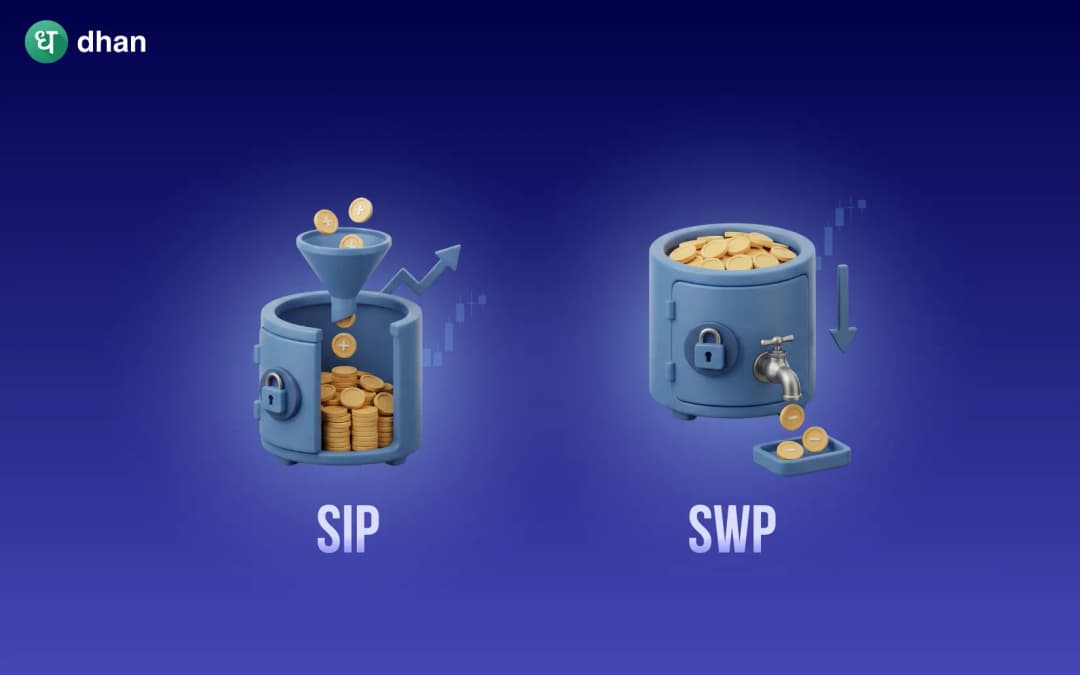
SIP vs SWP








Imagine that you’re in your 30s, and you’re diligently investing a small amount of your earnings every month. With compounding, your wealth grows gradually year after year.
Once you’re in your 60s, you want the same investment to pay you back, month after month, just like your salary. That’s the beauty of investing in mutual funds. It adapts to the goals of your life. When you want to build wealth, you create an SIP. But what happens when it’s time to enjoy your wealth? That’s when an SWP steps in.
But how do these two strategies really work? More importantly, when should you choose SIP and when should you switch to SWP? This guide has got you covered.
What is SIP?
A Systematic Investment Plan (SIP) is one of the simplest and most disciplined ways to invest in mutual funds. You need not invest in a lump sum, like you do in the case of fixed deposits in banks. Think of an SIP more like a recurring deposit at a particular frequency, like monthly, quarterly, or even weekly.
Your contribution to the mutual fund is automatically deducted from your account. With SIPs, investors benefit from rupee-cost averaging over time.
You can buy more units when prices are low and fewer when they’re high. Along with this, the power of compounding helps your returns earn even more returns of their own.
You can use SIP calculator to calculate your monthly SIP investments based on your goals, Suppose you’re investing INR 5,000 in a mutual fund for 10 years at 12% expected returns. With consistency and patience, it grows to INR 11.6 lakhs.
SIPs are ideal for short and long-term goals like:
- Building an emergency fund
- Buying a house
- Creating a corpus for your future
Therefore, SIPs help in evolving your savings into wealth over time.
What is SWP?
A Systematic Withdrawal Plan (SWP) helps you withdraw your money from your corpus at regular intervals. You don’t redeem the entire amount at one go. When you withdraw a fixed amount on a monthly, quarterly, or annual basis, the rest stays invested and keeps earning returns.
While you withdraw some of the mutual fund units in your portfolio with each withdrawal, based on the prevailing NAV, the remaining amount stays invested.
Particularly, retirees or anyone who wants to build a steady stream of income without liquidating their full corpus find SWP a viable mechanism.
For instance, if you build a retirement corpus of INR 1 crore through SIPs, and then keep withdrawing INR 50,000 per month while the amount remains invested at a 10% rate, it can sustain for several years. Thus, you enjoy both income and growth.
With SWP, your money keeps working even as you use it.
Key differences between SIP and SWP
We have compared SIP and SWP in this table to help you understand their purpose and differences.
SIP helps you build wealth, while SWP enables you to sustain that wealth and maintain your cash flow when you’ve reached your financial goals. Both these strategies are systematic and automated. While SIP is all about disciplined investing, SWP involves controlled spending. Both these strategies often work together in a balanced financial plan.
How SIP and SWP work together in a financial plan
SIP and SWP are complementary strategies that help you organise your financial journey. Here’s a practical example of how you can use both of these. Suppose you start investing at the age of 25.
Years 1-15: You’re in your accumulation phase, building wealth through SIPs in equity mutual funds.
Year 16 onwards: You partially shift to your withdrawal phase. Let’s assume you’re 40 then and want to fund your kids’ education without disrupting your overall corpus. So, you can transfer a part of your savings into debt or hybrid funds and start an SWP for regular monthly income.
Use a Dhan calculator to assess how much you can accumulate in 15 years, depending on the fund you choose, the amount you invest, and the expected return rate. Likewise, use an SWP calculator to determine how much you can withdraw from your corpus each month so that it doesn’t get exhausted.
When to use SIP?
When you’re getting started with investments or want to build wealth, SIPs give you the easiest strategy. SIPs are ideal in the following conditions.
- You’re a young investor or salaried professional looking to build wealth gradually
- You prefer disciplined investments, allowing compounding to work for you
Consistency defines your success with SIPs. You need to keep investing throughout the tenure, regardless of whether the market rises or falls. Over time, this helps you in averaging the costs.
Investors can also plan a step-up SIP as their income grows. Even if you increase your contributions by 10% annually, it can significantly boost your corpus.
When to use SWP?
SWPwhat s come into play in the latter phase of your investment journey when you’ve already built your corpus. It helps in generating a consistent stream of income and is generally used in the following circumstances.
- Creating a fixed flow of income during the retirement years without depending on your pension
- Creating a flow of passive funds without selling off your mutual fund units
- Goal-based payouts, like funding the education of your child, or any other fixed expenses, from the wealth you have accumulated
The key advantage of setting up an SWP is that it generates cash flow while preserving your capital. Planned strategically, an SWP can create consistent wealth throughout your lifetime and even leave behind a significant residual wealth for your subsequent generation.
SIP vs SWP: Taxation insights
Like many investors, you may get confused when it comes to the taxation of SIPs and SWPs. We have provided you with a quick breakdown here.
Taxation for SIPs
For SIPs, tax applies only when you redeem the unit. Each instalment of SIP is considered a separate investment when capital gains are calculated.
- Short-term gains (less than 1 year): STCG tax of 20% for equity funds
- Long-term gains (1 year or more): LTCG tax of 12.5% above INR 1.25 lakh gains
Taxation for SWPs
Each withdrawal is considered a partial redemption. The tax in this case depends on the holding period of the withdrawn units and the type of fund you invested in. SWPs from long-term equity investments often attract lower tax liability. This makes them more efficient compared to fixed-income alternatives.
Tools to help you plan better
For young investors, it’s easy to plan SIP or SWP with reliable tools. These Smart Calculator on Dhan can help you visualise how your money grows and sustains.
SIP Calculator: Use an SIP calculator to estimate your future corpus
SWP Calculator: Determine your monthly income after retirement
These tools help investors make goal-oriented decisions with transparency and confidence.
Common mistakes investors must avoid
Mistakes related to financial decisions can be costly. Even smart investors commit blunders at times. Here’s what you must avoid.
SIP mistakes
- Stopping SIPs during market downturns, as that’s when your average rupee cost comes down
- Ignoring step-up options as your income grows
SWP mistakes
- Withdrawing at a rate too high
- Redeeming from equity funds during short-term volatility
Investors, therefore, must stay disciplined and review their portfolios annually. Adjust your investments based on market conditions and your goals.
Conclusion
Being realistic with your goals and consistency in handling money define your success as an investor. As you march towards financial resilience, both SIP and SWP help you attain your long-term goals. SIP helps you build wealth while you keep enjoying its fruits through SWPs. With the right balance and consistency, you can inch towards your financial independence.
FAQs
Can I run an SIP and an SWP at the same time in the same mutual fund?
Yes. But first, you need to build a large corpus that can support your withdrawals while you continue to make fresh investments in that compound. This dual strategy works well when you want to continue to build wealth but also need a steady stream of income every month.
What happens to my SWP during volatile markets?
The amount you withdraw remains the same during volatile markets. However, you may have to redeem a higher number of units. That’s why it’s safer to set up an SWP from stable funds like debt or hybrid funds.
Can I modify or stop an SIP or SWP anytime?
Yes. Both these schemes offer the flexibility you need. Therefore, you can increase, decrease, pause, or stop them as your financial situation evolves with time.
Is SWP suitable even if I’m not retired?
Yes. The goal of setting up an SWP is to generate recurring income. So, you can use an SWP to fund predictable expenses like rent, school fees, or EMIs.
How do I decide the best withdrawal amount for my SWP?
For a starting point, consider 3% to 6% of the annual withdrawal value. It depends on the type of fund and your risk tolerance. However, if you withdraw at a higher rate, it may deplete your corpus faster.