


Wealth creation through SIP









If there’s one thing personal finance teaches us, it’s this: huge wealth doesn’t start with a large sum of money. It’s your small, yet consistent habits that help you build financial resilience. That’s the reason so many young investors are drawn toward Systematic Investment Plans (SIPs) these days.
Apparently, a systematic investment plan looks simple. You choose a fund, select an amount, and keep investing every month. However, something incredibly powerful works underneath. SIPs help investors cultivate discipline and reduce emotional decision-making. Ultimately, it’s the compounding power of time that helps you grow your wealth.
Why SIPs work so well for investors
Investors can capitalize on the power of SIP when they make saving a habit. Here’s why SIPs work so well for investors.
The habit advantage
With SIPs, investing transforms into a natural behavioural instinct. You start saving out of habit, just like paying your phone bill or ordering groceries. When investing becomes a routine, you stop overthinking every market move.
There’s no stress or unnecessary decision-making. Most importantly, you don’t end up with hefty losses while indulging in emotional trading. It’s pure discipline that helps investors stay on track, even when markets fluctuate.
Adjusting to your income growth
The best part of SIPs is that they grow with you. With a rise in your income, you can simply step up your SIP amount annually. A small increment of even 10% each year can significantly boost your corpus over the longer horizon.
This approach helps you align your investments with the rise in your income. Use a step-up SIP calculator to check where your overall corpus stands at the end of the tenure.
Simplified investing
When you invest in SIPs, you need not shell out large amounts. The process feels effortless. Most investors automate their contributions, which eliminates the psychological pressure of deciding when to invest. Also, you need not find the perfect entry point. SIPs automatically average the rupee cost over the tenure.
The power of compounding
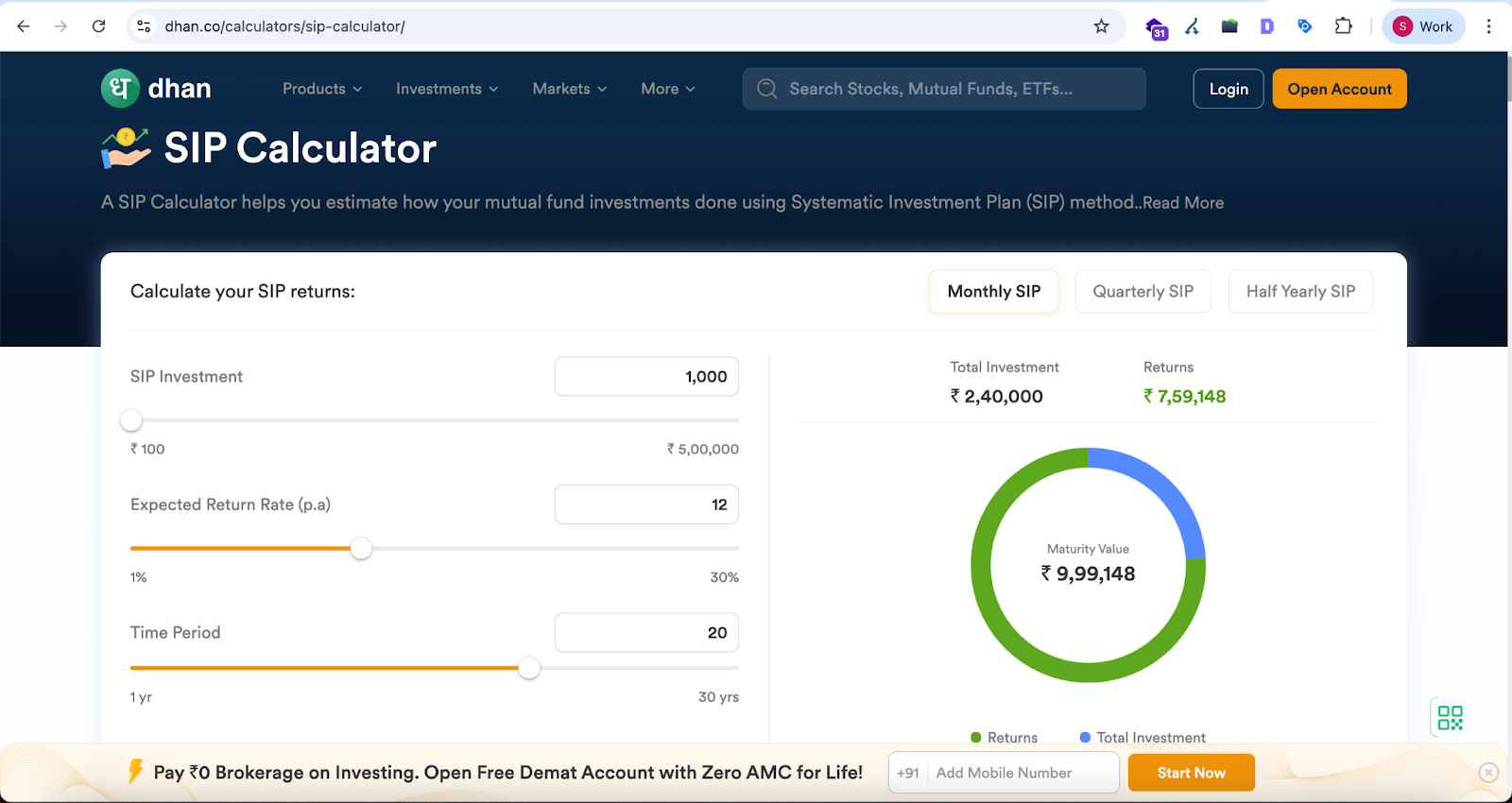
When your wealth compounds, the initial returns start earning their own returns. For instance, if you start investing just INR 1,000 a month while expecting a modest return of 12% annually, it creates a corpus of almost INR 10 lakhs in 20 years. You can use the online SIP Calculator to calculate the maturity value according to your monthly investment.
The growth is slow at first. But once you wait the initial 4-5 years, you’ll watch the compounding become exponential.
Time is the real wealth multiplier
The longer you stay invested, the higher your returns are. Even if you make a small investment consistently over long periods, it snowballs much faster compared to larger investments started later. Time does all the heavy lifting. Your job is just to remain consistent with your investments.
Why early investors have a big advantage
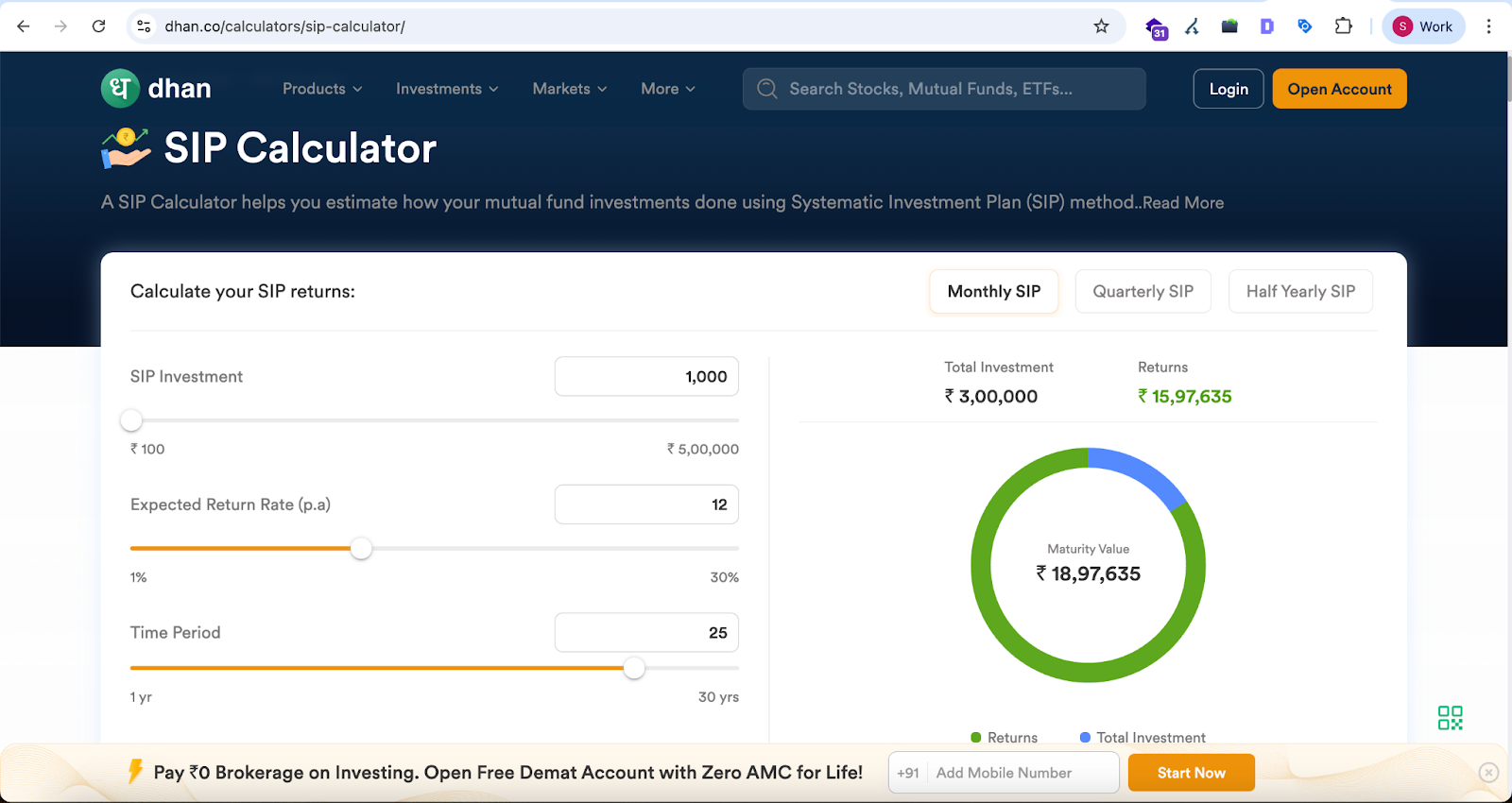
Even if you start early by a few years, the difference can be enormous. For instance, let’s go back to our previous example. Suppose you had started investing INR 1,000 a month five years earlier. At the end of 25 years, your corpus would be around INR 19 lakh. This is almost double what you would accumulate in 20 years. Thus, a difference of just 5 years can make a significant difference in compounding.
That’s why young investors feel motivated to start SIPs early. It pays to make your initial years in the profession count.
Rupee-cost averaging manages risk
Timing the market has little to do with when you invest for the longer horizon. Ever wondered why?
When markets dip, your SIP buys a higher number of units. On the contrary, it buys fewer when markets rise. This is an automatic adjustment, known as rupee-cost averaging. Naturally, your average purchase cost comes down over time. So, you shouldn’t be bothered by volatility. Instead, long-term investors benefit from periodic volatile markets.
Protecting investors from market timing
As an investor, you’ll acknowledge that timing the market turns out to be stressful and often unsuccessful. With SIPs, you’re completely relieved from this burden. Regardless of market conditions, you continue to invest. There’s no concept of ‘too early’ or ‘too late’. This psychological relief makes investing an advantage.
Rupee-cost averaging works brilliantly for long-term equity investors
When you look at fluctuating trends in the short term, the market looks scary. However, volatile markets are something SIP investors take advantage of. On every dip, you get an opportunity to accumulate more units at lower prices. Over the long horizon, this strategy builds a strong base to build steady wealth.
How to choose the right sip for your goals
Most investors willing to capitalise on the power of SIP face a dilemma over the choice of funds. We have simplified this decision-making process from a practical standpoint.
Equity funds for long-term growth
If you’re investing for the long term, you can opt for equity mutual funds. Large-cap, flexi-cap, or index funds are some of the most preferred options for long-term investing. These funds offer a decent growth potential and allow you to capture the market appreciation over many years. So, if your goal is 7-10 years away or more, create an SIP in an equity fund.
Debt funds for stability
Since debt funds offer predictable returns, they are preferred for stability. These funds are suitable for investors with short-term goals. Also, if you’re more conservative and don’t prefer risking your money in volatile markets, debt funds should be the perfect choice. The power of SIP in a debt fund is all about building a low-risk portion in your portfolio.
Hybrid funds for balanced growth
Hybrid funds combine portions of both the equity and debt segments. These funds offer a balanced approach to wealth building, and the process involves moderate risk. First-time investors, or those would prefer steady growth over aggressiveness, hybrid funds are the right avenue.
These funds also help you diversify your base. If you have medium-term goals or aren’t sure where to begin, hybrid fund SIPs offer a decent entry.
The smart way to build wealth faster: Step-up SIP
A step-up SIP allows you to increase your monthly investment automatically every year. Usually, professionals invest in these schemes considering future salary hikes. This approach allows you to increase your investments in proportion to your growth in income.
How a step-up sip boosts final corpus significantly
Let’s understand how a step-up SIP can boost your financial corpus.
In our second example, you had observed that staying invested in an SIP of INR 1,000 a month over 25 years at a 12% annual return could help you build a corpus of approximately INR 19 lakhs.
Now, let’s assume that you invested in the same scheme, but keep increasing your investment by 10% each year.
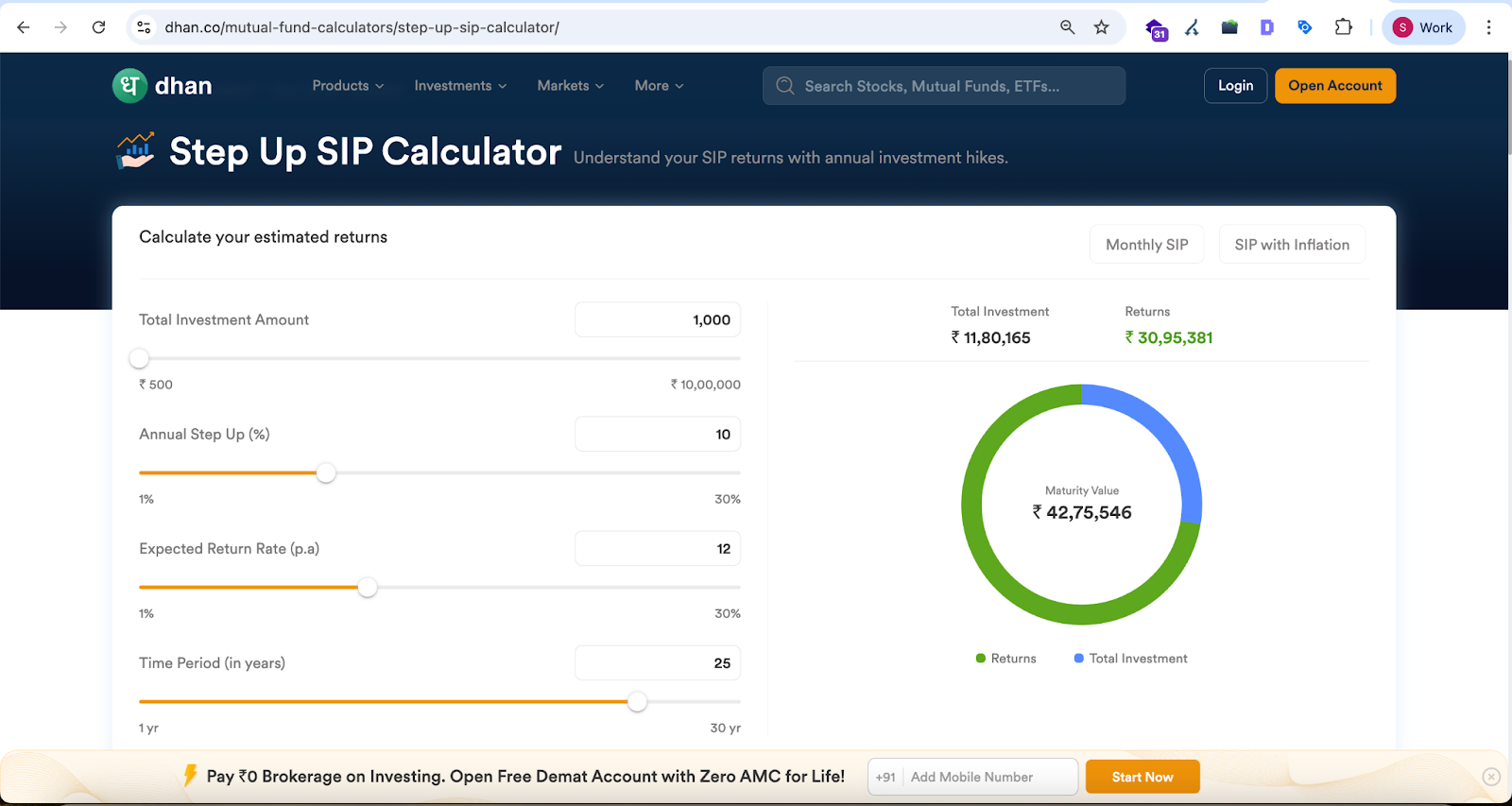
As evident from the calculation, your overall portfolio grows to almost 4X, with an estimated corpus of around INR 42.75 lakhs at the end of the 25th year. The growth is exponential. The combination of rising contributions and compounding turns your long-term corpus into something significantly larger.
When step-up SIP is most useful
Investors who are at the early phases of their careers and expect promotions must invest in step-up SIPs. When you start small and keep growing your contributions steadily, you can maximize the power of SIP.
Common mistakes investors make with SIPs
While SIPs are substantial wealth creators, investors often end up committing costly mistakes that deprive them of the projected growth potential.
Stopping the SIP during market corrections
Collapsing markets or long-term bear runs may seem scary for investors. Many investors feel disappointed and pause their SIPs. However, corrections actually offer better opportunities to accumulate your mutual fund units cheaply. Instead of fearing short-term losses and stopping SIPs, investors should continue the contributions. Stopping SIPs here reduces long-term gains and disrupts compounding.
Expecting quick returns
The power of SIP lies in steady growth. These mutual fund schemes are not meant for quick wins like intraday trading. So, you need to put in years of patience to grow. Investors expecting instant results often end up with premature withdrawals.
Not reviewing long-term goals periodically
When you think about wealth building from a practical standpoint, factor in lifestyle changes and evolving goals. Your income grows over the years, too. So, it’s crucial to review your SIP portfolio annually. This approach ensures that your investments remain aligned with your current needs and risk appetite.
Should you invest in SIPs or a lump sum?
As you try to benefit from the power of SIP, a combination of monthly contributions and a lump sum investment works the best. SIPs are ideal for volatile markets. They help you average your cost. These schemes are ideal for salaried investors contributing every month.
However, there’s another way to invest in mutual funds, where you put in a large sum when you receive a bonus or windfall. Particularly, lump sum investments can fetch you decent returns in bull markets.
Experienced investors combine both SIPs and lumpsum investments to make the most of strategic opportunities.
How to start an SIP on Dhan?
Dhan makes it easy for beginners to start investing in SIPs. You can even start investing with a nominal amount like INR 100 a month in some mutual funds.
The platform allows you to track your SIPs early and monitor their performance. You can make adjustments whenever needed.
Also, Dhan presents investors with the best performing funds under different categories to choose from, depending on their respective goals.
Summing it Up
SIPs are the ideal investment avenue for people of all age groups, where they can start small and achieve significant financial freedom. These schemes have proven that wealth creation doesn’t require big money. You just need to remain consistent and disciplined. When you invest every month and capitalize on the power of SIP, compounding does the magic. Start small, stay steady, and let time do the heavy lifting.
FAQs
How much should I start my SIP with?
You can start investing in SIPs with any amount. While some funds allow you to contribute a minimum amount of INR 100, it varies from fund to fund. However, you can invest a minimum of INR 1,000 in most funds.
Can I pause or change my SIP amount later?
Yes. This flexibility defines the ease of investing in SIPs. You can pause, modify, or increase your amount anytime, considering your financial situation.
Is SIP only for equity mutual funds?
No. SIPs can be created across different categories like equity, debt, hybrid, index funds, and other categories.
How long should I continue a SIP?
Ideally, you must continue investing in SIPs as long as possible. The longer your tenure, the higher the benefit of compounding is.
Can SIPs help me beat inflation?
Yes. Particularly, equity SIPs can help you beat inflation. Over long durations, these mutual funds often outpace inflation and help you build substantial wealth.