


What is a Money Market Fund?






It might be surplus salary or just business income waiting to be deployed. Many investors also park their funds temporarily before entering equities. In these situations, you look for safety and liquidity, while the excess funds give you reasonable returns.
While traditional savings accounts offer liquidity, returns are limited. Again, fixed deposits are stable, but they lack flexibility. That’s where you must know about money market funds.
In this blog, we have comprehensively discussed money market funds and how it works. Read on to understand its features, benefits, and risks. We have also discussed how you can effectively integrate it into your portfolio.
Understanding money market fund
A money market fund is a type of debt mutual fund that invests in short-term money market instruments. Typically, these funds invest in instruments that come with maturity periods of up to one year.
While understanding what is a money market fund, investors must know that they are meant particularly to manage cash on a short-term basis. The goal of these funds is to preserve your capital while offering better return potential compared to banks. Money market funds are highly liquid and carry relatively low risk. They mostly invest in high-quality, short-term debt instruments where the returns are stable and predictable.
Money market funds are different from equity funds as the latter invest in company shares. These funds invest in short-term borrowing instruments issued by:
- Governments
- Banks
- Corporations
These funds carry a lower risk level compared to longer-duration debt or equity funds. Therefore, if you are looking for a place to park funds safely for a short duration but want higher returns than a savings account, you may consider money market funds.
How does a money market fund work?
It’s essential to understand how the money market funds operate.
Pooling of money from investors
Firstly, money market funds pool money from investors. A professional fund manager is entrusted to manage this pooled corpus. The fund manager is responsible for:
- Selecting high-quality short-term instruments
- Maintaining liquidity
- Managing credit risk
- Optimising short-term returns
These funds deal with short-duration instruments. The focus lies on stability instead of chasing yield aggressively.
Duration and maturity
Usually, money market funds invest in instruments having short maturities, usually under one year. This short duration:
- Reduces the risk of changing interest rates
- Limits volatility in price
- Enhances liquidity
As the instruments mature quickly, the fund can reinvest frequently in new short-term securities at the prevailing interest rates. The instruments in which a money market fund invests generate interest.
Investment instruments used in money market funds
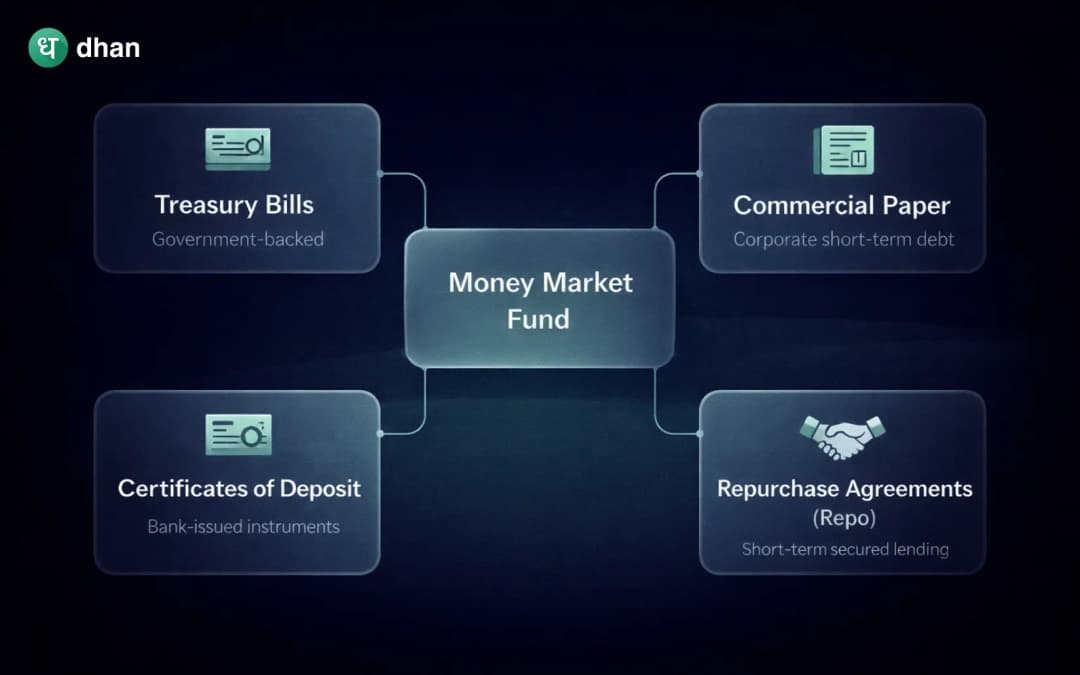
Money market funds invest in a wide range of short-term instruments. Each instrument has a specific role to play as it maintains safety and liquidity.
Treasury Bills
Treasury bills are short-term debt instruments that the government issues from time to time. These bills usually come with maturity periods of 91, 182, or 364 days. Treasury bills are considered among the safest instruments as they are backed by the government. While the returns are lower, they are highly secure.
Commercial Papers
Commercial papers are unsecured short-term debt instruments. They are issued by corporations to meet their working capital requirements. The yields generated by CPs are slightly higher compared to government securities. However, they carry marginally higher credit risk. This depends on the strength of the company issuing it.
Certificates of Deposit
CDs are short-term instruments that financial institutions and banks issue with fixed returns. They are considered relatively safe, particularly when the institution is well-rated.
Call or Notice Money
Call money is a very short-term fund that financial institutions borrow and lend between themselves, often for one day. If it is lent for 14 days, it’s known as notice money. These instruments help to enhance liquidity within the portfolio.
Short-term Government Securities
Apart from Treasury Bills, funds may also invest in other government securities with short-duration. These securities provide stability while reducing the overall risk of your portfolio.
Key features of money market funds
Now that you know what is money market fund, let’s take a look at its key features.
High liquidity
Investors can redeem their units easily from money market funds. It takes a short time for the proceeds to be credited. This makes them suitable for emergency or short-term requirements.
Low volatility
In money market funds, price fluctuations are limited due to the high quality of credit and short maturity instruments.
Short investment horizon
Investors must note that money market funds are not meant for creating long-term wealth. The goal is to park surplus funds for a short duration.
No lock-in period
Most money market funds do not have a mandatory lock-in period. This provides flexibility to investors.
Moderate but stable returns
In money market funds, the returns are generally higher compared to savings accounts, but lower than equity funds. Aggressive growth isn’t the objective here, as investors prioritise stability.
Benefits of investing in money market funds
Have a look at the prime benefits of investing in money market funds.
Capital preservation
The primary objective of money market funds is to protect your principal amount. It invests in high-quality short-term instruments to prevent your capital from being eroded.
Efficient cash management
Investors can earn potentially better returns from money market funds compared to savings accounts.
Stable portfolio
Money market funds can help you stabilise diversified portfolios, particularly when equity markets are volatile.
Liquidity for tactical allocation
As an investor, you can park your funds in a money market scheme before deploying them into equities or any other long-term instrument.
Sensitivity to lower interest rate
As the duration of these funds is short, changing interest rates has a limited impact on your portfolio compared to long-duration debt funds.
Risks associated with money market funds
Money market funds may involve low volatility, but investors must be aware of the risks associated with these funds.
Credit risk
In case a corporate issuer defaults, it may affect the value of the fund. However, fund managers usually choose high-rated instruments to minimise this risk.
Interest rate risk
Sudden changes in interest rates can influence the returns, although the impact is limited.
Liquidity risk in extreme conditions
When financial environments are stressed, money market funds may witness temporary tightening of their liquidity.
Lower return potential
The return potential of money market funds is modest compared to equity or even long-duration debt funds.
Money market funds vs other debt funds
Let’s check out how other debt funds compare against money market funds.
Who should invest in money market funds?
Money market funds are suitable for:
- Conservative investors
- Those parking funds for short-term goals
- Investors waiting for better entry points in equity markets
- Businesses managing working capital
- Individuals building an emergency fund
They may not suit investors seeking high growth over long durations.
How to choose the right money market fund
Here’s how investors must evaluate money market funds before choosing the right one.
Credit quality of portfolio
Have a look at the rating profile of instruments. Portfolios with higher ratings indicate stronger safety.
Expense ratio
Look for money market funds with lower expense ratios. This will help in improving your net returns. For better clarity, you can compare 2 or more mutual funds for better clarity.
Portfolio composition
Inspect the underlying allocation of the fund across T-Bills, CPs, CDs, and government securities.
Historical stability
Consistency matters more than peak returns. Make sure to evaluate the historical stability of these funds.
Reputation of the fund house
It’s advisable to choose a money market scheme from an established fund house with strong risk management practices.
Conclusion
Investors must understand what is money market funds are to make informed decisions while allocating their cash for the short term. With the right fund, you can preserve your capital while capturing better returns than a typical savings account. As these funds are highly liquid, you can access them any time you need.
If you are looking to balance liquidity with better yield potential, consider exploring money market funds. Within a diversified portfolio, these schemes play a practical and strategic role.
FAQs
Are money market funds safe?
Money market funds carry relatively low risk compared to equity funds. However, they are not completely free from risk as the returns depend on market instruments.
Can I lose money in a money market fund?
Losses are rare but possible in extreme credit or liquidity events.
How are returns generated in money market funds?
The returns in money market funds come from the interest earned on short-term debt instruments like Treasury Bills, CPs, and CDs.
Is a money market fund better than a savings account?
In terms of returns, a money market fund may appear better than a savings account. However, as the returns are linked to the market, they are not guaranteed.
Can I use money market funds for emergency savings?
Yes. Due to the relatively low risk and high liquidity, money market funds can be used to allocate your emergency fund.