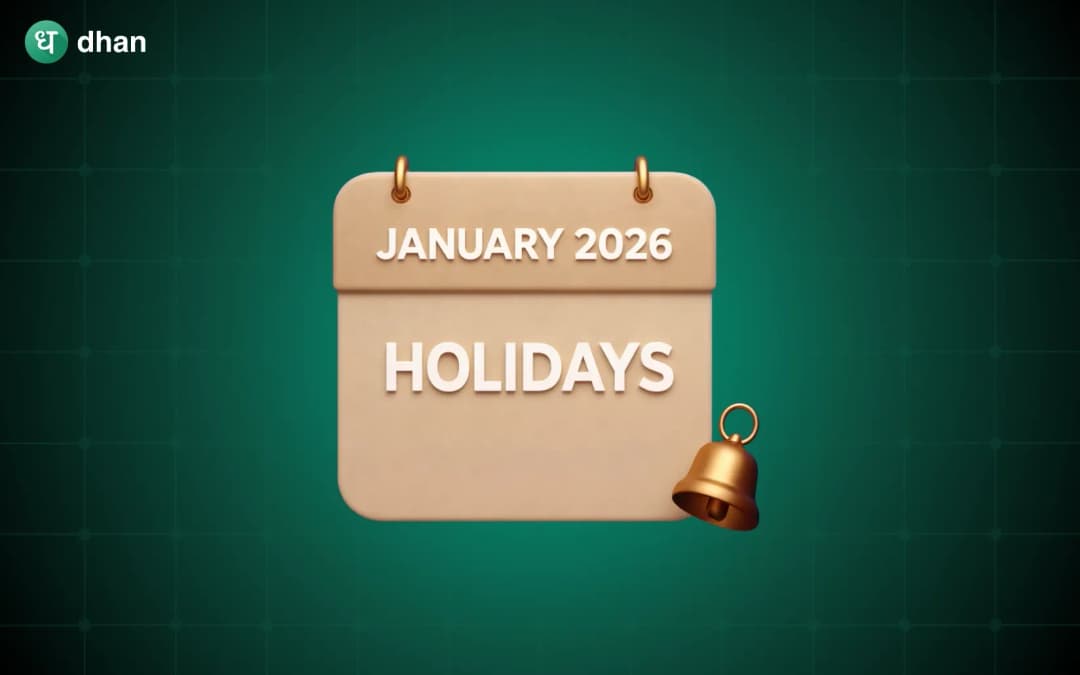
Stock Market Holidays in January 2026








Stock market holidays are significant in determining market activity, the timing of settlements, and funds within the financial system. A closure of stock markets or banks for a month can impact investors, traders, and all the other stakeholders.
Hence, it is useful to know the exact calendar of the holidays in advance to avoid unnecessary disruptions. Here is an in-depth overview of stock market holidays and bank holidays in January 2026, and how they affect market participants and what they should keep in mind.
Stock market holidays in January 2026
List of holidays for NSE, BSE and MCX are mentioned below:
NSE & BSE holidays in Jan 2026
In January 2026, the National Stock Exchange (NSE) and the Bombay Stock Exchange (BSE) will be closed on Monday, the 26th of January 2026, which marks the 77th Republic Day of India. There will be no trading in the derivative and equity segments on this particular day.
MCX holidays in Jan 2026
In the commodities market, there will be two trading holidays for MCX (Multi-Commodity Exchange) and NCDEX (National Commodity & Derivatives Exchange).
On January 1, 2026, the exchange will remain open for the morning trading sessions, but will be closed for the evening trading sessions. On January 26, 2026, the exchange will be closed for the morning and evening trading sessions.
As Republic Day falls on Monday, all participants in the market can look forward to having a long weekend from Saturday, January 24, 2026, to Monday, January 26, 2026. This is an ideal time to hold any portfolio reviews or plan long trades before closing over the weekend.
Bank holidays in January 2026
Apart from stock market holidays, several regional holidays would be observed by banks across India, apart from the usual second and fourth Saturdays, and Sundays off. These holidays can have a major impact on fund transfer for margin payments, processing SIP, IPO mandates, and equity settlement.
Bank holidays in January 2026 in different states and Union Territories of India are mentioned below:
Impact of bank holidays on stock market activity
While stock exchanges may be open during some of these bank holidays (except Republic Day), bank closures can pose practical challenges to investors:
- Delayed Fund Transfers: Services such as NEFT and RTGS may not be available in affected states during bank holidays. While IMPS operates 24 hours a day, it can take longer to process the transaction due to internal bank procedures.
- Margin Requirements: If you need to add funds to settle margin calls on open F&O positions, bank transfer delays could increase margin shortfalls and can lead to auto-square-offs.
- Mutual Fund Orders: The processing and settlement in mutual funds for purchase, redemption, and SIP debits are directly related to the bank's working days. Orders placed on a bank holiday will be processed on the following business day, which may affect the Net Asset Value (NAV) allotment.
- IPO and NFO Mandates: UPI authorisations and refunds for Initial Public Offerings (IPOs) or New Fund Offerings (NFOs) can be delayed on bank holidays.
What should investors do?
To avoid disruptions during the 2026 January holidays, investors need to plan systematically, such as:
1. Pre-fund accounts
Make sure you have enough balance in trading and demat account at least a day before holidays to avoid margin shortfall or to miss buying opportunities. This is especially important before the long weekend of the Republic Day to ensure smooth operations.
2. Plan around regional festivals
If your bank is in Tamil Nadu, West Bengal, or other places that have more than one bank holiday in January, then transfer money well in advance. Don't rely on same-day transfers in mid-January.
3. Avoid last-minute mutual fund orders
NAV cut-off timings shift to the next working day during bank holidays. Schedule SIP/lump-sum transactions at least 2-3 days before major holidays.
4. Complete IPO applications earlier
With several new IPOs expected to open in January, don't wait until the last day of subscription. UPI authorisations during the holiday seasons can be delayed, and this can lead to missed applications.
5. Monitor broker notifications
Brokers often publish holiday schedules, as well as settlement advisories, in advance. These notifications are useful to investors to reschedule the trades and to manage the position effectively, and to set an alert for these notifications.
6. Use UPI for smaller transfers
Even when banks are not open, UPI payments can be used for smaller transactions, which helps maintain liquidity for retail traders and investors. However, check transaction limits during holiday seasons.
7. Review T+1 settlement impact
As the equity markets of India follow T+1 settlement, any holiday that happens during the settlement cycle may delay the payout dates.
Final thoughts
The Republic Day long weekend (January 24-26) represents an opportunity for market participants to plan strategically. With the right planning in advance and awareness of the holiday schedule, market participants can ensure that operations run smoothly throughout the entire month.