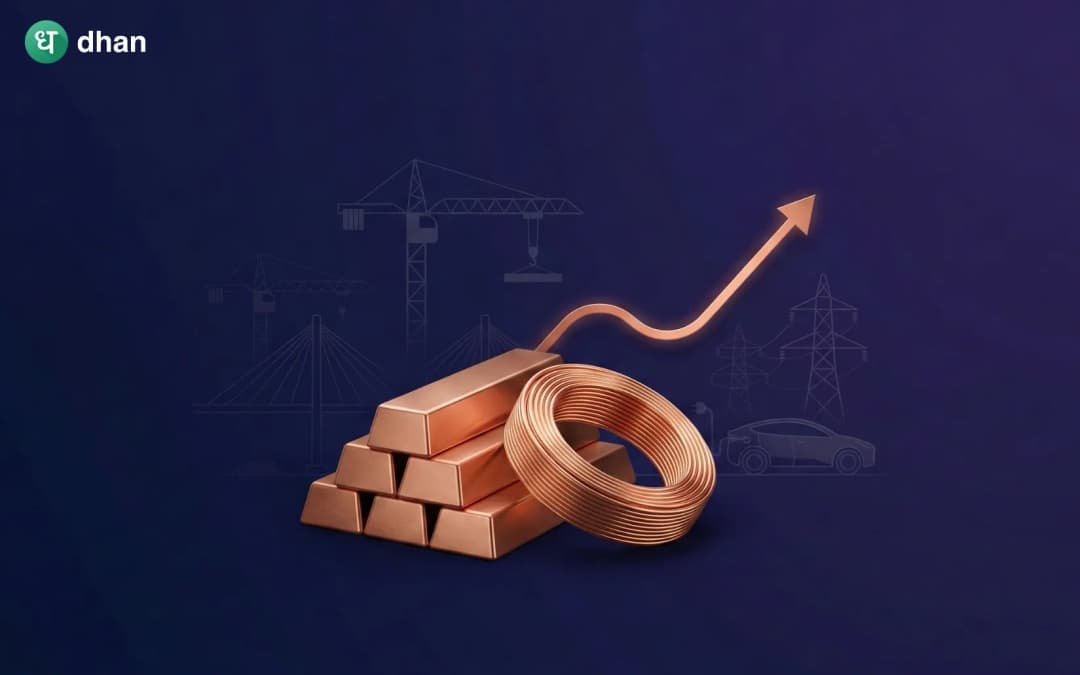
During the past few months, copper prices have increased rapidly and have drawn immense attention from Indian investors, manufacturers, and policymakers. Copper prices at major international exchanges, such as the London Metal Exchange, have soared to record highs of $12,960 per tonne after many years, and on the Indian Multi-Commodity Exchange, MCX copper has touched a record intraday high of Rs 1,306.05 per kg in late December and is up by more than 50% in 2025, emerging as one of the best-performing years in history since 2009.Let's discuss in detail what's driving this sustained increase in the price of copper in India.Strong domestic demand for infrastructure growthCopper consumption in India is directly related to economic activity, particularly in industries such as construction, power distribution, and manufacturing. Recent industry insight reports that copper demand in FY25 increased 9.3% to about 1,878 kilotonnes from 1,718 KT in FY24, fueled by surging infrastructure projects and a rise in the consumption of electrical goods.Also, the copper requirement is relatively high in infrastructure manufacturing products like wiring, cables, transformers, and electric grids, among others. Besides that, the thrust provided by the government initiatives, like the National Infrastructure Pipeline and rural electrification, directly boosts higher copper demand in the country. This resilient demand has kept copper consumption strong in India, leading to its high copper prices.👉 Copper Options Summary👉 Copper Option Chain👉 Copper Futures SummaryClean energy transition and electrificationBesides conventional industry use, the consumption of copper metal also finds its fit in the emerging sectors of renewable energy and electric vehicles. Solar and wind power plants use considerable quantities of copper in wiring, inverter systems, and in interconnecting various elements to the grid. Similarly, EVs consume three to four times more copper than traditional internal combustion vehicles.All this has been further fueled by the ambitious renewable goals of India and the incentive for the adoption of EVs. After the implementation of the electric mobility policies along with the development of charging infrastructure, this demand for copper is likely to further increase.Supply constraintsThe demand for copper keeps increasing, while the copper supply has hardly kept pace with its rising demand. Low ore grades, labour problems, and toughening environmental regulations in countries like Chile and Peru have led to various production stops that have ultimately hampered the production of copper mining.This reduced supply has driven down inventories and made copper metal relatively less abundant, thus driving up the prices. It is also indicated that the shortage of refined copper will persist through 2026, further fueling the rise of copper prices.Influence of global market trendsCopper is a globally traded commodity, and its price quotation is in U.S. dollars. Hence, every fluctuation in the dollar and global demand influences the copper prices seen in India. In the last few years, increasing usage of metals in the industrial process has enhanced investors' confidence, which has increased the copper price.Global growth expectations, combined with policy easing in several major economies, have also encouraged speculative investment flows into base metals and boosted copper prices. As of 2nd Jan '26, Hindustan Copper stock has given a returns of 60% in the past 1 month.Import dependence and trade dynamicsIndia still relies heavily on imports of refined copper and concentrates. India has limited domestic mining production; as a result, this makes India dependent on imports to satisfy its domestic copper demand.This reliance on imports means that a rise in copper prices internationally will have an immediate effect on the domestic copper price. Higher global benchmarks mean higher MCX prices and higher costs of raw materials to copper-intensive industries.The bottom lineCopper prices are rising due to a combination of high domestic demand, limited supply, structural expansions in clean energy and electrification, and broader macroeconomic trends. In India, with its recent accelerating industrial growth and infrastructure investment, this rally in copper prices is both an opportunity and a challenge for market participants.As global and domestic demand for copper is likely to remain strong in 2026, copper will be a commodity to watch as one of the major economic and investment trends in 2026.