What is an Overnight Fund?








If you’ve ever wondered where to keep your money safely for just a few days, an overnight fund might be the answer. But what is an overnight fund exactly, and how does it work?
This fund buys financial instruments that mature the very next business day. Because of this ultra-short maturity, overnight funds are considered among the lowest-risk mutual fund options.
Let’s break it down in simple terms.
Understanding overnight fund
The overnight fund is a type of debt mutual fund that concentrates on investing only in overnight securities. Such are financial instruments, such as:
- Overnight reverse repos
- Tri-party repo (TREPS)
- Other debt instruments with one-day maturity
The fund manager puts money in securities that mature the next day every day. When it matures, they are reinvested in new overnight instruments once again.
The fund has extremely low interest rate and credit risk due to this one day cycle of the fund.
How does an overnight fund work?
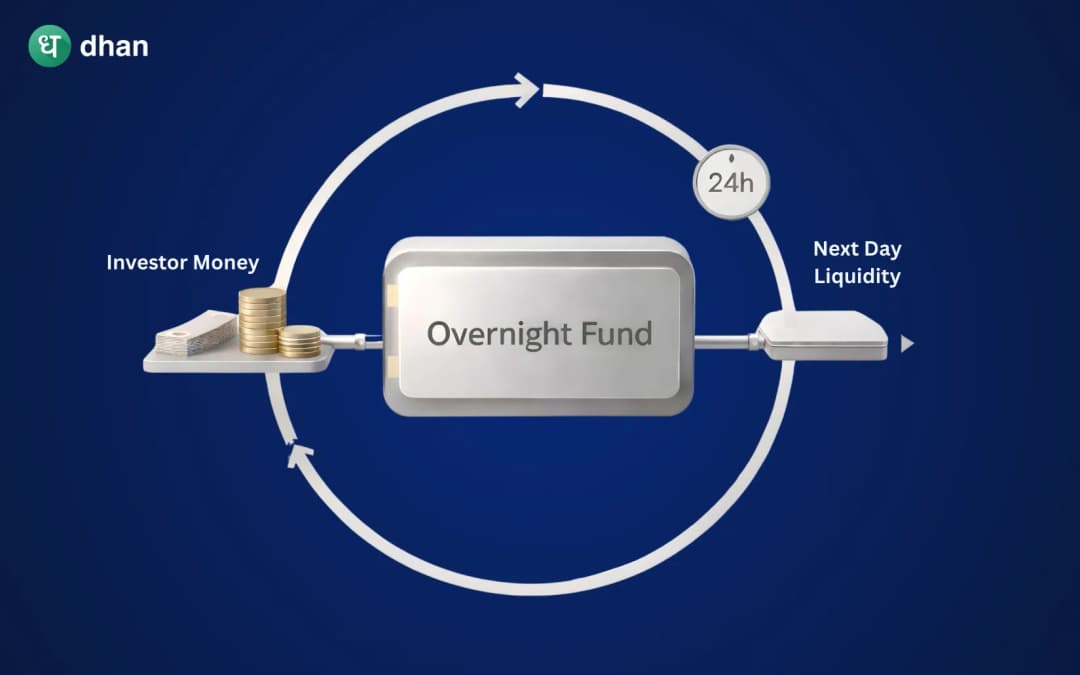
Now that you know what an overnight fund is, here’s how the process typically works:
- The fund collects money from investors.
- The fund manager invests this money in overnight debt instruments.
- These instruments mature the next day.
- The returns earned are added to the fund’s Net Asset Value (NAV).
- The cycle repeats daily.
The portfolio is reset on a daily basis as the securities have a maturity date. This goes a long way in reducing the effect of:
- Interest rate fluctuations
- Long-term market volatility
- Credit downgrade risks
This renders the overnight funds very predictable in comparison to the debt funds with longer periods.
Key features of overnight funds
Below are the key features that make overnight funds a reliable and low-risk option for very short-term investments.
Ultra-short maturity
Every investment matures after one day. Long-term bond exposure is zero. This daily reset causes a great deal of uncertainty to be eliminated in the portfolio. It makes sure that they do not commit funds in longer-term instruments that can change in value.
Low interest rate risk
Because the maturity is just one day, changes in interest rates have a minimal impact on returns. The NAV of the fund is not significantly impacted by sharp movements in the overall market rates. This renders overnight funds as one of the steadiest funds under the debt mutual fund.
High liquidity
Investors can usually redeem money quickly. Most overnight funds allow T+1 settlement, meaning the money is credited on the next working day. This renders them very convenient when using in case of an emergency or temporary cash requirements.
Low volatility
NAV fluctuations are minimal compared to other debt or equity mutual funds.The value of a fund usually moves in a predictable and consistent direction. This stability renders it appropriate for a conservative investor who wants low market movement.
Suitable for short-term parking
Ideal for parking surplus funds for a few days to a few weeks. It assists the investors to achieve low returns rather than keeping the money lying in a savings account. This makes the overnight funds a viable option as one awaits to invest money in long term investments.
Benefits of investing in overnight funds
Here are the main advantages that make overnight funds a practical choice for safely parking short-term surplus money.
Capital safety
Overnight funds are said to be one of the safest types of mutual funds. Due to the fact that investments are being matured on a daily basis, the risks of default are very minimal.
Better than idle cash
Instead of keeping money idle in a savings account, investors can earn slightly better returns without taking significant risk.
No lock-in period
No lock-in period is usually provided, making it flexible to withdraw where there is the need.
Low expense ratio
Many overnight funds have relatively low expense ratios compared to actively managed debt funds.
Ideal for emergency buffer
Overnight funds can be used as a short-term parking place should you need easy access to funds, and at the same time, the funds are earning low returns.
Risks involved in overnight funds
Even though overnight funds are low risk, they are not completely risk-free.
Interest rate risk (minimal):
Though very limited, sudden interest rate changes can cause small NAV movements.
Credit risk (very low):
If the counterparty defaults, there could be an impact. However, since investments are extremely short-term and generally high-quality, this risk is very low.
Lower returns:
Returns are modest. If you are looking for high growth, overnight funds are not suitable.
Final thoughts
So, what is overnight fund in simple words? It’s a debt mutual fund that invests in one-day securities to offer ultra-low risk and high liquidity.
If you need a safe place to park money for a very short duration, overnight funds can be a practical option. They offer stability, quick access to funds, and minimal volatility.
However, if your goal is long-term growth or inflation-beating returns, you may need to explore other investment options. Overnight funds are about safety, not high returns.
FAQs on Overnight Fund
1. Is an overnight fund safe for investment?
Yes, overnight funds are considered one of the safest mutual fund categories. Since they invest in one-day securities, both interest rate risk and credit risk are very low.
2. How long should I invest in an overnight fund?
Overnight funds are best suited for a few days to a few weeks. They are ideal when you want to keep money safe temporarily before using or investing it elsewhere.
3. Can I withdraw money anytime from an overnight fund?
Yes, most overnight funds do not have a lock-in period. You can redeem your investment anytime, and the amount is usually credited on the next working day (T+1 basis).
4. Do overnight funds give guaranteed returns?
No, returns are not guaranteed. They are usually stable and consistent with the short-term money market rates and fluctuate minimally.
5. What is the difference between an overnight fund and a savings account?
Overnight funds can be slightly higher in returns than savings accounts. The change in the level of the NAV of the fund is minimal compared to savings accounts, yet the risk is very low.