



Calendar Spread Trading: How it works, benefits & risks







Key takeaways
- A calendar spread is an options strategy which involves buying and selling options with the same strike price but different expiry dates. The trader usually buys the option with the later expiry and sells the option with the nearer expiry.
- Calendar spreads are mainly used when a trader expects the underlying asset to remain relatively close to a chosen strike in the near term, while expecting the longer-dated option to retain more value.
- The strategy can benefit from differences in time decay and implied volatility, but it is sensitive to changes in volatility, the underlying price and the timing of the trade.
Options strategies do not always have to be about simply betting that a stock or index will rise or fall. Sometimes, the more important question is when the price movement is likely to happen.
A calendar spread is built around this idea.
Instead of buying and selling options with the same expiry, a trader uses two options with different expiration dates. The strike price is generally the same, while the expiry dates differ. The trader typically sells the nearer-term option and buys the farther-term option.
For example, if a stock is trading at ₹1,000. A trader could buy a call of ₹1,000 with expiry next week and sell a call of ₹1,000 with expiry next month. Both options have the same strike, but different expiration dates.
The strategy is not simply a directional bet. The trader is also taking a view on time decay and implied volatility.
What is a Calendar Spread?
A calendar spread, involves two options on the same underlying asset with:
- The same strike price
- The same option type
- Different expiry dates
In the most common structure, the trader:
Buys the longer-dated option + Sells the shorter-dated option
The two legs can be calls or puts.
For example:
- Buy 25,000 Nifty call expiring in 30 days
- Sell 25,000 Nifty call expiring in 7 days
The strike remains the same, but the expiration dates are different.
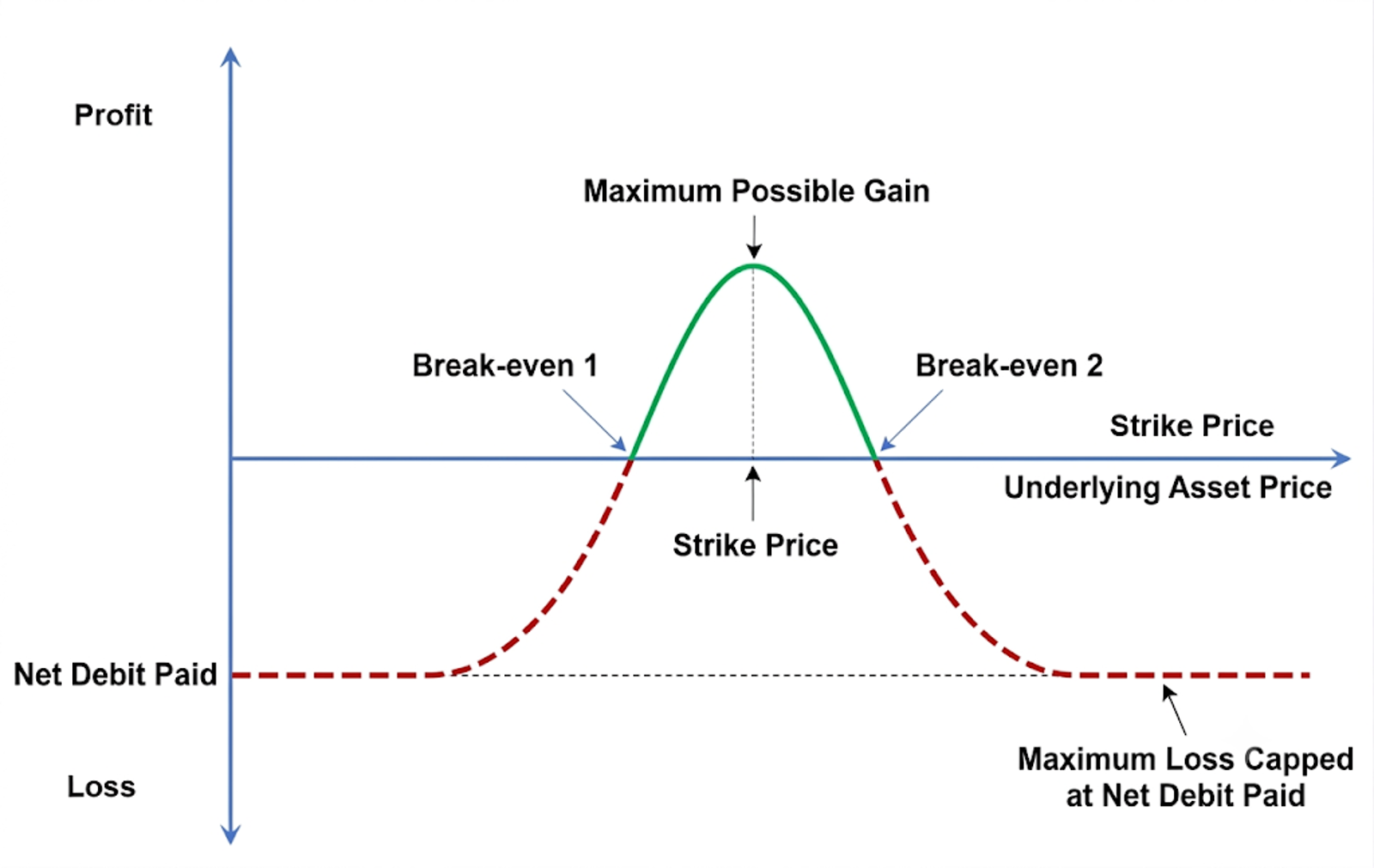
Because the trader is buying one option and selling another, the strategy is generally established for a net debit. This means the trader pays an upfront amount to enter the position.
How does a Calendar Spread work?
The easiest way to understand the strategy is to look at what happens to the two options as the nearer expiry approaches.
Suppose an index is trading at 25,000. A trader expects the index to remain close to 25,000 over the next week but does not have a strong view about its direction over the following month.
The trader may follow the steps below in order to execute the calendar spread strategy:
- Buy 25,000 CE with 30 days to expiry at ₹180
- Sell 25,000 CE with 7 days to expiry at ₹80
The net debit is:
₹180 − ₹80 = ₹100
Assuming the lot size is 50, the initial cost would be:
₹100 × 50 = ₹5,000
This is a simplified example that ignores brokerage, taxes and other charges.
Now imagine the index remains close to 25,000 as the short-dated option approaches expiry.
The short call has very little time remaining. If it expires around the strike, its value may decline significantly because of time decay.
The longer-dated call still has considerable time remaining. It may retain more value because it has more time for the underlying to make a potentially favourable move.
Why does time decay matter?
Time decay, also called theta decay, refers to the reduction in an option's time value as its expiry approaches.
All else being equal, an option with less time remaining generally has less time value than an otherwise comparable option with more time remaining.
However, the rate of time decay is not identical throughout an option's life.
The short-dated option in a calendar spread generally experiences faster time decay as it approaches expiry. The longer-dated option also loses time value, but it has more time remaining.
This creates the opportunity for the trader to benefit from the difference between the two options.
Numerical example
Consider a stock trading at ₹500. A trader expects the stock to stay close to ₹500 over the next two weeks.
The trader decides to use a call calendar spread, hence they buy ₹500 call expiring after 45 days at ₹35 and sell ₹500 call expiring after 15 days at ₹15.
Net premium paid:
₹35 − ₹15 = ₹20 per share
If the lot contains 100 shares, the initial debit is:
₹20 × 100 = ₹2,000
Now suppose the stock remains around ₹500 as the 15-day option approaches expiry. The short call may lose much of its time value. If it expires at the strike, its intrinsic value is zero.
Meanwhile, the longer-dated call still has 30 days remaining. Its market value will depend on the stock price, implied volatility and remaining time.
But this outcome is not guaranteed. If the stock moves sharply away from ₹500 before the short option expires, the spread can behave differently.
Types of Calendar Spread
There are two types of calendar spreads as discussed below:
Call calendar spread
A call calendar spread uses two call options with the same strike and different expiries.
The trader generally buys the longer-dated call and sells the shorter-dated call.
This structure is considered when the trader expects the underlying to remain near the chosen strike in the short term while retaining longer-term upside exposure through the farther-dated call.
Put calendar spread
A put calendar spread uses two put options with the same strike and different expiries.
The trader generally buys the longer-dated put and sells the shorter-dated put.
Its structure is similar to a call calendar spread, but the payoff characteristics can differ because the options are puts.
The choice between calls and puts depends on the trader's market outlook, implied volatility and the pricing of the available options.
When is a Calendar Spread used?
A calendar spread is generally more suitable when the trader expects limited movement around a particular strike in the near term.
For example, suppose an index is trading at 22,000, and a trader expects it to remain relatively close to that level until the weekly expiry. However, the trader does not necessarily expect the same range to continue over the following month.
A calendar spread around the 22,000 strike could be considered.
The short option benefits from losing time value as its expiry approaches, while the longer-dated option continues to carry time value.
The strategy can therefore be particularly sensitive to where the underlying is trading when the short option approaches expiry.
How implied volatility affects a Calendar Spread
Time decay is only one part of the equation.
Implied volatility (IV) represents the market's expectation of future price movement as reflected in option prices. Changes in IV can affect both options in a calendar spread.
Suppose a trader buys the longer-dated option when its IV is relatively high. If implied volatility falls after buying the option, then longer-dated option may lose value even if the underlying remains near the selected strike.
Conversely, an increase in implied volatility can increase the value of the options, although the impact may not be identical for both expiries.
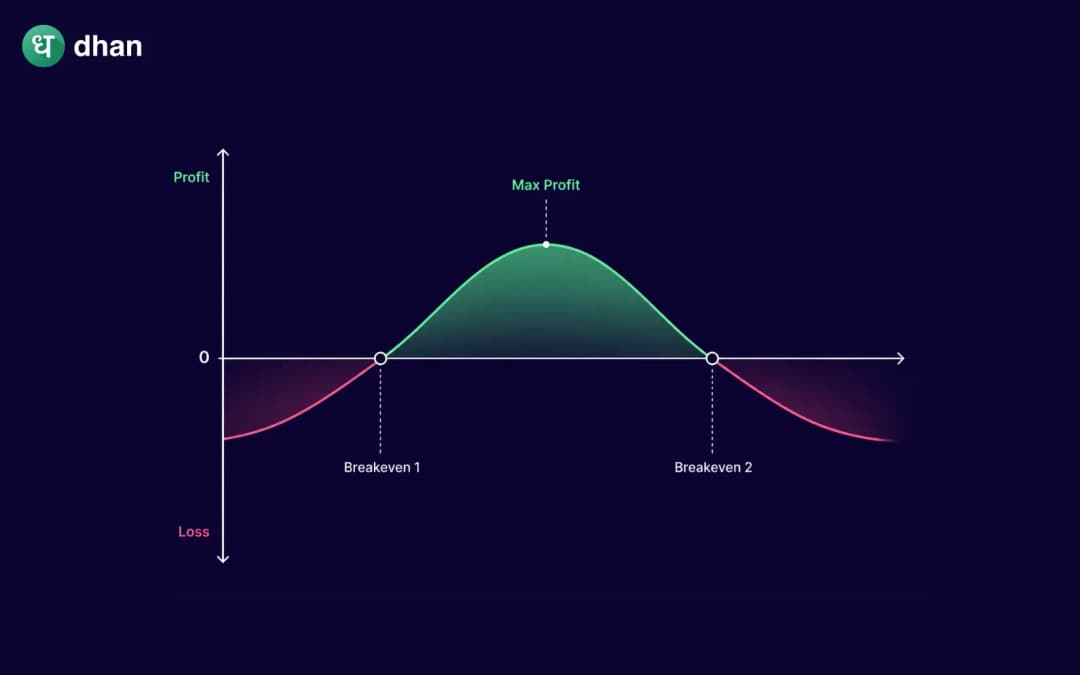
Calendar Spread payoff profile
Unlike a simple long call or long put, a calendar spread does not have a straightforward "market goes up, trade wins" or "market goes down, trade loses" structure.
The payoff of a calendar spread depends on the following factors:
- Underlying price
- Time remaining
- Implied volatility
- Premium paid
- Relationship between the two expiries
The maximum potential profit is often discussed around the selected strike near the short option's expiry, but the exact payoff depends on the option prices and market conditions.
A calendar spread's payoff can also change significantly as the short option approaches expiry.
This makes it important to understand the position dynamically rather than focusing only on the payoff diagram at the time of entry.
Advantages of Calendar Spreads
The advantages of a calendar spread strategy are as follows:
- The strategy can benefit from the faster time decay of the near-term option.
- A trader who expects the underlying to remain near a particular strike over the short term can use the spread instead of simply buying a call or put.
- If the short option expires and the trader closes or manages that leg, the farther-dated option can still retain value and continue to provide exposure to the underlying.
Disadvantages of Calendar Spreads
Along with advantages, the calendar spread strategy has the following disadvantages:
- The strategy can lose value if the underlying moves too far from the chosen strike.
- Changes in implied volatility can work against the trade. If the longer-dated option experiences a significant decline in IV, its value can fall even when the underlying remains near the expected price.
- The position is more complicated than buying a single option. Traders need to monitor two expiries, two premiums and the changing relationship between the options.
- The short option creates an obligation that must be managed. As expiry approaches, the short leg can become sensitive to price movements, particularly if it moves into the money.
Conclusion
A calendar spread is an options strategy that combines a short-dated option and a longer-dated option at the same strike. In this case, the trader sells the near expiry and buys the far expiry, paying a net premium to establish the position.
The strategy is closely linked to time decay, but that is only part of the picture. The underlying price and implied volatility can have a significant impact on the spread's value.
Calendar spreads are generally most relevant when a trader expects the underlying to remain near a chosen strike over the short term. They can offer a structured way to express this view while maintaining a longer-dated option position.
FAQs
What is a calendar spread in options?
A calendar spread is an options strategy where trader deals with two options having same strike price but different expiry dates. Usually, a trader sells the nearer-term option and buys the longer-term option.
Is a calendar spread bullish or bearish?
A calendar spread is not purely bullish or bearish. Its expected behaviour depends on the type of option used, the selected strike, the underlying price and the trader's view.
What is the maximum loss in a calendar spread?
For a standard long calendar spread established for a net debit, the initial debit paid is generally the maximum amount at risk if the position is managed as a defined-debit strategy. Brokerage, taxes and other charges can add to the overall trading cost.
How does implied volatility affect a calendar spread?
Changes in implied volatility can change the value of both options. Because the two options have different expiries, their sensitivity to volatility can differ, which can have a meaningful effect on the spread's overall value.
Is a calendar spread suitable for beginners?
It can be studied by beginners, but it is more complex than buying a single call or put. It is recommended to study the options and how different factors affect the options before using the calendar spread.