Iron Condor Strategy explained simply







There are many option trading strategies, especially momentum-based ones, when there is a strong or specific direction. But what to do when the market moves sideways? The answer is to use strategies such as the iron condor strategy that can work in sideways or range-bound markets. In this article, we will cover what is the iron condor option strategy, how to use it, and more.
What is the Iron Condor option strategy?
Named after the largest flying bird, the iron condor option strategy spreads its wings across both sides of the options chain - selling out-of-the-money call and put, while also buying further out-of-the-money options to limit risk.
Taders create a wide price range within which they expect the market to remain.
If the markets remain within that range, they earn a profit. However, if the price breaks out, the outer options keep the losses in check. Hence, the word “iron” as in ironclad.
Option traders prefer this strategy because it offers a possibility for profit generation with defined risk in range-bound markets.
How does the Iron Condor strategy work?
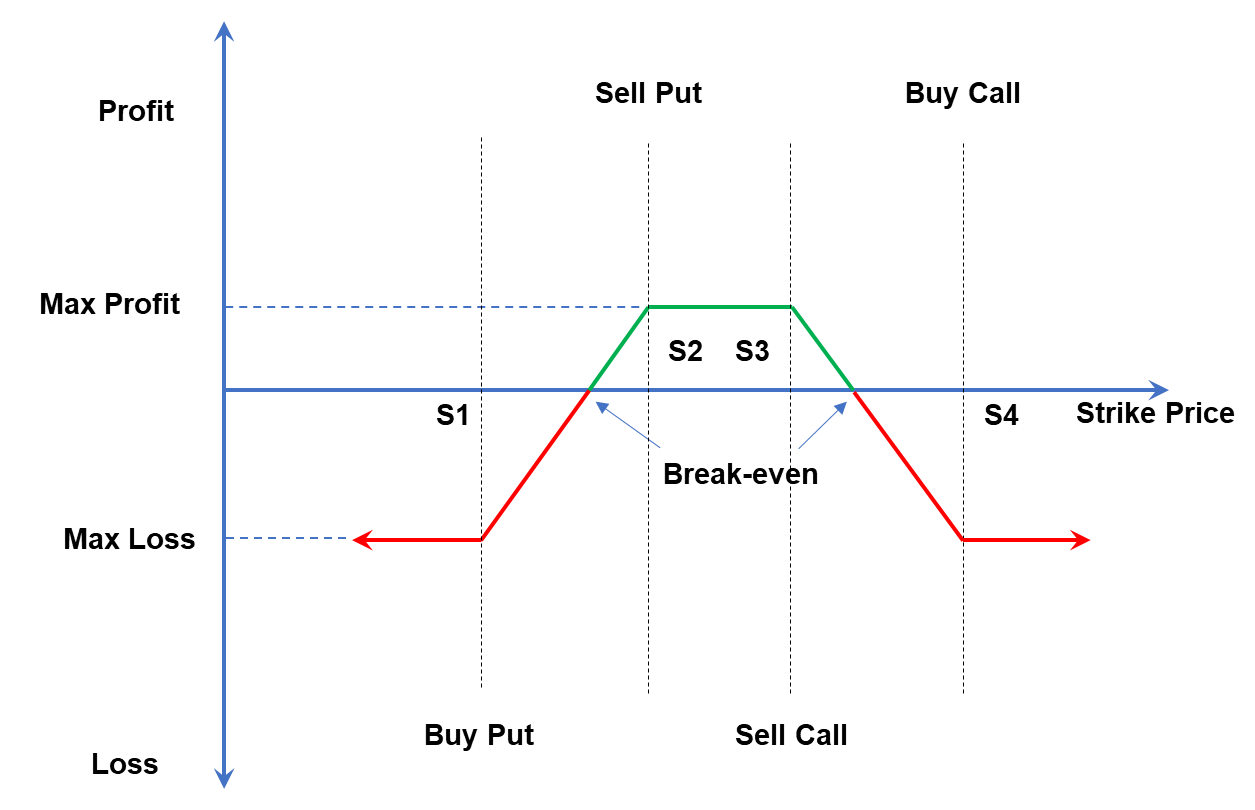
An iron condor option strategy consists of four options, all with the same expiry date.
- Sell an out-of-the-money put
- Buy a further out-of-the-money put
- Sell an out-of-the-money call
- Buy a further out-of-the-money call
The sold options contribute to the profit.
The bought options act as loss limits. The payoff diagram for the iron condor strategy is as follows:
Here’s an Iron Condor example to help you understand how it works.
Say, you’re trading Nifty 50 options. Today, Nifty is at 26,000. You have a feeling that it will stay between 25,800 and 26,200 for the next month.
Step 1: Sell one Put at 25,800
Logic: You collect the premium because you think Nifty won’t fall below 25,800.
If you’re right, and Nifty stays above 25,800, the put options will expire worthless because nobody wants the right to sell at that lower level when they can sell at a higher price on the open market. Now what if you’re wrong? Then there’s step 2.
Step 2: Buy a Put at 25,600
Logic: This acts as insurance against crashes.
If Nifty falls below 25,800, your losses will keep growing as it falls. But if you buy a put option at 25,600, it will start gaining value as the market drops. This gain will offset your loss, so you can’t lose beyond the 200-point gap between 25,800 and 25,600 (minus the premium).
Step 3: Sell a Call at 26,200
Logic: Here, you’ll collect the premium upfront because you think the market will not rise above this level.
If you’re right, and Nifty doesn’t cross this level, the option will expire worthless as nobody would want the right to buy at 26,200 when they can buy cheaper in the open market. The premium is yours to keep.
However, if you’re wrong and the market rises above 26,200, then your losses will rise as long as the markets keep rising, until expiry. To cap this loss, you need step 4.
Step 4: Buy a Call at 26,400
Logic: This is your insurance policy in case the market rallies.
If the market rises above 26,200, your call option will start gaining value. Yes, you pay a premium for it, but if the market does break out, your call option’s value will also rise. And if it doesn’t rise above or reach 26,400, the option will expire worthless as traders can buy cheaper in the open market. All you lose is the premium.
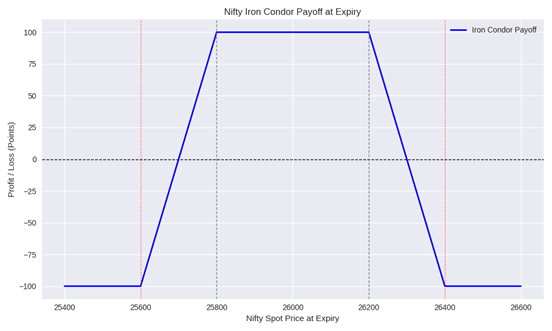
How to read the graph:
The flat blue line at the top (25,800-26,200): This is your profit zone, wherein both sold options expire worthless, and you retain the premium.
Slopes on either side: Losses start building if Nifty breaks below 25,800 or above 26,200.
Stops at 25,600 and 26,400: Bought options kick in to stop the loss, acting as insurance
Understanding maximum profit and loss
The maximum profit in an iron condor option strategy is the net premium received if the price of the underlying stays within the two sold strikes until expiry.
The maximum loss occurs if the price moves beyond either protective strike. But because it is capped, you can plan your capital allocation more effectively.
Here are a few assumptions in order to calculate your maximum profit and loss potential:
Premium collected for selling the ₹25,800 put: 70 points
Premium collected for selling the 26,200 call: 70 points
Premium paid for buying the 25,600 put: 30 points
Premium paid for buying the 26,400 call: 10 points
Therefore,
Net premium collected = (70 + 70) – (30 + 10) = 100 points.
With Nifty’s lot size of 50,
Max profit: ₹5,000, if Nifty stays within the predicted range of 25,800-26,200.
Max loss: ₹5,000 (since your point spread is 200 on either side of the breakout, minus the 100 premium you’ve collected).
When to use an Iron Condor
Given how the maximum profit was achieved if the underlying stayed within a given range, an iron condor option strategy works best in a range-bound or sideways market. A market with a strong directional bias will break out or break down, resulting in losses either way. Ideally, it is best used when you expect little to no change in terms of price.
Secondly, moderate to slightly high volatility is ideal as option premiums are inflated when volatility increases. However, there is a greater risk as high volatility can cause prices to go beyond your range. Traditionally, Iron Condors have been set up in low-volatility scenarios, but they come with lower premium collections.
Avoid setting it up before major announcements, as they tend to cause strong directional movement.
Use it during consolidation phases when indices are moving between support and resistance levels.
Is the Iron Condor right for you?
Firstly, you must be comfortable holding multiple options positions and know how to adjust them.
Secondly, this strategy works best when the market is expected to remain relatively calm during the options’ lifespan.
And finally, if you like strategies with defined risk and reward, then this is a great tool to have in your trading arsenal.
To wrap up
Risk management is key in the iron condor option strategy, as all options being out-of-the-money at expiry is not realistic for all trades. In the real world, the trading window can fluctuate significantly. However, while the average trader is generally on the lookout for a bullish run, smart traders make their money when the markets are relatively quiet.
An Iron Condor strategy can take your trading game to another level, especially when you set it up on Dhan. The platform enables multi-leg strategies, featuring a comprehensive set of technical indicators to support your market analysis. If you’re a beginner, start with small positions initially and refine them with experience.
FAQs on Iron Condor Strategy
Is the Iron Condor a safe strategy?
Because your risk is capped, it is a relatively safe strategy as opposed to classical options selling. However, like all types of trading, there is market risk.
Can I use an Iron Condor in stock options?
Yes, it can be used, but ensure there’s enough liquidity in the market at the time. If there aren’t enough buyers or sellers, you may get an unfavourable entry or may not be able to exit when you want.
How long should an Iron Condor be held?
The 15-30 day window allows time decay to work to your advantage. It also offers the highest liquidity while still controlling risk.
What happens on expiry?
If the market price remains within the sold strikes, you get the maximum premium. If it moves beyond that range, then the bought options protect you, capping your loss.
Can Iron Condors be adjusted?
Of course. If the price moves in any direction, you can make rolling bets in that direction to shift your risk window and reduce potential losses. But if the markets take on a clear direction, it’s recommended to cut your losses and exit the position entirely.