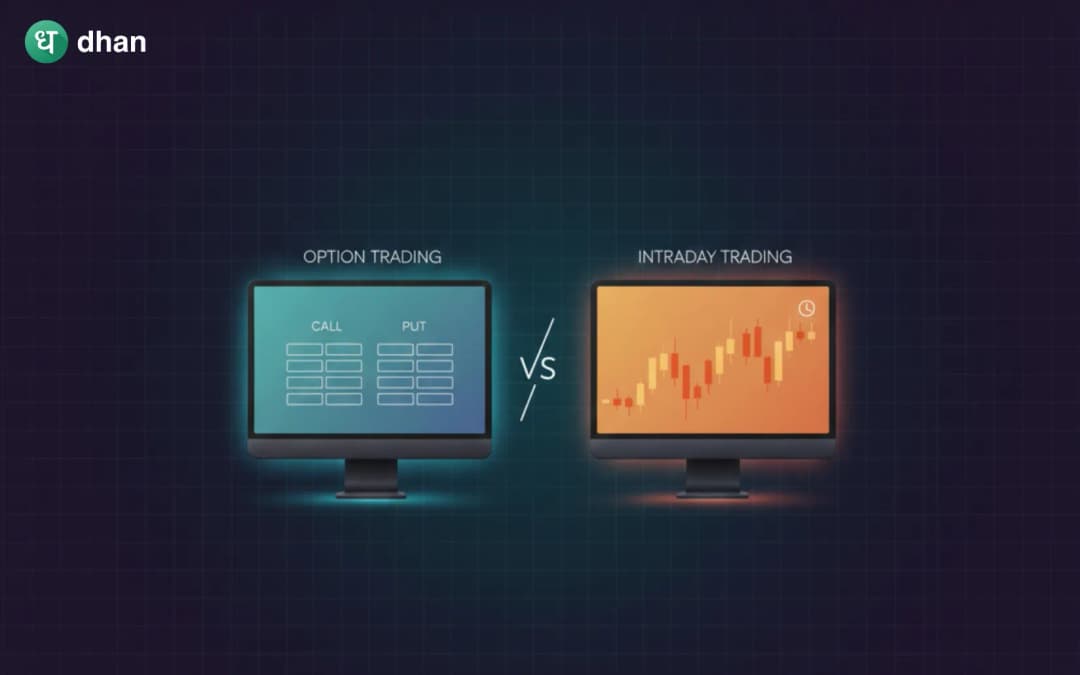
Option Trading vs Intraday Trading






Not all investments are long-term. Short-term trading offers opportunities in the moment, and has potential for profit if practised sensibly and with discipline. This includes intraday trading and option trading. Both are different and have different risk ratios. Let’s look at how option trading vs intraday work, and how they differ, starting with intraday.
What is intraday trading?
Intraday trading is when you buy and sell a stock on the same day, typically by 3:15 pm, before the market closes. That means you cannot hold the stock overnight. You start and finish the trade in a single trading session.
How does intraday trading work?
In practical terms, say you buy a stock in the morning at ₹100. By noon, it rises to ₹105. You sell your position and make a gross profit of ₹5 a share. Now, say, the price drops to ₹95, and you want to wait and avoid the loss. The broker will forcibly sell your position at the end of the day, as it is an intraday trade. So, the gains and losses here are seemingly minimal (₹5 per share, in this example) as stocks rarely hit their upper circuit in a single day.
And this is where it gets complex. To maximise intraday trading possibilities, there is “Intraday margin”.
Margin is leverage, a multiplier effect that your broker offers, to amplify your trade. Say you want to invest in shares that cost ₹100 and you have a ₹1000 cash balance. You would be able to buy 10 shares. But if the broker were to offer 5x leverage (₹5,000) by blocking your ₹1000 as “margin”, you would be able to buy 50 shares. Now the price rises to ₹105. With 10 shares, you make a profit of ₹50. With 50 shares, you make a profit of ₹250.
The same goes for losses. If the price falls to ₹95, your losses would be amplified to ₹250, instead of ₹50.
SEBI requires brokers to collect margin upfront, which means you have to maintain a cash balance on which leverage can be offered. If the position falls to a point where the broker’s share might get utilised, either the broker will square off the position (close), or ask for more funds (margin call). This prevents your losses from exceeding the margin limit and eating up the broker’s capital.
However, if you do not want to take the loss by the end of the day, you can add enough funds to buy the entire position and hold on to the stock after the trading session. This conversion, while more capital-intensive, can prevent immediate losses.
What is options trading?
Options trading is the buying or selling of financial contracts that give the trader the right to buy or sell an underlying asset at a price agreed upon beforehand, before the expiry date.
In simpler words, you can buy the right to purchase or sell an asset at a fixed price until the expiry date of the contract. The crucial idea being that you have the “option” of going ahead with the trade, as opposed to an obligation. You can walk away from the trade having just paid the price of the contract premium if the financials don’t make sense later.
How does options trading work?
There are two main terms to understand here: call and put.
Call options
Call options give you the right to buy, while put options give you the right to sell. To get this right, you have to pay a price, called the premium.
Say you want to book a flight ticket for next month, and it costs ₹10,000 currently. But you’re not sure of the plan yet. But you know, if you wait any longer, the price could rise beyond your budget. On your booking portal, you may get the option to “lock this price”, for say, ₹1,000, for 48 hours. What that means is that if you pay ₹1,000, you can buy this ticket for ₹10,000 anytime in the next 48 hours, regardless of the price rise.
The next day, if the plan’s confirmed, you check the same ticket and it now costs ₹12,500. But because you paid the premium of ₹1,000, you get the ticket for ₹10,000, resulting in savings of ₹1,500. That’s essentially how a call option works, protecting against price rises, when you want to buy low.
The complexity, and the biggest risk here is if you want to sell call options. Say you want to sell call options at ₹1,500 strike price per lot. The current price is ₹1,600. If the price falls, potential buyers are not incentivised to buy your call options as they become less valuable. But if the price rises, so does the intrinsic value of the contract, and buyers’ interest. Your loss (market price - strike price) widens as the price moves up, leading to potentially unlimited losses before expiry.
Put options
Now, let’s look at put options. Say, XYZ is trading at ₹1,500. You buy a put option with a strike price of ₹1,500, paying a premium of ₹20 per share. At expiry, the put allows you to receive the difference between the strike price and the market price. If XYZ falls to ₹1,400, you will receive ₹100 per share as cash settlement, or ₹80 per share after subtracting the premium. If the price rises to ₹1,600, the put expires worthless and your maximum loss remains the ₹20 premium.
Does that mean you have to own XYZ shares in order to sell them? Not really. You can sell your put options contract itself on the exchange’s options market, before expiry. Your put options would have gained in value to, say, ₹100. You can now sell your put options to pocket ₹80 per share.
Now, if you do own XYZ shares, put options can act as an insurance policy. You are protected at ₹1,500 minimising your losses if the market falls.
So, put options protect you against price falls when you want to sell high.
But wait, as is the case with trading, there are some layers to this as well. As expiry dates approach, the price of the premium changes. Volatility dictates how expensive a premium can get. Movement in the underlying asset also determines the sensitivity of the options--measured through Greeks.
SEBI requires traders to keep a minimum amount of money—called SPAN and exposure margin—when selling options positions, so the exchange can handle sudden market moves. This results in a significant capital outlay from the get-go.
Options trading vs. intraday trading
Options trading is slightly more complicated and riskier, especially when we consider options selling, but intraday trading also comes with its own set of risks. Here’s how they differ:
When does option trading vs intraday make sense?
Options trading can appeal to two different kinds of traders, as there are two very different ways to trade in them.
- If you want structure, defined risk, and the ability to trade without being glued to screens all day, buying options trading is more suited to your sensibilities as your loss is restricted to your premium.
- Selling options - this is mostly for experienced traders who want a steady income. Option sellers receive the premium upfront, so they earn as long as the market stays within their anticipated range. But if the market moves in the opposite direction, the losses can be significant, which is why it also requires high capital. Selling options requires understanding volatility, time decay and Greeks, so the learning curve is steeper.
Intraday trading, on the other hand, is best suited for those looking for quick trades within the same day. If you're unable to exit at the right time, losses can be sizeable. So, if you enjoy fast-paced decision-making and want to take advantage of short-term price moves, intraday trading can suit you. However, it does demand discipline, quick reactions and strict risk control. This works best in markets with a clear trend.
Suming It up
Both option trading vs intraday offer short-term opportunities, but they demand different levels of planning, risk-taking and discipline. Your preferences are likely to change as you gain experience, and it’s no surprise that a lot of traders end up using a combination of these strategies depending on market conditions. Download the Dhan app, and make informative trades on options, or trade intraday, with speed and precision.
FAQs
Is options trading safer than intraday trading?
Options selling carries the highest risk, as the upward price movement can be limitless. But intraday is also risky, as the leverage can magnify losses if the market moves against you.
Can beginners start with intraday trading?
They can, but it is a risky strategy as discipline and fast decision making are required – skills that are honed with experience. Beginners should start small and focus on controlling risk at all times, with discipline.
Can I convert an intraday trade into delivery?
Yes. If you have enough funds to pay for the full value of the shares, you can convert an intraday position into delivery and hold it after market hours.
Which is more profitable: options trading or intraday trading?
No clear answer here, as both can be profitable. Of course, with intraday, your gains can be maximised with leverage, but it comes at the cost of diligence and discipline. Options are more strategic and sensitive to volatility. There is no clear winner here. Choose whichever method you’re comfortable with.