


Theta Decay in Option Trading






Key takeaways
- Theta measures the rate of change of an option's price with respect to time, with other pricing factors being unchanged. It generally works positively for option sellers and negatively for option buyers.
- Time decay is not uniform throughout an option’s life. It usually becomes more noticeable as the expiry date gets closer, particularly for options that are near the money.
- Theta can work against long option positions even when the underlying asset does not move sharply. Traders therefore need to consider both the direction of the trade and the time available for that view to play out.
When traders buy an option, they are not only taking a view on the direction of the underlying asset. They are also taking a view on time.
An option has a fixed expiry date. As that date approaches, there is less time available for the underlying asset to make a favourable move. This reduction in remaining time can reduce the option's time value, a process commonly known as theta decay or time decay.
This causes an option buyer to lose money even when the underlying asset barely moves. For example, suppose a trader buys a call option as they expect the stock to rise. If a stock remains around the same price for several days, the option can lose its value as the expiry approaches.
Theta helps traders understand this effect. It represents the estimated change in an option's price due to the passage of time, with other variables held constant.
What is Theta in options?
Theta is a Greek used to measure an option's sensitivity to the passage of time.
Option Greeks are used to understand how an option's price may respond to different variables. While delta measures sensitivity to the underlying asset's price, theta focuses on the effect of time.
For an option buyer, theta is generally negative. This means that, all else being equal, the option tends to lose some value as time passes.
For an option seller, theta is generally positive. If the option loses time value while the underlying asset and other factors remain unchanged, that decline can benefit the seller.
For example, consider a call option trading at ₹120 with a theta of -₹3 per day. If all other factors remain unchanged, its theoretical value could fall by approximately ₹3 after one day because of time decay.
Why does Theta Decay happen?
An option gives the buyer the right, but not the obligation, to buy or sell an underlying asset at a predetermined strike price before or at expiry, depending on the contract.
The key point is that this opportunity exists only for a limited period.
Imagine a trader has purchased a call option with 30 days remaining. There is still considerable time for the underlying asset to make a favourable move.
Now compare that with the same option when only two days remain. The opportunity for a major favourable move before expiry has become much smaller in terms of available time.
As a result, the option's time value generally declines as expiry approaches.
An option premium can broadly be viewed as:
Option premium = intrinsic value + time value
Intrinsic value represents the option's current in-the-money value, while time value represents the additional amount traders are willing to pay for the possibility of a favourable move before expiry.
How Theta changes as expiry approaches
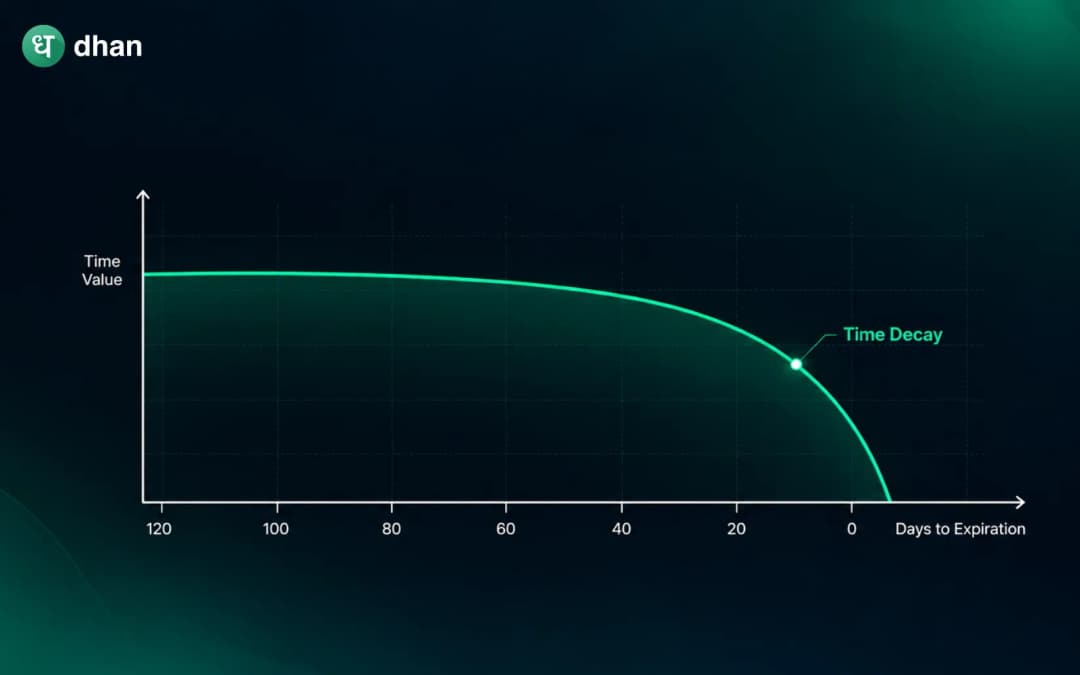
Theta decay is not a straight-line process.
An option does not necessarily lose the same amount of time value every day. The rate of decay can change as the expiry date approaches.
As expiry approaches, time decay tends to accelerate. So the effect of losing one more day can be relatively small if an option has several weeks left, but much more noticeable if there are only a few days remaining.
Consider this simplified example:
- An option has 30 days remaining and trades at ₹100.
- After several days, it may gradually lose some time value.
- When only five days remain, the daily impact of time decay may become more significant.
- Near expiry, the remaining time value can disappear rapidly if the option does not move into a favourable position.
This is why traders should not assume that an option losing ₹2 today will lose another ₹2 tomorrow.
Theta Decay example
Suppose a trader buys a call option for ₹150.
The option has a theta of -₹4 per day.
If the underlying price and implied volatility remain unchanged, the theoretical impact of theta would look approximately like this:
This is only a simplified illustration.
In actual markets, the option premium may not follow this path because the underlying price, implied volatility and other pricing inputs can change continuously.
Suppose the underlying suddenly rises, and the option moves further in the money. The increase caused by the underlying's price movement could more than offset the loss caused by theta.
Theta for call and put options
Theta affects both call and put options.
For long call options, theta is generally negative because the buyer owns an asset that loses time value as expiry approaches.
For long put options, theta is also generally negative. The put buyer is similarly paying for the opportunity to benefit from a favourable move before expiry.
For short call and short put positions, theta is generally positive. The option seller may benefit when the option's time value declines, provided other price changes do not create a larger loss.
For example, suppose a trader sells a put option for ₹80. If the option later falls to ₹60 partly because time has passed without the underlying making the expected move, the seller may benefit from the reduction in premium.
Theta and moneyness
Theta does not affect every option in exactly the same way.
At-the-money (ATM) options often experience relatively significant time-value decay because their premiums contain a substantial amount of time value.
Deep in-the-money (ITM) options have a greater proportion of their premium represented by intrinsic value, so their time-value component can be smaller.
Deep out-of-the-money (OTM) options may have relatively low premiums, but their remaining time value can still decline rapidly as expiry approaches, particularly when there is little chance of moving into the money.
If you want know more about moneyness, you must read ITM vs ATM vs OTM Options explained for traders
How traders use Theta in option trading
Theta becomes particularly relevant when deciding how long an option position can realistically be held.
Suppose a trader expects a stock to rise but does not know when the move will occur. Buying a short-dated call gives the trader less time for the expected move to happen. If the stock remains flat, theta can gradually reduce the option's value.
A longer-dated option generally gives the trade more time, although it may also carry a higher premium.
This creates an important trade-off. The trader is not simply choosing between a cheap option and an expensive option. They are also choosing how much time they want their market view to have.
Theta can also be considered when comparing different option strategies.
- Long option positions are exposed to negative theta, so the underlying may need to move sufficiently and within a suitable timeframe to offset the loss from time decay.
- Short option positions generally have positive theta, allowing the passage of time to work in their favour when other variables remain supportive.
- Strategies involving multiple options can have combined theta that differs from the theta of each individual leg.
- Traders holding options close to expiry need to pay particular attention to how quickly time value can change.
Buying an option vs selling an option
Consider two traders who have opposite positions in the same call option.
The buyer pays ₹100 in premium, while the seller receives ₹100.
Suppose the underlying remains relatively stable and the option's premium falls to ₹80 as expiry approaches.
The buyer has an unrealised loss of ₹20, while the seller has an unrealised gain of ₹20 before considering charges and other factors.
This illustrates how the same theta effect can have opposite implications for the two sides of an option trade.
But there is an important catch.
If the underlying suddenly makes a large move, the option premium can rise sharply. A seller's positive theta may then be outweighed by losses caused by the underlying's movement.
Common mistakes traders make with theta
One common mistake is assuming that theta represents a guaranteed daily loss.
It does not. Theta is a theoretical sensitivity measure, and actual option prices are constantly changing as market conditions change.
Another mistake is ignoring the expiry date. A trader may choose an option because its premium appears affordable without considering how little time remains for the expected move to happen.
A third mistake is assuming positive theta means option selling is automatically favourable. Time decay can benefit sellers, but large movements in the underlying, changes in volatility and other risks can have a much greater effect on the position.
Traders sometimes compare theta values without considering the options premium, moneyness and time remaining. This may give you the wrong interpretation.
Conclusion
Theta decay is one of the most important concepts for understanding how time affects option prices.
For option buyers, theta generally works against the position as the option's time value gradually declines. For option sellers, the same time decay can work in their favour, provided other market movements do not create larger losses.
The impact of theta is also not constant. It can become more significant as expiry approaches, particularly for options near the money.
The practical lesson is simple: when trading options, a market view is not enough by itself. Traders also need to consider how much time the trade has to work.
FAQs
Which options have higher theta?
Options near the money usually have significant time-value exposure, and theta can increase in magnitude as expiry approaches.
What is theta decay in options?
Theta decay refers to the reduction in an option's time value as the expiry date gets closer. It generally works against option buyers and can benefit option sellers when other factors remain unchanged.
Does theta decay happen every day?
Time decay occurs continuously, but the rate is not necessarily the same every day. The effect can become more pronounced as an option approaches expiry.
Can an option lose money even when the stock price does not change?
Yes. If the underlying price remains unchanged, the option can still lose value because of the passage of time. A decline in implied volatility can also reduce the premium.
Why does theta matter more near expiry?
As expiry approaches, there is less time remaining for an option to become profitable. Consequently, the remaining time value can decline more rapidly, particularly for options close to the money.