What is Short Selling in share market?




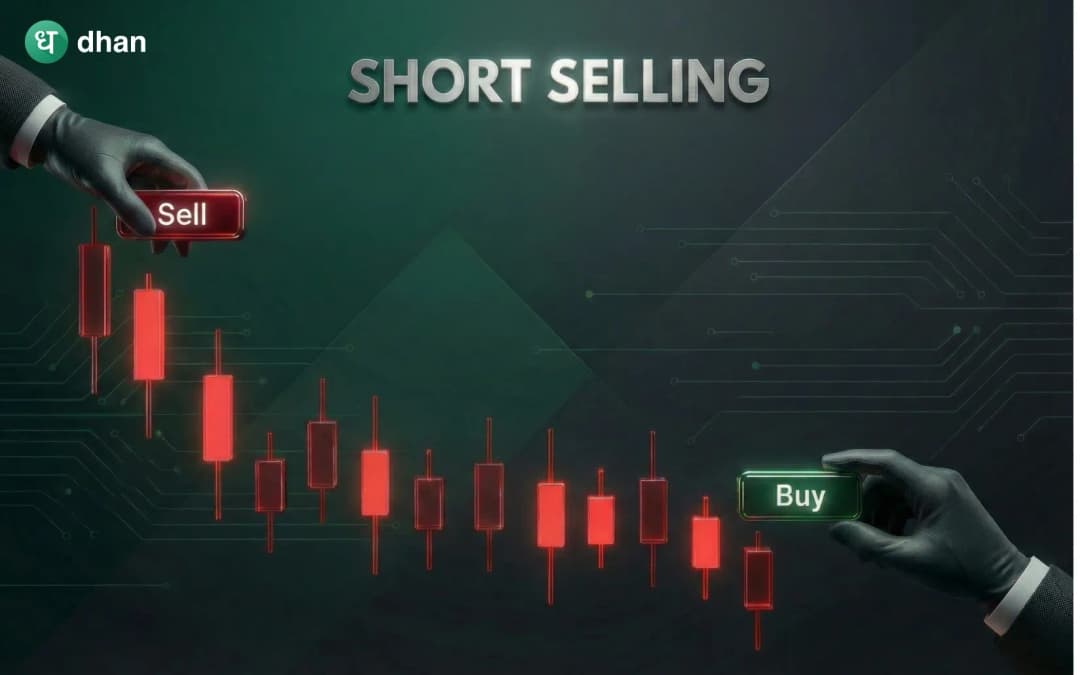


The difference between the selling price and the buying price is your profit, after borrowing costs, of course.
Regular trading works on the simple premise that you buy a stock and hope for the price to rise before you sell it. But short selling reverses the idea. Short selling in India can only be done on intraday trades, meaning you must close the position before the day’s end.
Here’s how you can get comfortable with the idea of short selling.
How short selling works?
Considering the complexity of the trade, this is a strategy meant for advanced traders. This is how short selling works:
Borrowing shares
You believe a stock is going to fall on a particular day. Your broker will arrange shares that you can borrow through the SLMB (Securities’ Lending and Borrowing Mechanism). These shares generally belong to an investor who is lending them for a fee.
Selling the borrowed shares
Now you sell these borrowed shares in the market at the prevailing price.
Buy back the borrowed shares
You must now buy back the same number of shares from the market and return them to the lender, before 3:20 pm.
Profit or loss
Your hope here is that the prices would have fallen as you anticipated, so that you can buy the shares back at that lower price. The lower your buy-back price, the larger your profit. Now, if the price rises, you will have to buy back the shares at the higher price, resulting in a loss.
Failure to comply
Now, if you do not want to repurchase the shares because they are higher priced, the clearing corporation will step in and forcefully close the position, incurring additional penalties and interest. You may even lose your trading privileges if you fail to return the shares. So, it is mandatory for you to close the position on the day itself.
Short selling example
Here's a simple example to illustrate the concept:
Let’s say that the shares of ABC Ltd. are currently trading at ₹100.
- You expect the price to fall today.
- You undertake a short sale of 100 shares at ₹100 each at ₹10,000.
- If the price drops to ₹90, you can buy 100 shares for a cost of ₹9,000.
- Gross profit before borrowing cost, taxes, and brokerage is ₹1,000.
However, if the price rises to ₹120
Then your buy-back cost becomes ₹12,000, resulting in a loss of ₹2,000 before other costs.
These are the risks and opportunities involved with short selling.
Why do traders short sell?
Short selling serves multiple purposes for traders.
Profit from a falling market
The market isn’t only moving upwards. For large parts, it’s sideways and then there are periods of declining prices – a bearish run. During such periods, traders can still make a profit, instead of waiting for the market to rise.
Risk management
Large investors use short selling to manage risk. Say a fund holds banking stocks, but expects a short-term correction in the banking index, it can short banking stocks to offset the losses in its long-term position.
Regulating prices
Short sellers often look for overvalued stocks or those with weak fundamentals. The selling pressure, in turn, helps correct their valuation faster than if there were just optimistic buyers. Regulators and academics recognise its impact on efficient price discovery.
Key risks of short selling
Short selling carries some obvious and higher risks than normal investing.
Unlimited loss potential
You lose when the price of the stock rises. The price can rise indefinitely or until it hits the upper circuit. It differs from regular investing, where your maximum loss is the amount you invested.
Margin requirements
Short selling requires margin. Margin is like a security deposit that you pay the broker in order to borrow shares. It works like collateral in case your position goes against you.
For example, you short sell shares worth ₹10,000. The broker requires a 20% margin. That means you must deposit ₹2,000 upfront as margin in your trading account. Now, if your position rises to ₹12,000, the loss is ₹2,000, eating into your margin. If this loss increases, further eating into your margin, the broker may forcefully close the position or ask for a top-up – margin call.
Market events
Corporate actions like buybacks, mergers, or even positive market news can cause prices to rise sharply, hurting short sellers. This can lead to a margin call and unfavourable position settlement.
How to short sell on Dhan?
Dhan allows intraday short selling in line with SEBI regulations. The process is fairly simple.
Step 1: Choose an eligible stock
Dhan displays all the stocks available for shorting, based on liquidity filters and exchange rules.
Step 2: Select the sell option
On the trading window, select “Sell” and choose Intraday (MIS).
Step 3: Enter the price and quantity
Enter the number of units you would like to short sell and fulfil the margin requirements.
Step 4: Square off before market close
Intraday positions are automatically closed around 3:20 pm if you do not close the position. It is strongly advised to buy back the shares and return them to the lender before the trading window closes.
Tips:
- Use stop-losses to limit your risk.
- Note that brokerage and borrowing charges apply.
Dhan provides a real-time view of the risk and margin availability to help you manage your exposure.
Who should avoid short selling?
Short selling is recommended only for advanced traders who understand market behaviours deeply.
You should avoid short selling if:
- You are new to trading
- You do not actively monitor positions
- You cannot fulfil margin obligations
- You are not familiar with intraday trading
Long-term investors and beginners must first learn market basics and get comfortable with intraday trading before getting into short selling.
Final thoughts
Short selling is an advanced trading strategy that allows traders to profit from a bearish or even sideways market. They can also manage risk in their long-term portfolio by short-term hedging. Furthermore, market efficiency is also improved when traders hold short positions. Used wisely, short selling can be an effective tool.
FAQs
Can short selling affect my long-term investing account or holdings?
No, short selling does not have an effect on your long-term positions, as it is a separate trade entirely.
What happens if I forget to square off a short sell position?
Short selling must be squared off by 3:20 pm. Otherwise, the broker will automatically close your position at the prevailing rate and levy extra charges for the same.
Are dividends or bonuses relevant for intraday short sellers?
Because positions are not carried overnight, dividends, bonuses, and stock splits do not apply to intraday short sellers.
Why are some stocks blocked from short selling even during market hours?
It could be due to low liquidity, high volatility, or any special restriction imposed by the exchange. The list of allowed stocks is revised periodically to prevent excessive speculation and settlement risk.
Is short selling suitable during events like budgets, results, or policy announcements?
These events involve extra risk. Prices can go up or down. There can be sudden increases or sharp decreases. This makes it risky.