What are Corporate Actions?


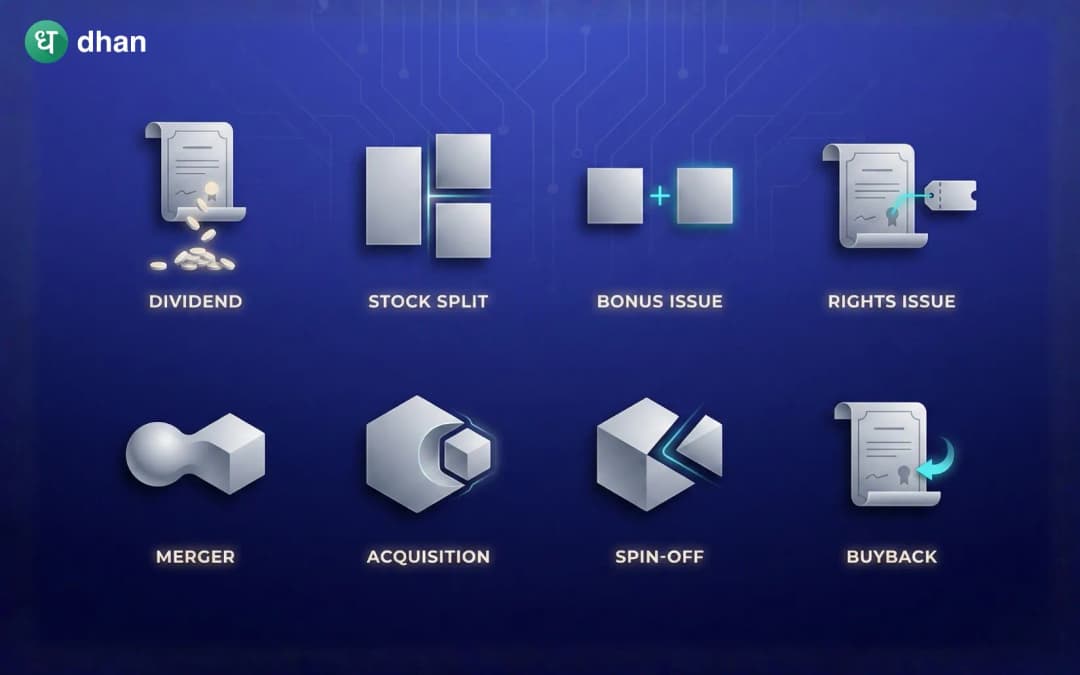



Suppose you’re holding shares of a particular company. One fine morning, you notice the stock values have drastically dropped, and you have a higher number of shares in your demat account. It’s natural to wonder what happened!
It’s not always the market, but the company itself, taking strategic decisions that influence the stock value. These are corporate actions that play a significant role in your investment journey.
Common corporate decisions like bonus issues, stock splits, buybacks, or mergers carry a message about the health and interaction of the company.We have comprehensively discussed what corporate actions mean for you as an investor in this guide.
What are corporate actions?
The board of directors of companies listed on the stock market sometimes makes decisions which directly affect its shareholders. These activities, known as corporate actions, can influence the following aspects of the company.
- Capital structure
- How it distributes profits
- Capital raising strategies
- Employee rewards
- Restructuring of business operations
Corporate actions come under three broad categories.
Mandatory actions
Actions like dividends, stock splits, or mergers apply to every shareholder automatically.
Voluntary actions
Buybacks and rights issues are some voluntary actions that require a specific choice or direct participation of investors.
Mandatory-with-choice
For dividend options, the default action applies, but investors have the option to choose an alternative.
As an investor, you must regularly track corporate actions since they influence both short-term moves in the market and long-term wealth creation.
Types of corporate actions & their impact
Corporate actions from the board of directors of a company can be of different types. Investors must stay updated with the latest news to track these activities.
Dividends
Companies share their profits with shareholders in the form of dividends. These are one of the most popular corporate actions.
You can receive dividends in two forms: cash dividends and stock dividends. With cash dividends, you get actual money in your bank account. Stock dividends are additional shares that are added to your demat account.
The stock price adjusts downwards on the ex-dividend date, which reflects the payout. Dividends are a steady source of income for long-term investors.
Bonus shares
Some companies convert their accumulated reserves into additional shares. If you happen to own some stocks of the particular company before a specific date, you receive these bonus shares. For instance, Bajaj Finance executed a 4:1 bonus share issue in 2025.
When the number of shares increases, the stock value adjusts in the same proportion. This implies that the overall value you invested remains the same.
For the company, issuing bonus shares improves liquidity. As a result, the stock becomes more affordable, often exciting investors.
The issue of bonus shares also demonstrates the confidence of the management. Companies usually issue bonuses when they expect their future earnings to be stable.
Stock splits & reverse splits
These are common corporate actions, as a result of which a stock divides each share into multiple shares. For instance, a 1:5 split implies that if you are holding one share of a company, it will become five. The price is automatically adjusted, while you retain the same investment value. Stock splits also make the shares more accessible and increase liquidity.
On the other hand, a reverse split does just the opposite. These corporate actions combine multiple shares into one. Usually, it is done to fulfil certain listing requirements or improve the perceived strength of a stock.
Both stock splits and reverse stock splits impact the sentiment of investors, liquidity, and accessibility while keeping the fundamentals of the company constant.
Rights issue
During a rights issue, existing shareholders of a company get the opportunity to buy additional shares at a discounted price. These corporate actions help companies to raise capital, which is then used for expanding funds, repaying debts, and strengthening their balance sheets.
As an investor, you can:
- Subscribe and buy the shares
- Renounce your rights by selling them
- Do nothing and simply ignore
If the fundamentals of the company are strong, investors can benefit from subscribing and buying the shares at a discount. The share price adjusts temporarily but generates long-term value.
Share buybacks
Sometimes, a company buys back its own shares from the market to reduce the total number of outstanding shares. This corporate action often increases its Earnings Per Share (EPS) and strengthens its stock price.
Usually, strong buyback activity implies that the management believes that the company is undervalued. At times, they return their excess cash to shareholders. During volatility, buybacks stabilise the share price and improve confidence. Done at the right time, it creates value for long-term investors.
Mergers & acquisitions
Mergers and acquisitions are some of the most talked-about corporate actions. These involve instances when companies combine or one company takes over another. The board of directors undertakes these activities to bring about growth, cost-effectiveness, or gain a competitive advantage in the market. M&A activities also allow businesses to explore new markets.
But what do M&A activities mean for shareholders? Often, these decisions involve a share swap, cash payout, or a combination of both. The number of shares of the new entity you receive is determined by the swap ratio.
During these activities, the acquirer stocks may fall due to cost concerns, while the share price of the target company rises.
Spin-offs & demergers
During a spin-off or demerger, a company separates one of its business divisions into a new, independent entity. You receive shares of the new company, considering the proportion of your holdings. Often, spin-offs create value for investors because they allow each business to work more efficiently. As an investor, you gain exposure to two specialised companies instead of one diversified business.
DRIPs, ESOPs, and other events
Dividend Reinvestment Plans (DRIPs) are corporate actions where dividends are automatically reinvested into additional shares for investors, which eventually compound.
Employee Stock Option Plans (ESOPs) are exclusively meant to reward employees. They gain ownership of the company, which means they remain committed to its long-term goals.
Special dividends or preference share conversions also fall under corporate actions, influencing the value of shareholders. Both these actions improve participation and adjust the ownership in positive ways.
Why Corporate Actions Affect Stock Prices
Both market psychology and mathematical adjustments come into the equation during corporate actions, affecting stock prices.
- During stock splits, bonus issues, and rights issues, stock prices are mechanically adjusted.
- The reserves of a company are reduced temporarily during stock splits. That’s why the stock trades at a lower price on the ex-dividend date.
- During buybacks, stock prices are usually higher as the supply of shares is reduced.
- M&A actions often trigger speculation, optimism, or concern, depending on deal quality.
Stay updated with upcoming events and deadlines on a dependable platform on Dhan.
How investors should read and respond to corporate actions
Investors must analyse the future implications of these corporate activities, not just the announcements. For instance, a buyback at overvalued levels may not excite investors. On the contrary, a rights issue, along with proper expansion plans, may create long-term gains.
From the perspective of investors, the best strategy is to evaluate the overall fundamentals of the company before reacting to any corporate action. Research and find out:
- Is the business growing?
- Does it have strong earnings?
- Is its debt manageable?
A rights issue from a strong company is very different from one where finances are strained. So, short-term price movements shouldn’t bother investors, particularly during splits, bonuses, or M&A news.
Conclusion
Corporate actions significantly shape how you invest, diversify, and generate income. We have explained these actions in this guide in detail for your convenience. Stay updated with the latest corporate actions news on Dhan and understand these events to respond wisely. With a strategic approach, investors can spot opportunities and ignore the noise.
FAQs
Do corporate actions change the overall value of my investment?
It depends on the nature of the action. Activities like stock splits or bonus issues simply adjust the number of shares and price in the same proportion, which means the overall value remains unchanged. However, dividends, buybacks, and M&A activity can affect actual value.
What should I do when a rights issue is announced?
Firstly, check why the company is raising the funds. If the organisation is financially strong and is raising capital for expansion, you may benefit when you subscribe at a discounted price. However, if this corporate action is being taken to reduce stress or repay debt, proceed with caution. If you don’t want to subscribe, you can even renounce or sell your rights.
Are stock splits always good for investors?
There’s no gain in terms of the intrinsic value of a stock when it splits. However, they improve affordability and liquidity. Due to the lower price of the stock, new retail investors find it attractive, which eventually increases the trading volume. This has a positive influence on the sentiment of investors. As an investor, your concern should be whether or not the company is likely to provide you with long-term growth.
How do mergers affect my existing shareholding?
Your existing shares may get converted into shares of the new entity based on a pre-decided swap ratio during a merger. This implies that you may end up with more, fewer, or differently valued shares.
Should I participate in buybacks?
You can decide to participate in a buyback as long as the company is fundamentally sound. It must offer a price higher than the market value