FII & DII Trends in September 2026








Key takeaways:
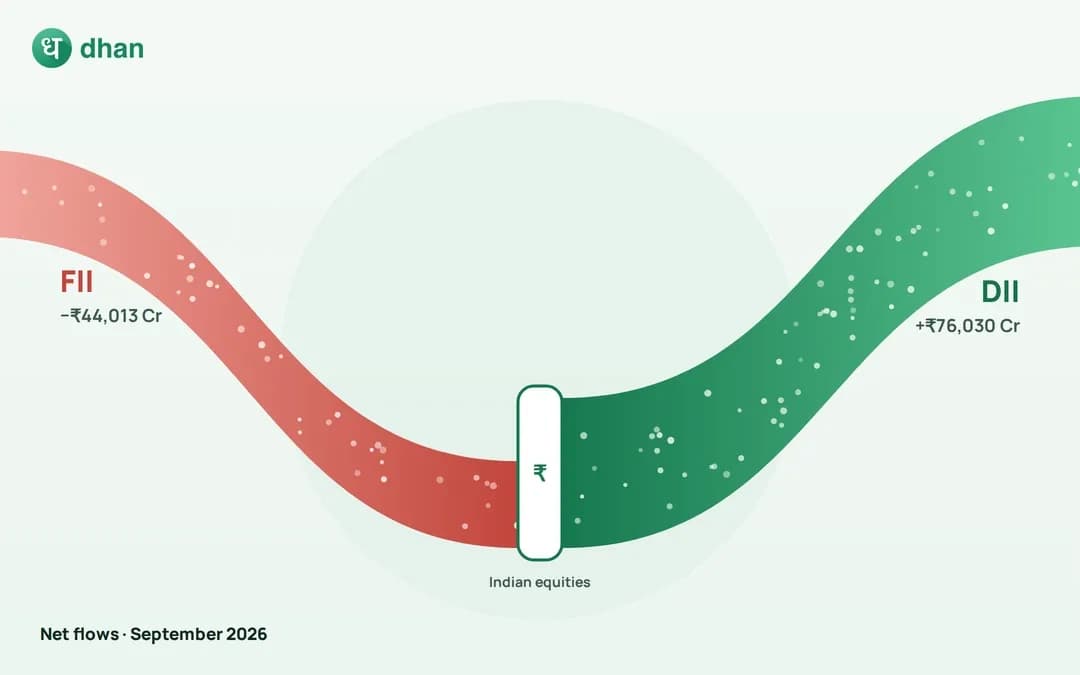
- FII selling increased sharply in September 2026, with net outflows rising to ₹44,012.82 Cr from ₹7,531.84 Cr in August.
- Strong buying by domestic institutional investors continued to support the market, with DIIs recording a net inflow of ₹76,030.29 Cr, higher than ₹58,268.15 Cr in August.
- FII gross purchases stood at ₹3,13,522.98 Cr in September, while gross sales increased to ₹3,57,535.80 Cr.
- DII gross purchases stood at ₹3,67,838.29 Cr in September, while gross sales were ₹2,91,808.00 Cr.
September 2026 saw a sharp increase in selling pressure from Foreign Institutional Investors. FII outflows rose from August and accelerated towards the end of the month, as concerns over crude oil prices, global bond yields, the rupee and geopolitical uncertainty weighed on investor sentiment.
At the same time, DIIs continued their strong buying trend and helped absorb a large part of the foreign selling. Domestic institutional buying reached its highest level in the recent three months, providing support to Indian equities during a period of heightened volatility.
FII & DII activity in September 2026
September saw FIIs remain net sellers in the cash segment, with foreign outflows increasing sharply compared with August.
In September, FIIs purchased shares worth ₹3,13,522.98 Cr and sold shares worth ₹3,57,535.80 Cr. This resulted in a net outflow of ₹44,012.82 Cr from Indian equities.
FII selling increased from the ₹7,531.84 Cr net outflow recorded in August 2026. It was also close to the ₹49,028.63 Cr outflow seen in June. September figure shows that foreign selling pressure returned strongly after remaining relatively limited during July and August.
Domestic investors, meanwhile, continued to provide strong support to the market. DIIs purchased shares worth ₹3,67,838.29 Cr and sold shares worth ₹2,91,808.00 Cr, resulting in a net inflow of ₹76,030.29 Cr.
DII net buying increased from ₹58,268.15 Cr in August and ₹35,099.25 Cr in July. Strong domestic buying helped counter the sharp increase in foreign selling and provided liquidity to the Indian equity market during September.
Here is the data on FII and DII inflows and outflows for September 2026.
Data source: NSE, ScanX
Why did FII selling increase in September 2026?
Unlike August, when FII selling remained relatively limited, September saw a sharp deterioration in foreign investor flows. Several factors contributed to the increase in selling.
- Higher crude oil prices became a major concern for investors. Rising oil prices can put pressure on India's import bill, inflation and the rupee because the country depends heavily on crude oil imports. Towards the end of September, Brent crude moved above $100 a barrel, adding to concerns around inflation and market stability.
- Rising US bond yields also affected foreign investor sentiment. Higher Treasury yields can make US assets more attractive compared with emerging-market equities. US 10-year Treasury yield moved above 5.2% towards the end of September, adding pressure on foreign flows into Indian equities.
- Indian rupee also remained under pressure. A weaker rupee can reduce dollar-denominated returns for foreign investors, particularly when global bond yields are already high.
- Valuations also remained a concern. Foreign investors continued to compare Indian equities with other emerging markets, particularly as global market conditions became less favourable. Reports during September indicated that FII selling was selective rather than a complete withdrawal from India, with foreign investors still participating in IPOs and other primary-market opportunities.
Why did DII buying continue in September 2026?
Domestic Institutional Investors remained a major source of support for Indian equities during September.
- Steady domestic liquidity continued to drive DII activity. Mutual funds and other domestic institutions have become an important source of capital for Indian equities, helping absorb foreign selling during periods of market volatility.
- Domestic investors also remained consistent throughout the month. DIIs were net buyers during all 21 trading sessions in September, while FIIs were net sellers in most of the sessions.
- The growing strength of domestic investors is making Indian equities less dependent on foreign flows. DIIs have increasingly absorbed FII selling and provided the market with greater stability during periods of global uncertainty.
Final words
September 2026 saw a sharp divergence between foreign and domestic institutional flows. FII net selling increased to ₹44,012.82 Cr from ₹7,531.84 Cr in August, reflecting higher pressure from global market concerns. DIIs, however, remained strong buyers, with net inflows rising to ₹76,030.29 Cr from ₹58,268.15 Cr.
Rising crude oil prices, higher US bond yields, rupee weakness and global uncertainty weighed on foreign investor sentiment. DIIs helped absorb a large part of the FII selling and provided support to Indian equities. The trend continued into early October, with FIIs selling while DIIs remained net buyers.