How Dhan’s DEXT helps in fast trade execution?







You've analysed the chart. You've timed your entry just right. You hit the Buy button, and then you wait. For most Indian traders, this half-second of uncertainty between clicking a button and seeing whether an order is confirmed is more than just an anxious pause. It's a window where prices can move, fills can slip, and even carefully planned trades can turn into disappointments.
In fast-moving markets, where price fluctuations occur every fraction of a second, the speed of execution isn't a convenience. It's a trader's competitive edge. This is exactly the problem that DEXT- the Dhan Exchange Trading System was built to solve. In this blog, we will explore how DEXT help in fast order execution.
Why fast order execution matters
Before knowing how DEXT helps in fast trade execution, it's worth establishing why speed matters so much, especially for Indian retail traders.
When a trader places a trade, the order passes through several different systems before it gets to the exchange. At each stop, validations are executed, margins are verified, and risk parameters are verified. The duration this journey takes from traders tapping buy/sell options to the exchange acknowledgement is the order execution latency. In the Indian markets, most retail brokers execute this process in 100 milliseconds to 150 milliseconds. That might seem negligible to traders. But in a dynamic market, even millisecond delays can cause:
Slippage
The trader's order gets filled at a different price than what they saw at the time of submitting the order. Slippage occurs when orders are executed at different prices due to delays, and fast execution reduces this risk. For a scalper or options buyer, even a slippage of small amounts per lot gets accumulated over dozens of daily trades, effectively adding drag on profitability.
Missed entries
In a trending market, a 100ms delay means that the entry price is history by the time the order hits the exchange. Traders have to either pay more to buy or settle for a lower price to sell.
Failed hedges
For traders who are managing multi-leg F&O positions, the delay in one leg can leave them exposed while they wait for the other leg to execute.
Even a 1-millisecond delay can cost significant losses to traders. Speed is not a luxury feature. A fast order execution trading platform is a fundamental requirement.
What is DEXT, and why was it built?
DEXT (Dhan Exchange Trading System) is Dhan's in-house, proprietary trade processing system, built from scratch on the latest technology stack. It is Dhan's answer to one of the biggest pain points in Indian retail trading, i.e. slow and vendor-dependent order infrastructure.
Traders in India face friction in using multiple trading platforms for analysis and trade placements. Placing large quantity trades or multiple orders simultaneously has often been time-consuming and cumbersome for Indian traders.
Most Indian stock trading platforms, even the big, established ones, are running on third-party Order Management Systems (OMS) developed by external vendors. These systems were architected more than ten years ago, for a different era of trading volume and speed in the market. Because they're shared infrastructure, brokers using them have little control over performance improvements, and they have to wait for the vendor to iterate.
Dhan made a different call. DEXT was built in-house, making Dhan one of the very few stock trading platforms in the world, not just India, that owns and manages their entire core trading infrastructure from order submission to exchange dispatch. This ownership is the foundation of everything that DEXT achieves. DEXT was developed to fulfil three core goals:
- Speed: Achieve ultra-low latency in order execution.
- Innovation: Allow for rapid iteration and new feature development without vendor dependency.
- Reliability: Eliminate single points of failure and ensure seamless scale.
How DEXT delivers fast order execution
The secret of DEXT's fast trade execution lies in the way it processes the orders. It does not process orders sequentially; it processes them in parallel, across five highly specialised layers. Here's a breakdown on how an order is transported through DEXT:
Layer 1: The Receiver
The receiver is the order’s entry point. The moment a trader taps buy or sell on the Dhan, ScanX Screener, or DhanHQ API, the order strikes the Receiver, which is DEXT's ingress gateway. The Receiver instantly:
- Assigns a unique Order ID
- Performs light-weight preliminary checks (syntax, completeness)
- Simultaneously sends the order in two parallel streams. One is a direct stream to the Internal Validator, and another is a validation stream to the OMS and RMS.
The Receiver pre-alerts the order constructor, the final assembly layer, to start preparing for an incoming order, so that layer doesn't sit idle waiting. This anticipatory readiness eliminates downstream wait time before it can even happen.
Layer 2: The Order Management System (OMS)
In a traditional OMS, validation checks occur in sequence, i.e., one after the other, with each waiting for the previous one to complete. DEXT eliminates this.
The DEXT OMS executes 40 to 50 independent checks simultaneously, each of which executes independently and streams the result to the Internal Validator the moment it finishes. These checks include:
- KYC and user compliance verification.
- Instrument eligibility and segment-specific rules.
- Market open/close and exchange connectivity states.
- Price validation against real market data.
- Freeze quantity limits (for automatic Iceberg order slicing)
Because all 40-50 checks run in parallel, instead of in sequence, the OMS layer contributes almost no cumulative latency.
Layer 3: The Risk Management System (RMS)
This is the most computationally intensive layer in the whole pipeline. The DEXT RMS conducts 130 to 150 risk-related checks per order, all at the same time. These checks cover:
- Margin sufficiency and availability for the user.
- Exposure from existing open positions and pending orders.
- Liquidity thresholds and adherence to price bands.
- Internal risk policy enforcement and user-specific behavioural flags.
- Volatility and exchange operational status match.
The RMS doesn't sacrifice thoroughness for speed. By running checks in parallel, and not in sequence, the total time taken is determined by the slowest single check, not the cumulative sum of all checks.
Layer 4: The Internal Validator and encoder
Once the checks are streaming in from the Receiver, the OMS and RMS, they all meet at the Internal Validator, which is DEXT's decision-making centre, contained in the encoder layer. Two architectural mechanisms make this layer uniquely reliable:
- Barrier synchronisation: The Internal Validator collects more than 200 validation results, in the order of 5 from the Receiver, 40-50 from the OMS and 130-150 from the RMS, in the form of state flags. The order is not allowed to execute until the status of every single check has been reported. This ensures no order slips through without validation.
- Consensus Mechanism: It requires a unanimous pass from all checks. Even a single failure causes rejection or flagging. This mechanism is what makes DEXT the fastest and safest without loss of integrity.
Once validated, the Encoder formats the order in a structured exchange-compatible format for downstream transmission.
Layer 5: The Order Constructor
The final layer packages all of the validated inputs together in a complete, exchange-ready order. The Order Constructor:
- Integrates the output from the Internal Validator and Encoder.
- Formats the order into exchange protocols (FIX, JSON or other).
- Adds required metadata like client codes, product type, and timestamps.
- Performs final lightweight integrity check.
- Sends the order to NSE, BSE or MCX.
Because the Order Constructor was pre-alerted by the Receiver Layer (Layer 1) that it will be receiving an order, it starts doing its preparations early. Thus, the Order Constructor is ready to send by the time the validated order arrives. This pre-initialisation results in optimisations in the entire DEXT architecture.
The AWS infrastructure behind DEXT's speed
DEXT doesn't work on standard shared cloud infrastructure. Dhan's DEXT is built on the AWS stack. Amazon EC2 instances are used to host both the Order Management System and Execution Management System, which are the core of DEXT's processing pipeline.
Amazon Aurora replaced the earlier RDS for MySQL setup, and has reduced the time taken for provisioning replicas from more than 30 minutes to just 5 minutes, reducing the cold start latency to less than 20ms, and enabling automated failovers in less than a minute.
AWS Direct Connect creates secure, dedicated connectivity between Dhan's cloud infrastructure and India's stock exchanges, avoiding the public internet for lower, more predictable latency.
AWS Auto Scaling dynamically optimises compute resources to handle sudden surges with EC2 Reserved Instances, reducing costs by 40% by reserving compute between a 6-hour trading window.
With Active-Active Disaster Recovery, if Dhan's main data centre faces any problem, the system switches seamlessly to the DR location with zero downtime for traders.
Additionally, servers are maintained below 30% utilisation during regular trading hours, with Active-Active mode of operation running simultaneously across multiple locations, including Mumbai and Bangalore. This headroom enables DEXT to absorb a hundredfold surge in users at market opening with no slowing down.
DEXT vs. Third-Party OMS
Most stock trading platforms in India use third-party Order Management Systems (OMS), which means that the expected speeds of Order Execution across these brokers with the same OMS will more or less have the same performance, as it is controlled by the vendor, not the broker. For brokers using vendor infrastructure, performance improvements get introduced on the timelines of vendors and not their own.
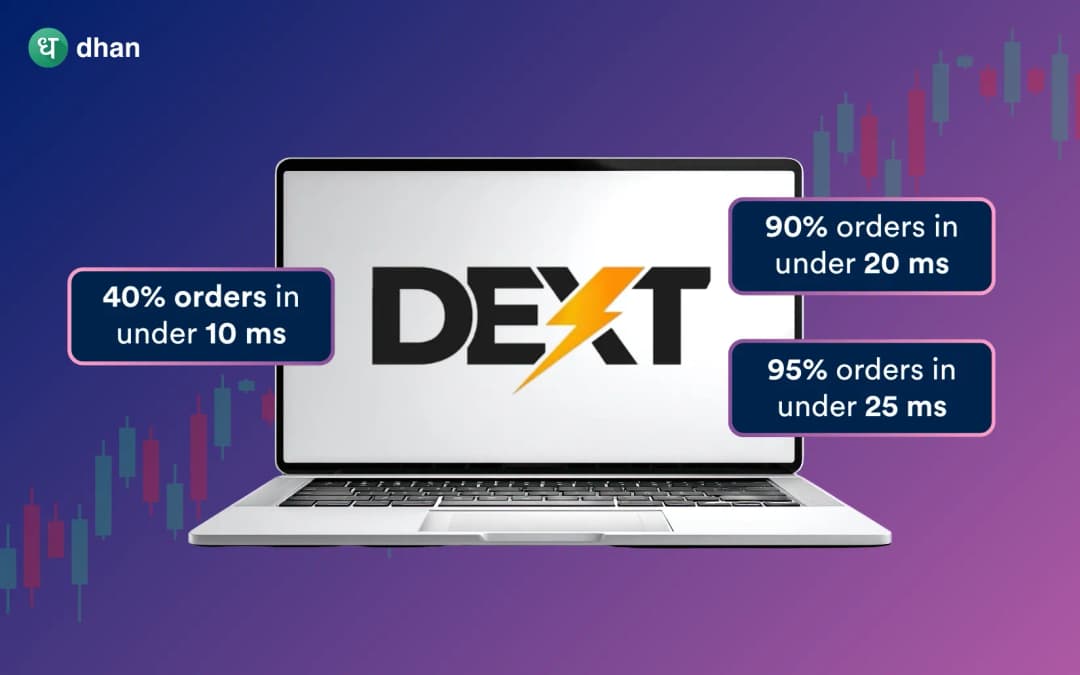
In contrast, due to DEXT's in-house ownership, Dhan can and does iterate on performance every month. The jump from 40% sub-25ms in April of 2024 to 95%+ sub-25ms by March 2025 happened because Dhan had controlled every layer of the stack due to the in-house ownership. Dhan didn’t have to negotiate with vendors, waiting for 3rd party updates; it just had to engineer sprints that directly improve what traders experience.
The numbers behind DEXT's fast trade execution
The architecture described above is not theoretical. It is backed by proven and publicly documented results. According to the official Amazon AWS Case Study on Dhan:
To wrap up
Fast order execution is not a feature to check off a list. For Indian traders, especially those who are involved in intraday equities, F&O, and algo strategies, it makes a key difference between a good trade and a missed one, an intended slippage and unexpected losses.
DEXT offers fast trade execution through the combination of architectural innovation (parallel processing across 200+ simultaneous validation checks), infrastructure excellence (AWS EC2, Aurora, Direct Connect) and engineering ownership that allows Dhan to consistently improve its performance without waiting for any third party.
In a market where milliseconds determine outcomes, DEXT is the engine that ensures traders get the trade they planned for, not the trade the delay gave them.