How to Earn Rent on Stocks (Try SLBM on Dhan)





Key takeaways:
- SLBM allows investors to lend eligible shares for a fixed period and potentially earn a lending fee.
- Stock lending does not mean permanently selling your shares; the shares are only temporarily transferred to a borrower in exchange for a lending fee while you keep the ownership rights.
- Lending income depends on demand, stock availability, tenure, quantity, prevailing lending rates, charges, and taxes.
- Stock lending is more relevant for long-term investors who do not need immediate access to the lent shares.
- Dhan’s Rent Stocks section enables investors to discover eligible holdings, assess opportunities, place lending orders, and track lending contracts digitally.
For most investors, stocks are bought with two expectations: capital appreciation and dividends. You purchase shares of a fundamentally strong company, hold them in your demat account, and wait for the business and its share price to grow over time.
But what happens while those shares remain in your portfolio?
These shares can remain in investors' portfolios for months or even years without being actively used. This is where stock lending offers a potential third source of income from eligible holdings. Let’s understand how stock lending works, what affects the potential lending income, and how you can rent stocks through Dhan.
What is Stock Lending through SLBM?
SLBM stands for Securities Lending and Borrowing Mechanism. It is a SEBI-regulated framework through which investors can lend eligible securities to borrowers for a predetermined tenure. Borrowers may need these shares for short-term purposes such as short selling, arbitrage, or meeting settlement obligations.
Instead of purchasing the shares, the borrower can obtain them through SLBM and pay a lending fee to the lender. Thus, rather than holding SLBM-eligible shares in the demat account, investors can choose to lend them through SLBM for a defined period. In return, they receive a lending fee, often referred to as rent on stocks.
At the end of the lending contract, the borrower must return the shares. Clearing corporations facilitate settlement between the lender and borrower and act as the central counterparty within the SLBM framework.
Why do investors choose to Rent Stocks?
Stock lending is not a replacement for capital appreciation or dividends. Instead, it offers an additional income source to an existing portfolio and makes existing holdings more productive. For example, an investor may buy shares of a company with the intention of holding them for the next five years because of the company's robust long-term business prospects.
If those shares are in demand in the stock-lending market, investors can consider lending them for a defined period and potentially earn additional income alongside their existing portfolio returns. Investors choose to rent their stocks because:
- It can help generate potential lending income from eligible long-term holdings.
- It allows investors to retain the ownership rights and continue receiving dividends.
- It provides a regulated route to participate in securities lending.
- It can make idle portfolio holdings more productive.
- It offers an alternative source of return that does not depend directly on a rise in share price.
What determines Stock Lending Income?
SLBM income is not fixed or guaranteed. It depends on market demand, lending period and the agreed lending fee for a particular security. Several factors can influence the potential stock-lending income, such as:
- Borrowing demand: Securities that are in greater demand from borrowers may attract higher lending fees.
- Availability of shares: If the supply of a particular stock available for lending is limited, lending rates may increase, depending on market demand.
- Contract tenure: Different lending periods have different rates.
- Market conditions: Factors such as market volatility, corporate developments, short-selling demand and settlement requirements can also influence borrowing activity.
- Quantity lent: The number of shares that investors lend also affects the net lending income.
- Transaction charges and taxes: Applicable charges and taxes can affect net income.
Why did SLBM remain less accessible to retail investors?
SLBM adoption among retail investors remained relatively limited due to lower awareness, perceived complexity and fragmented processes. Furthermore, most traditional platforms also had a minimum transaction size of ₹1 lakh for stock lending, which was not feasible for smaller portfolios. In addition, retail investors had limited access to real-time insights regarding which stocks were in demand or what rental yields they commanded.
Historically, stock renting was cumbersome, as it required offline documentation, branch visits, and manual coordination, which made it even less attractive to retail investors. As a result, SLBM became a mechanism widely adopted by institutional investors.
How does Dhan make SLBM accessible?
Dhan's approach is to make advanced market mechanisms more accessible to retail investors. Through its SLBM offering, it provides a digital workflow for identifying opportunities, placing lending orders and tracking contracts.
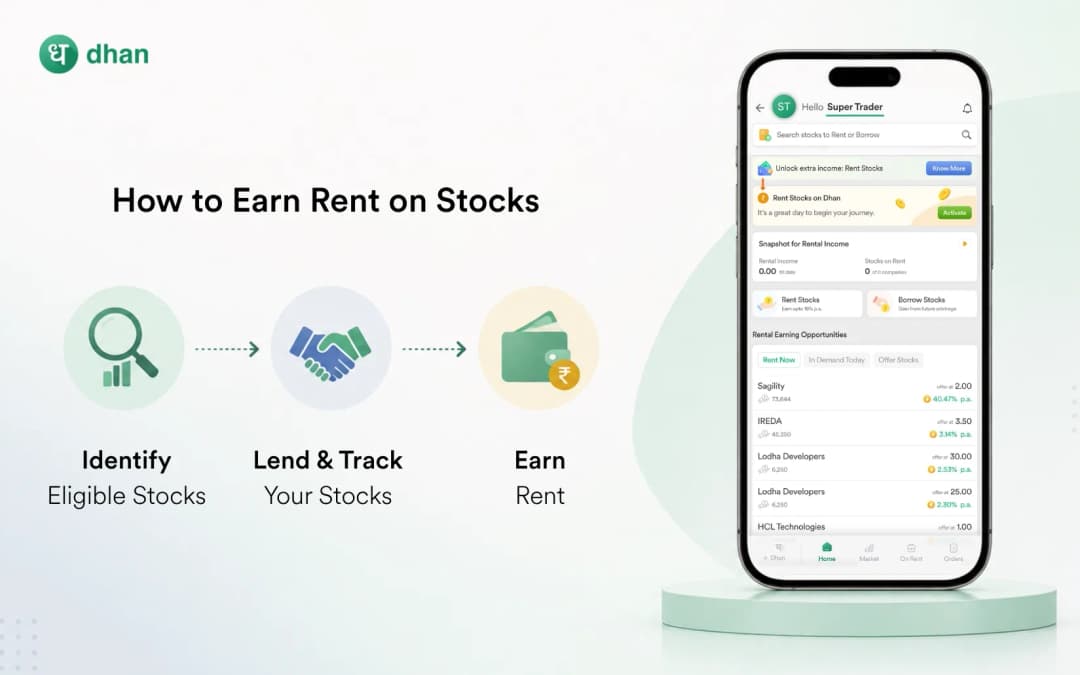
On Dhan, investors can identify lending opportunities, place lending orders and monitor active contracts through the dedicated Rent Stocks section. Dhan helps streamline the stock-lending workflow through the following features:
- Online transactions: Dhan has transformed the fragmented, multi-step offline stock lending process into a consolidated online process under the Rent Stocks section on its homepage.
- Real-time discovery engine: The 'In demand today' section shows real-time market demand for different stocks. Investors can instantly see which of their portfolio holdings are in demand among borrowers.
- Stock lending calculator: An in-built calculator helps investors gauge the net rental income and annualised yield in real time before placing a lending order.
- Frictionless execution: Investors can select an eligible stock, specify the quantity and place a lending order through the Rent Now option.
- Dedicated rental portfolio: A dedicated Rent Stocks interface lets investors view active contracts, monitor lending income and track contract expiry dates.
- Zero rental brokerage: Unlike the industry standard rental brokerage of 10% to 15% of rental income, Dhan charges zero rental brokerage.
- End-to-end digital onboarding: Investors can rent out stocks digitally on Dhan without visiting branches or submitting physical documentation.
Wrapping up
SLBM gives investors a regulated way to potentially earn lending income from their idle eligible holdings without permanently selling those securities. Dhan makes this process more accessible by bringing stock discovery, lending orders and contract tracking into a digital workflow. This can help long-term investors explore an additional use for eligible holdings that might otherwise remain idle in their portfolios for extended periods.
Before participating, investors should review the lending terms, understand the applicable charges and taxes, assess demand for their holdings, and consider whether the arrangement fits their investment objectives.