Multiple Demat Accounts








With the increasing number of retail investors in the Indian capital markets, the demat account has become an indispensable tool to hold investments in the Indian financial landscape. The demat account enables investors to manage all types of investments electronically, securely, and efficiently.
When investors move ahead in their investment journey, a common question arises: Can they have multiple demat accounts?
What is a demat account?
A demat (Dematerialised) account is an account for holding securities in an eleceaccount on Dhan holds securities like:
- Equity shares
- Mutual fund units
- ETFs
- Corporate bonds and debentures
- Government securities
Is it legal to hold multiple demat accounts?
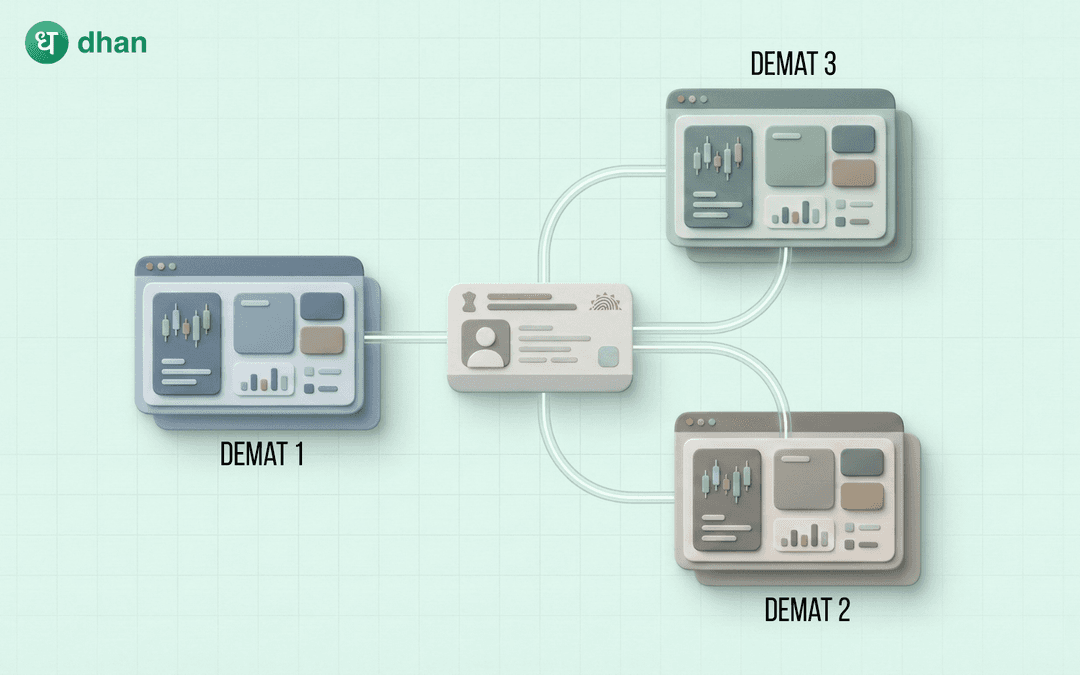
Yes, SEBI permits investors to hold more than one demat account, provided they comply with SEBI regulatory norms. Therefore, investors can hold multiple accounts on different brokerage platforms like Dhan, depending upon their requirements and preferences, by following certain key regulatory guidelines, such as:
- Every demat account has to be opened with a different Depository Participant.
- All demat accounts are linked to the same PAN card.
- Details such as the name, date of birth, and address in the KYC process should be consistent.
- It is not permissible to open two demat accounts with the same DP under a single PAN number.
- Joint demat accounts are permitted, but with the same ownership pattern in which the securities are held in physical form.
These guidelines have been laid down by SEBI to promote transparency and to prevent any misuse while reporting taxes.
Why investors choose multiple demat accounts
There are various reasons why investors hold more than one demat account. Some reasons are mentioned below:
Diversification
Some investors prefer to segment their long-term and short-term investment portfolios. This is done in order to avoid blending their short-term and long-term investment portfolios. It also helps in preventing the selling of their long-term investment portfolios when they are actively involved in short-term investment transactions.
Family requirements
There may be times when investors choose to open multiple demat accounts for different family members or to manage their inherited securities. This separation simplifies investment planning and helps maintain clear ownership records.
Availing different benefits
Various brokers offer different services, features, tools for research, and support. An investor can make use of the best qualities of different platforms by opening accounts with different brokers. For example, through this, one can make use of the derivatives trading service of a platform, the capital market research service of a different platform, and the low charges of yet another platform.
Risk management
Diversification of investment portfolios across several demat accounts helps in diversification of risk. This is because investors can continue with their operations despite whatever challenges their other accounts may face, whether related to technology or any other form of regulatory or operational disruptions.
Challenges of managing multiple accounts
Although there are some benefits of holding multiple demat accounts, managing them presents several challenges to investors, such as:
Increased costs
Each demat account incurs separate charges such as AMC, platform fees, etc. These charges accumulate across multiple accounts, potentially resulting in erosion of investment gains if the accounts are not actively used.
Complex portfolio tracking
As investments are distributed across multiple demat accounts, tracking investment holdings becomes increasingly difficult. Simultaneously, viewing overall investment performance, dividend income, and tracking investment records requires more effort and organisational discipline.
Tax complications
When it comes to tax return submission, the data from various demat accounts has to be consolidated. This can create difficulties when it comes to tracking capital gains, dividend income, and other taxable events across different platforms, and can be cumbersome, increasing the risk of errors or omissions.
Missed corporate actions
When there are corporate actions such as bonuses, rights, and stock splits, managing them can become an issue if the securities are held in multiple accounts. You'll need to respond and track corporate action notifications from each depository participant separately; otherwise, some corporate actions can go unnoticed if accounts are not regularly monitored.
Best practices for managing multiple demat accounts
If you find maintaining multiple demat accounts beneficial, the following best practices will help you do so efficiently.
Maintain comprehensive records
Create a centralised spreadsheet or use a portfolio management tool to track all your holdings across different accounts. It should include details like account numbers, depository participant details, securities held, and reasons for holding them. Regular updates to this master document will save time and prevent confusion while handling multiple demat accounts.
Define a clear purpose
Assign specific roles to each demat account. For example, if you have more than one demat account, you could use one for long-term investments, another for trading purposes, and the third for debt securities. This helps with clarity in investment strategy and simplifies decision-making.
Consolidate where possible
Periodically review your demat accounts and see where you can consolidate holdings to reduce operational costs. The consolidation of holdings is a simplified procedure that will enable you to transfer securities from one demat account to another.
Track annual maintenance charges
Be aware of the fees associated with each account type. At the same time, some annual fees can be waived if you maintain above the minimum trading activity or minimum balance levels.
Leverage technology
There exist many portfolio tracking apps that can aggregate holdings of multiple demat accounts, allowing you to oversee all your investments on a single platform. Using these tools simplifies tracking and analysis of different demat accounts.
Stay informed about corporate actions
You can set reminders and notifications for all demat accounts that will help you not miss deadlines related to corporate actions. Missing deadlines can lead to loss of opportunities.
Regular portfolio reviews
Perform quarterly or bi-annual analysis of all your demat accounts. Analyse whether each account is fulfilling its intended purpose, or if it makes more sense to consolidate your accounts and streamline operations without undermining your financial strategy.
When to consider consolidation
Despite the flexibility of multiple accounts, consolidation often makes financial sense in some situations. For example, if your dormant accounts are generating hefty maintenance fees, the expense might exceed the associated gain. Similarly, if multiple account administration creates more confusion than clarity, in these cases, account consolidation would serve as an enhancer for your investment process.
If you've decided that consolidation is the right move, following a systematic approach will ensure a smooth transition without disrupting your investment portfolio.
Step 1: Identify your primary demat account.
Step 2: Evaluate all holdings.
Step 3: Check for pending corporate actions.
Step 4: Begin off-market transfers
Step 5: Monitor the completion of transfers.
Step 6: Verify and reconcile
Step 7: Close inactive accounts
Conclusion
Holding multiple demat accounts is legal and can be strategically beneficial for some investors. The key lies in making use of the multiple accounts purposefully and not randomly accumulating them.
Whether you are planning to hold several demat accounts or merge them into a single account, the decision depends on your investment plans, risk tolerance, and ability to manage the portfolios. This clarity will ensure that the multiple demat accounts do not restrict you from achieving your financial plans, but instead help you to achieve them.
FAQs
Are there any limitations to the number of demat accounts I can open?
No, SEBI does not impose restrictions on the maximum number of demat accounts an investor can hold. You may open multiple demat accounts with different depository participants, based on your requirements. However, every demat account has to comply with the KYC guidelines and has to pay separate AMC charges every year.
Can I transfer securities between two different demat accounts?
Yes, you can transfer securities from one demat account to another via an off-market transfer facility. This is done by filling in the Delivery Instruction Slip (DIS) or making use of an online transfer service offered by the depository participant. This is an easy process, and some stock brokers charge a nominal fee for an inter-depository transfer. This transfer usually takes about 2-3 working days to complete.
Does holding multiple demat accounts impact my tax returns?
Holding multiple demat accounts doesn’t affect the tax liability you have to pay; however, having multiple accounts will make filing tax returns complicated for you. This is because you will have to compile the data for all accounts to calculate the capital gain and dividend income for the tax returns. Keeping proper records will help make this job a lot simpler for you.
What happens to my multiple demat accounts if I want to close one?
If you ever decide to close a Demat account, it is necessary to first shift its securities to another demat account or sell them. Only when the account balance is zero will you be able to make a request for closure of your account to your depository participant. Also, make sure that no unexecuted trade or corporate action is pending in your account.
Can I hold the same stock in more than one demat account?
Yes, it is possible to hold the same securities in multiple demat accounts. Various traders follow this process to separate different approaches to investments; for example, they make long-term investments in one account and trading activities in another account to avoid mingling both investment strategies.