


RBI repo rate hike to 5.50%: Top 10 stocks to watch






Key takeaways
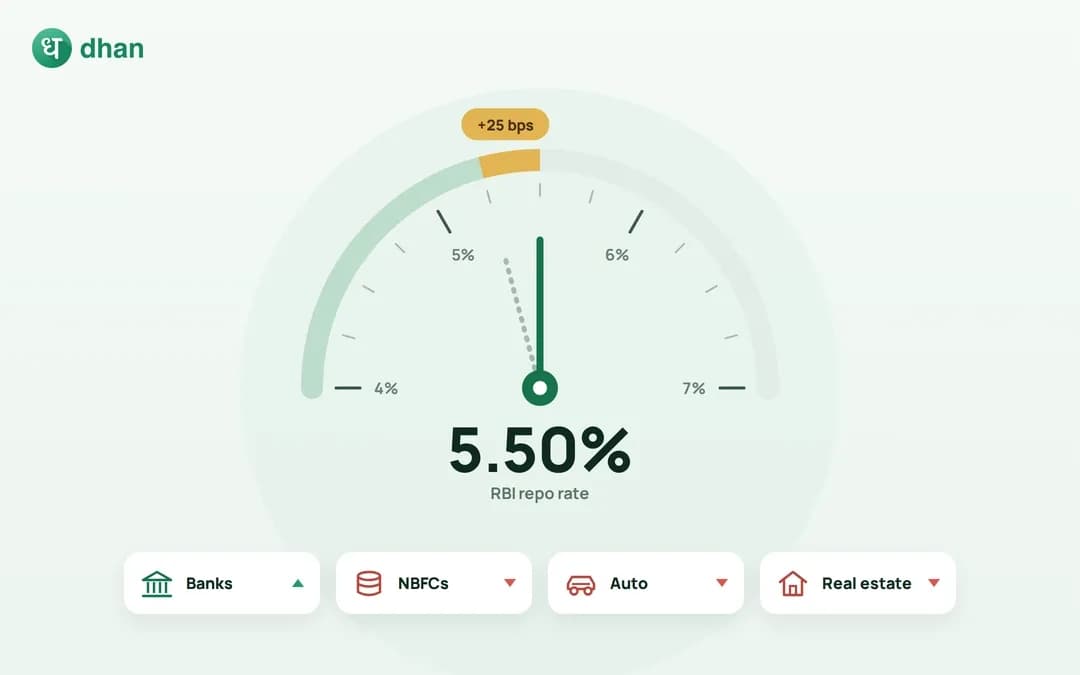
- RBI raised the repo rate by 25 bps to 5.50%, signalling a shift towards a tighter monetary policy after more than three years.
- Banks could benefit from loan repricing, especially those with higher exposure to repo-linked and floating-rate loans.
- NBFCs may face higher funding costs, while autos and real estate could see pressure from higher EMIs and weaker affordability.
- Kotak Mahindra Bank, Axis Bank, ICICI Bank and HDFC Bank are among the key banking stocks to watch, while Bajaj Finance remains important on the NBFC side.
On October 7, 2026, RBI increased the repo rate by 25 basis points to 5.50%. A 25-basis-point rate hike may look small on paper, but it can have a much bigger impact on the stock market. RBI has now signalled a clear shift after more than three years without a repo-rate increase. For investors, the question is no longer whether rates matter, but which companies could emerge stronger from this change.
In this blog, we examine the sectors affected by the new rate cycle and rank the top 10 stocks to watch.
Which sectors will be affected by the RBI repo rate hike?
Here are some sectors that will be affected by the recent repo rate hike:
Banking: The biggest potential beneficiary
Banks could benefit from the rate hike because many loans are linked to the RBI’s repo rate. When the repo rate rises, banks can increase interest rates on these loans. In June 2026, around 91% of floating-rate loans at private banks were linked to external benchmarks, compared with about 54% at public sector banks. This means many loan rates can rise faster when the RBI raises the repo rate
NBFCs: Funding costs are the key risk
NBFCs could face more pressure because their borrowing costs may rise after a rate hike. This can reduce profits if loan rates do not increase at the same pace. This could put pressure on margins, especially for NBFCs that rely heavily on borrowed funds.
Auto
Auto companies are rate sensitive because vehicle purchases often depend on financing. Higher rates can lift EMIs and affect affordability, especially for price-conscious buyers. Strong sales can cushion the initial impact.
Real Estate
Real estate faces pressure through higher home-loan and project-financing costs. Developers with stronger balance sheets and premium demand may absorb the impact better than highly leveraged peers.
Which 10 Stocks Should Investors Watch?
Here are the top 10 stocks that could see an impact from the RBI’s repo rate decision.
1. Kotak Mahindra Bank
Kotak Mahindra Bank could benefit if higher lending rates increase the income it earns from loans. When the RBI raises the repo rate, rates on some loans can also move higher, although the benefit could be partly offset if deposit costs rise.
Its September 2026 net advances rose 24.7% YoY to ₹5.77 lakh Cr, while deposits increased 23.2% to ₹6.51 lakh Cr.
2. Axis Bank
Axis Bank could also benefit as a higher repo rate can push up lending rates on some loans, supporting interest income. The benefit may be smaller if the bank has to pay more to attract deposits.
September 2026 gross advances rose 22.7% YoY to ₹13.85 lakh Cr, while deposits increased 20.7% to ₹14.52 lakh Cr.
3. ICICI Bank
ICICI Bank could be one of the better-positioned lenders if the repo-rate hike leads to higher loan rates faster than its funding costs. Its large lending business means even a small improvement in interest income can have a meaningful impact.
ICICI Bank reported that 55.3% of its domestic loan book was linked to the repo rate and other external benchmarks as of March 31, 2026. Another 31.5% was fixed-rate, and 13.2% was linked to MCLR and older benchmarks.
4. HDFC Bank
HDFC Bank could see some support as a higher repo rate can lead to higher rates on certain loans and support interest income. However, the bank may also face higher deposit costs as interest rates rise.
HDFC Bank’s deposits grew 18.8% YoY to ₹33.27 lakh Cr in September 2026, while its loan book increased 15.3% y-o-y to ₹33.07 lakh Cr.
5. State Bank of India
SBI could benefit from higher lending rates because of its massive loan base. A rise in rates on even a part of its loans can support interest income, although higher deposit costs could reduce some of the benefit.
SBI reported 18.63% YoY growth in whole-bank advances in Q1 FY27. Domestic advances rose 18.15%, RAM advances 18.20%, and deposits 9.73%. CASA stood at 39.24% on June 30, 2026.
6. Bajaj Finance
Bajaj Finance could face pressure if its borrowing costs rise faster than the rates it charges customers. A higher repo rate can make funding more expensive for NBFCs, which could put pressure on profits if lending rates do not rise at the same pace.
Also, Bajaj Finance raised FD rates by 15 - 40 bps across 12 - 60 month tenures, which are effective from October 7. The top rate for regular depositors moved to 7.75%.
7. Maruti Suzuki
Maruti Suzuki could face some pressure because higher interest rates can make car loans more expensive and increase monthly EMIs. This may lead some buyers to delay purchases, especially if borrowing costs remain high for longer.
Maruti Suzuki sold 236,013 vehicles in September 2026, including 185,252 domestic units, 6,542 units sold to other OEMs and 44,219 units in exports.
8. Mahindra & Mahindra
A higher repo rate can increase the cost of vehicle loans and put pressure on demand. However, M&M’s strong SUV performance currently provides some protection.
M&M sold 64,092 domestic SUVs in September 2026, up 14%, while total vehicle sales reached 114,874, up 15%.
9. DLF
DLF could face pressure as higher home-loan rates can make property purchases more expensive and affect demand. However, its strong cash position provides some protection if financing costs remain elevated.
DLF’s net cash position reached ₹15,200 Cr at the end of June 2026. Q1 FY27 sales bookings were ₹657 Cr, while net profit rose 4.1% to ₹793.90 Cr.
10. Godrej Properties
Godrej Properties could face pressure as higher mortgage rates may make home purchases less affordable and affect demand. Strong customer demand, however, can provide some cushion if the rate increase does not continue for an extended period.
Godrej Properties reported Q1 FY27 booking value of ₹8,651 Cr, up 22% YoY, with 3,738 units sold.
What Should Investors Watch Next?
For banks, watch loan repricing, deposit costs, CASA and NIM. For NBFCs, focus on funding costs and spreads. For autos and real estate, track EMIs, volumes, bookings and affordability.
Liquidity also matters. RBI Governor Sanjay Malhotra said banking-system surplus liquidity had averaged about ₹7.3 lakh Cr, or 2.7% of deposits, since early September. The RBI plans to absorb the surplus gradually through its liquidity operations.
Conclusion
October rate hike creates clear winners and losers. Large banks with stronger lending businesses look better positioned, while NBFCs, autos and real estate face pressure.
The impact, however, will depend on how long rates remain high and how quickly companies adjust to the new environment. Investors should therefore focus on earnings, demand and funding costs rather than the rate hike alone.