Stop Loss Order





Key takeaways
- Stop loss helps limit losses in the market by automating the process of executing an order at a specific price.
- The correct placement of a stop loss should always be based on market structure, volatility, and the way that one trades.
- There are different types of stop loss strategies, namely fixed, trailing, and volatility stops, among others.
Most traders place significant importance on seeking that perfect entry. Yet, experienced traders know that capital protection should always take priority over the actual act of entering the trade. That is where the importance of using a stop-loss order comes in.
A stop-loss order is a useful instrument that helps to limit risks in the financial market. In case the market moves against the trader’s position, the stop loss order helps to automatically limit possible losses. Otherwise, even small errors can lead to considerable losses.
Be it stocks, commodities, forex, or derivatives, understanding the use of stop-loss orders is important for trading in a disciplined way.
What is a stop-loss order?
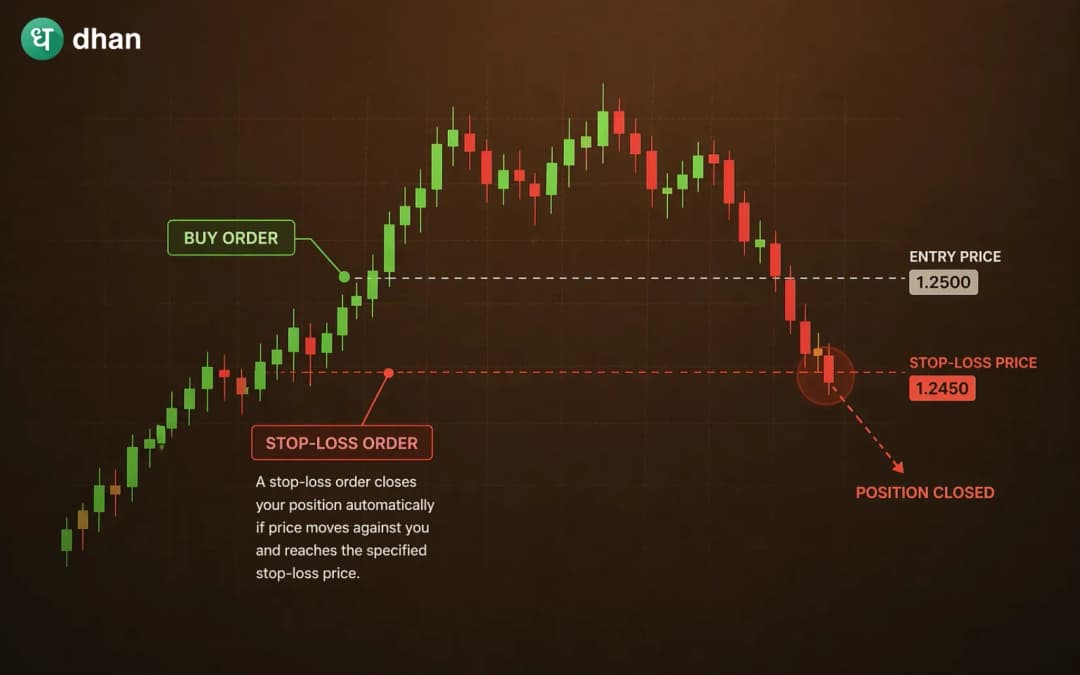
A stop-loss order refers to an order or instruction given to a broker to automatically buy or sell the security when it touches a certain price, referred to as the stop price.
The primary objective of a stop-loss order is clear to prevent any possible loss.
For instance,
- You purchase a stock at ₹500
- You set your stop-loss order at ₹470
- If the price drops to ₹470, the order is automatically executed.
This prevents instances where traders hold onto a losing stock position, hoping that the price will go up.
This removes the element of human emotion from volatile stock movements.
Why stop-Loss orders matter in trading
Market trends can be reversed within mere seconds based on sudden information, market changes, global events, or heavy selling. In the absence of risk management practices, an otherwise well-thought-out trading plan could end up being highly unsuccessful.
Traders who do not place stop losses tend to:
- Keeps losing trades for too long
- Cut their profits prematurely
- Average out of bad positions
- React irrationally during market turmoil
- Losing control over their risk management
Stop losses offer an automatic exit strategy for the trade ahead of time. Stop losses help traders to:
- Restrict losses automatically
- Protect their trading money
- Avoid making decisions based on emotions
- Maintain discipline in trading
- Trade consistently under volatility
In trading, loss management comes before profit management. One uncontrolled trade can undo months of profits.
Types of stop-loss orders
There are various kinds of stop losses which can effectively serve varying circumstances.
1. Fixed Stop-Loss
This is the most commonly followed approach. The investor sets a certain price level where the trade will exit automatically.
For example,
Entry Price: ₹1000
Stop-loss Point; ₹950
In case the stock prices drop to ₹950, the position closes automatically.
Pros:
It is simple to follow and manage risk exposure.
Cons:
The stop level does not adjust itself to changing market conditions.
2. Trailing Stop-Loss
The trailing stop-loss changes its position whenever the market price changes in favour of the trader.
Example:
- Buy stocks for ₹100
- Set trailing stop-loss for ₹10
- Market price rises to ₹130
- Stop-loss automatically gets adjusted to ₹120
This helps traders earn profits while moving further ahead.
Pros:
The traders can easily lock in their profits during a strong trend.
Cons:
Unforeseen volatility in the market may lead to an early exit from the trade.
3. Stop-Loss Market Order
Once the stop price has been reached, the trade is automatically executed at the best possible market price.
Pros:
It increases the chances of execution in a volatile market.
Cons:
It increases the slippage risk when market moves quickly.
4. Stop-Loss Limit Order
In this category, both the stop price and limit price are determined by the trader.
Execution takes place only within the specified limit range.
Pros:
It provides more flexibility in controlling the execution price.
Cons:
It may not be able to be executed as it lies outside the limit price.
Difference between Stop-loss market and Stop-loss limit orders
This table gives a brief overview of the usage of each order:
How traders decide stop-loss levels
Putting random stop-loss levels is one of the most common mistakes made by traders. Stop loss must take into account market structure and trading strategies. Here are some ways to set a stop loss:
Percentage-Based Stop-Loss
Under this strategy, the traders take a fixed percentage of their total trading capital in each trade.
Example:
- 3% risk per trade
- Capital: ₹3,00,000
- Maximum Risk: ₹9,000
This approach facilitates consistency in risk management. This strategy is easy to follow and good for beginners, but it does not consider the real market situation and chart patterns.
Support and Resistance Method
Traders normally place their stop-loss orders near the level of support or resistance shown in the price chart.
Example:
- Place a stop-loss below support for a buy trade
- Place a stop-loss order above the resistance on a short position
This approach ties stop placement to real market action rather than arbitrary price levels. This allows traders to avoid unnecessary exit points when prices fluctuate normally.
Volatility-Based Stop-Loss
Highly volatile securities should have higher stop loss placements since prices fluctuate heavily in a relatively short period of time.
Technical tools such as ATR (Average True Range) can help traders determine the average market movement before entering into any stop-loss order.
Example:
- High ATR -> High stop loss
- Low ATR -> Low stop loss
This strategy avoids triggering stop losses prematurely in volatile market conditions.
Common stop-Loss mistakes traders make
Despite their simplicity, most traders use stop-loss orders incorrectly.
Keeping the stop-loss too tight
Very closely placed stop-loss orders might get triggered even when there are only normal price movements. This leads to excessive exits and missing out on profitable opportunities.
Moving stop-loss repeatedly
Some investors adjust the stop-loss to a lower level when they open an unfavourable position.
This makes risk management ineffective.
Trading without any stop-loss
One of the most serious mistakes while managing risks comes from trading without a stop-loss order. It leads to losses and emotions getting into decisions. Losses can accumulate very quickly through unmanageable trades.
Ignoring market volatility
The application of a uniform stop loss size across all stocks or assets does not work.
Each asset behaves differently from others.
Advantages of stop-loss orders
There are several benefits offered by stop-loss orders apart from protecting against losses.
Better emotional control
Stop-loss orders keep the trader calm in case of abrupt changes in the markets since the exits have already been planned.
Stronger risk protection
A stop loss sets the highest tolerable loss prior to entering the trade, ensuring that capital is safeguarded against unlimited downside risk.
Faster trade management
The trader does not have to monitor the market continuously after setting the stop-loss orders. Everything happens automatically once the price triggers.
More consistent trading
The key benefit of setting stops lies in ensuring discipline in exiting trades, which prevents traders from incurring huge losses.
Disadvantages of stop-loss orders
Below are some downsides of using stop-loss orders that you need to take into account when making a risk management plan.
Slippage risk
In case of extreme volatility, transactions may be made at prices different from what was expected. This happens during sharp market movement or an important news release.
Premature exits
Sometimes, even normal market fluctuations may cause stop losses to be triggered prematurely, which might lead to closing the trade before the real trend materialises.
Gap-opening risk
If the market gap opens either high or low, stop-loss orders might not be executed at their precise intended levels. An overnight gap widens the possibility of this happening.
Poor stop placement
The arbitrary placement of stops can result in too many exits. Knowledge of the volatility and construction of the markets is essential here.
Overdependence on stops
Stop losses can never fix bad trading and bad risk management. Proper trade planning is needed in order to be successful.
Best practices for using Stop-loss orders
For effective use of stop-loss orders:
Set risk before entry
One must determine the acceptable risk prior to entering into a trade. The decision provides structure to trading from the start.
Avoid emotional adjustments
Do not change your stop loss order emotionally after sustaining losses. Losses form an essential part of trading.
Match stop loss with market volatility
Volatility calls for bigger stops because of market movement. With smaller stops, the chances of being stopped out prematurely become high.
Maintain healthy risk-reward
Don’t execute any trade where the risk is greater than the potential reward. Favourable risk/rewards increase consistency.
Review stop placement regularly
The market is dynamic during trading hours. Checking your stop levels ensures your trades work according to the market trend.
Use proper position sizing
The most effective stop loss can be rendered useless by oversized positions. Proper position sizing is crucial for risk management.
Wrapping up
A stop-loss order isn't just a part of the trading system; it's a survival technique in finance.
In most cases, it is not the faulty analysis but the improper risk management that leads to losses after the trade starts moving against the position. Proper stop loss techniques can assist in managing risks and avoiding emotionally driven decisions.
There is no perfect exit strategy for all, but failing to have an effective exit strategy makes one prone to risk.
FAQs
Can stop-loss orders be used in intraday trading?
Yes. The use of stop-loss orders is common practice during intraday trading to limit rapid loss during very volatile periods.
Can stop-loss orders fail during market crashes?
Yes. When there is a market crash or a gap occurs, the movement can be extremely quick, causing prices to vary from expectations.
Which is better for volatile markets: tight or wide stop-loss?
Wide stop losses are more suitable for volatile markets since tight stops may get triggered early because of the volatile price action.
Why should stop-loss be placed close to support and resistance?
Support and resistance levels always lead market-wide buy and sell orders. A stop-loss that is placed arbitrarily within support and resistance levels may cause unnecessary triggers.
Can a trader make profits using stop-loss in case of strong trend movement?
Yes, traders can use a trailing stop loss that will track the movement of the stock price and help them earn profits without being forced to exit their positions early.