What is SOA?







There’s no denying that you put in significant time selecting the right stocks, mutual funds, and SIPs. But did you ever sit and think about how these investments are actually recorded?
Often, this gap creates confusion, particularly when you notice some investments appear in a demat account, while others reflect through a separate statement altogether.
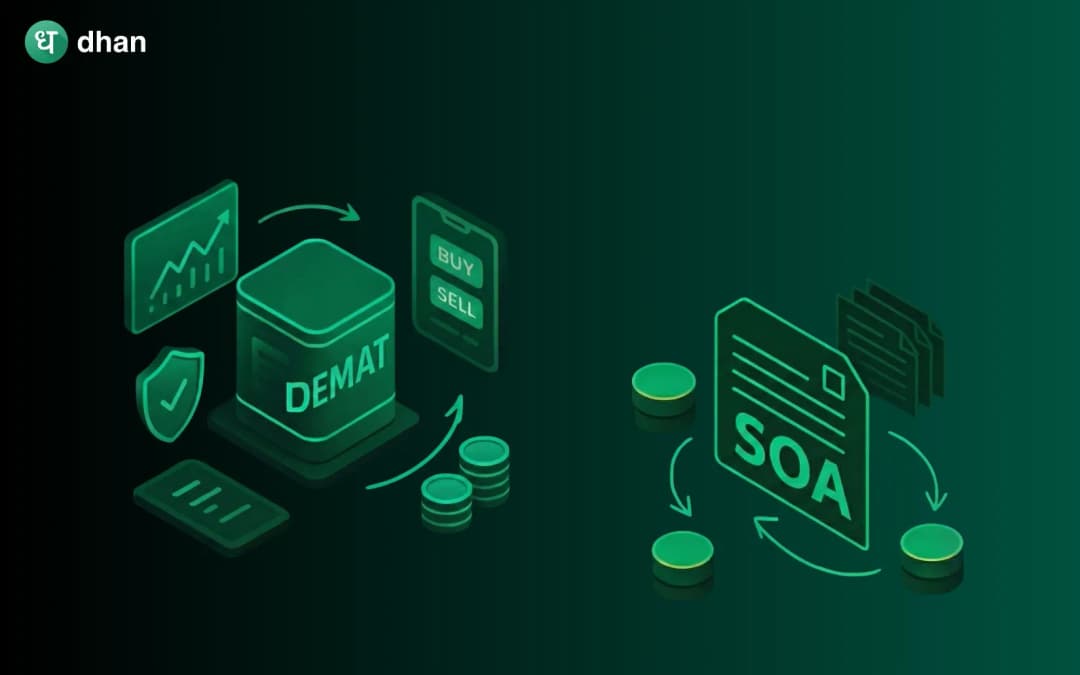
This is where you must understand the differences between a demat and an SOA (Statement of Account). The common point is that both of them serve the same goal of tracking your ownership of assets. However, there’s a difference in the process through which they work.
So, if you’re diversifying your investments through mutual funds, equities, ETFs, or bonds, you must understand these differences to track your portfolio better and ensure compliance.
Initially, both SOA and a demat account may appear interchangeable. However, they cater to different preferences and investment styles. In this guide, we have comprehensively explained what an SOA is, how it works, and how it is different from a demat account.
What Is a Statement of Account?
Before we discuss demat vs SOA in depth, you must know what a statement of account is.
A Statement of Account (SOA) is a document that records your mutual fund investments. However, an SOA does not hold securities electronically like a demat account. It reflects the units you own in particular schemes of a mutual fund. The fund house directly issues these units, and they are linked to your PAN.
Investors who commonly access the money market through AMCs use SOAs. Therefore, it provides you with a transparent record of transactions, and you don’t need a trading or brokerage account for this.
Who Issues an SOA and How It’s Maintained?
Mutual fund AMCs and their Registrar and Transfer Agents (RTAs), like CAMS or KFintech, issue SOAs and maintain them. A folio number is used to record each transaction, and it is then mapped to your PAN. These transactions may include:
- SIP instalment
- Lump-sum investment
- Redemption
As the system is based on your PAN, a single statement can easily consolidate all your mutual fund holdings across AMCs.
What information an SOA contains?
Your SOA provides a number of essential details, like:
- Name and PAN of the investor
- Names of mutual fund schemes
- Units held and NAV
- Transaction history
- Folio numbers
- Mode of holding
- Nominee details
Therefore, an FOA provides a comprehensive record of your mutual fund ownership.
How SOA investments work in practice
When you invest in a mutual fund through AMCs, you buy the units directly from the respective fund house. Therefore, exchanges are not involved in the process. Once your investment is processed, the authorities allot your units at the NAV applicable. It is then recorded under your folio.
Your SOA reflects SIPs, lump-sum investments, redemptions, and switches. So, the process doesn’t require a trading account to execute the orders. Everything is processed based on NAV cut-off times.
As an investor, you can access your SOA through:
- AMC portals
- RTAs
- Monthly or quarterly consolidated account statements
This structure is suitable for long-term investors who prefer simplicity, lower costs, and direct ownership.
What Is a Demat Account?
A demat account is an electronic account where your securities are stored in digital form. So, you need not hold physical certificates for assets like shares, ETFs, bonds, and mutual fund units. These are safely stored electronically with a depository.
Investors prefer creating demat accounts on platforms like Dhan. These accounts are essential for online transactions, where you can buy, sell, and transfer securities.
Assets held in a demat account
A demat account can hold a wide range of assets. These include:
- Equity shares
- ETFs
- Bonds and debentures
- Mutual fund units
- REITs and InvITs
Therefore, your demat account serves as a consolidated space to hold multiple asset classes.
Depositories like NSDL and CDSL maintain demat accounts through registered Depository Participants (DPs). Typically, these are your brokers.
The demat account is linked to a trading account. This helps you seamlessly execute trades, which are then settled.
Demat vs SOA - Key Differences
The key demat vs SOA difference lies in where and how your investments are stored.
Storing your assets
SOA records mutual fund units that are issued directly by AMCs. Demat accounts, on the other hand, store securities that are traded in the market electronically.
Investments in an SOA are not exchange-based. However, demat holdings are settled at exchanges.Access
AMCs and RTAs are responsible for managing SOAs. On the contrary, brokers and trading platforms provide you with access to your demat account.
SOA is ideal for investors who focus primarily on mutual funds. Demat, on the other hand, would be more suitable for you if you invest across equities, ETFs, and derivatives.
Transaction behaviour
The transaction behaviour constitutes another key demat vs SOA difference. Investments recorded in an SOA are NAV-based. They are processed once per day. However, demat trades are executed in real time during market hours.
However, both these options are regulated and safe. Therefore, the ultimate choice depends on your investment style, asset mix, and convenience.
Which option should investors choose?
When you compare demat vs SOA, none of the options is absolutely better. It all depends on your investment preferences.
Suppose you’re a long-term mutual fund investor who prefers SIPs with direct investing. SOA often proves sufficient as there’s minimal complexity in tracking.
However, if you have a fairly diversified asset mix like stocks, ETFs, and bonds, or want a consolidated place to store all your investments, a demat account would be a better option.
Many investors use both SOA and demat accounts. The SOA format is more suitable for mutual fund tracking, while stocks and ETFs remain in demat accounts. With this hybrid approach, investors enjoy the flexibility they need.
Taxation, reporting, and compliance differences
There’s no demat vs SOA difference from the tax perspective. Depending on the type of asset and the holding period, the capital gains are calculated.
However, there’s a difference in reporting. SOA investments are reported through AMC and RTA statements. On the other hand, demat investments appear in broker and depository reports. This gap is bridged by the CAS, which combines these two formats into a comprehensive view.
This simplifies compliance for investors, regardless of the holding format. The only crucial requirement is to maintain the record properly.
Common misconceptions around SOA and demat
Before we wrap up this demat vs SOA blog, let’s bust some common myths.
SOAs are unsafe
Some investors hold the wrong conception that SOAs are outdated and unsafe. In reality, SOAs are transparent and properly regulated. Long-term investors widely use SOAs for tracking mutual funds.
Demat accounts are mandatory
Another misconception is that demat accounts are mandatory for all investments. While you do need a demat account for stocks, they are optional for mutual funds.
Demat holdings perform better
Some investors also believe that demat holdings perform better. That’s not true. Ultimately, your returns depend on the performance of the underlying asset, not how you record it.
Now that you know the facts, you can make informed decisions as you build wealth.
Summing it up!
As an investor, you would like to choose the right asset classes. However, that’s only half the journey. You must also know how your investment is recorded and tracked.
You may prefer the simplicity of SOA or want to stay consolidated through a demat account. With clarity, you can exercise better control over your assets and invest with confidence.
FAQs
Can I convert mutual fund holdings from SOA to demat format?
Yes. You can request a conversion through your broker or AMC to convert your mutual fund holdings from SOA to demat format.
Is a demat account compulsory for SIP investments?
No. You can invest in SIPs through an AMC even if you don’t have a demat account.
Are SOAs safe and regulated?
Yes. The investments you make through an AMC are recorded in the SOA and are regulated by SEBI. AMCs and RTAs are responsible for maintaining them.
Can I track both SOA and demat investments together?
Yes. CAS combines both these formats into a single report.
Do brokers charge fees for SOA?
Typically, SOAs do not involve brokerage charges. This is because AMCs directly handle them.