


Risk Management in Stock Market





By understanding and implementing effective risk management strategies, the Indian investor can navigate the intricacies of the stock market with greater confidence, ensuring their capital is protected and striving for consistent and substantial rewards. In this blog, we will explore some of the key ways to reduce risk in the stock market.
Risk Management Strategies for Stock Market
Effective risk management doesn't require complicated financial models but common sense, discipline and a long-term perspective. Some simple practices that help reduce risk in the stock market are:
Diversification
Diversification is one of the best practices to minimize the risk of investing in the stock market. It involves the diversification of investments across different assets, industries and geographical regions such that the bad performance of one investment is compensated for by the strength of another investment. Investors can spread their investments among the following:
- Across asset classes: Don't invest all the investment in one asset class, as this makes the investment more concentrated. Consider diversifying investments in ETFs, bonds, gold, real estate, or other asset classes as they tend to perform differently under various market conditions.
- Across industries/sectors: Within the same asset class, diversify among companies in different sectors (e.g., IT, healthcare, banking, manufacturing). This helps to ensure that the portfolio is not too reliant on the fortunes of one industry.
- Across market capitalizations: Invest across large-cap stocks, mid-cap stocks and small-cap stocks. Large-cap companies provide stable returns, whereas the mid and small caps provide higher growth potential but with increased risk, providing a balance to the portfolio.
- Geographical diversification: Indian investors can also consider geographical diversification by investing in international markets, which can provide exposure to different economic cycles and mitigate country-specific risks.
- Mutual funds and ETFs: For retail investors, mutual funds and Exchange Traded Funds (ETFs) provide a convenient way of achieving diversification, as they invest in a basket of securities that are chosen by the professional fund managers.
Stop-loss orders
A stop-loss order is an important risk management tool that has allowed an investor to pre-define the maximum amount of loss that they are willing to suffer on a particular stock. It's an order to sell a security if the price falls below a specific price.
For example, if an investor buys a stock at Rs. 100 and he places a stop loss order at Rs. 90, then the investor will have an automatic sale of the shares if the price of the stock becomes Rs. 90, and he will have a loss of only 10%. Thus, stop-loss orders help investors to protect themselves from a huge loss if the stock records a plunge unexpectedly.
There are different types of stop-loss orders, such as market orders (orders that are executed at the next available price) and limit orders (orders that are executed at the specified price or better).
While the use of stop-loss orders is a good strategy, it's important to place them at a realistic level, away from a price that might lead to premature selling in response to normal market volatility.
Asset allocation
While diversification is important to help spread risk, asset allocation is more about finding the best mix of different asset classes (such as stocks, bonds, and cash) depending on an individual's investment goals, risk tolerance and investment time horizon. Some key things to take into account for asset allocation are:
- Risk tolerance: Aggressive investors can invest a higher percentage in equities, while conservative investors may prefer investing more in debt instruments.
- Time horizon: Younger investors who have a longer time horizon can afford to assume more equity risk because they have time to recover from market downturns. Those who are closer to retirement are more conservative in their allocation.
- Financial goals: The asset allocation strategy should be synchronised with an individual's financial goals, such as retirement planning, buying a house, or financing their child's education.
Regularly review and rebalance asset allocation to ensure that it is still in line with the individual's changing financial situation and market conditions.
Invest for the long term
The stock market has historically shown an upward trend in the long term, irrespective of the market volatility, while in the short term, market volatility has a significant impact on stock market returns.
Investing with a long-term perspective (5-10 years or longer) will give investments more time to ride out a downturn in the market and take advantage of the power of compounding. Some of the benefits of long-term investing include:
- Mitigates short-term volatility: Daily or monthly movement in the market does not have a greater significance in the long run (years).
- Compounding: Reinvesting returns (such as dividends) allows returns to generate their own returns, which result in exponential growth over time.
- Reduced emotional decisions: A long-term perspective eliminates panic selling by investors in corrections.
- Tax Efficiency: India's taxation policy on capital gains is more tax efficient for long-term gains (held for 1 year or more) as compared to short-term gains (held for less than 1 year).
Check best stocks for long term investing
Invest via Systematic Investment Plans (SIPs)
A Systematic Investment Plan (SIP) implies investing a fixed amount on a regular basis (like weekly, monthly, or quarterly) in a mutual fund or a particular stock. This strategy aids in reducing the risk through:
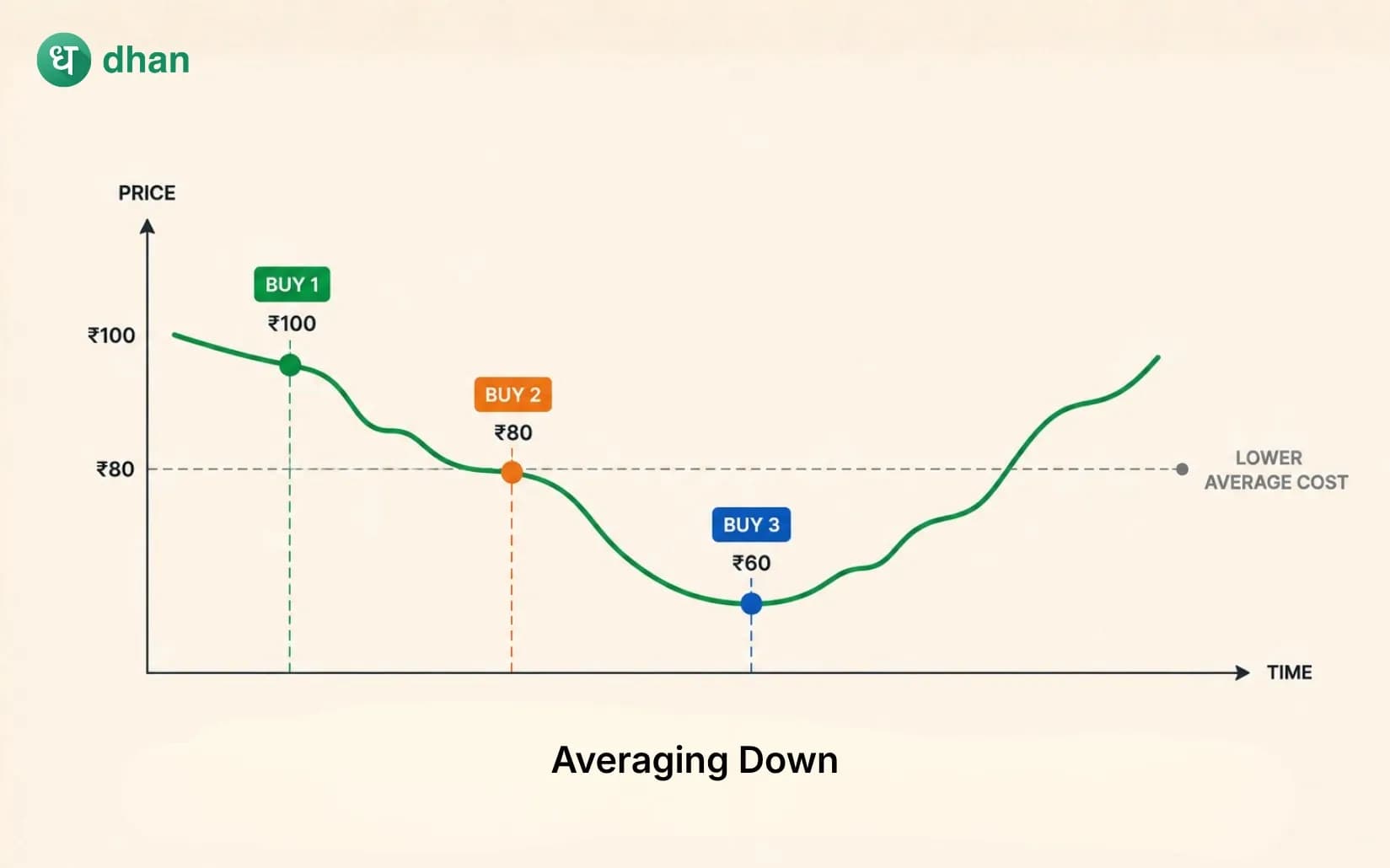
- Rupee cost averaging: When the market prices are high, the fixed investment buys fewer units, and when the market price is low, the fixed investment buys more units. Over time, this averages out the cost of the purchase per unit and provides better returns.
- Disciplined investing: SIPs help to build financial discipline in the investors as they automate the regular investments and help to avoid emotional decisions. The SIP calculator can be used to estimate monthly investments according to the desired goals.
- Affordability: With SIPs, investors can even invest small amounts regularly, which makes it accessible for everybody to invest in the stock market.
Avoid over-leveraging
The use of borrowed money (margin trading) using a margin trading facility or MTF for purchasing stocks can lead to a greater return, but it also has an inherent risk of magnifying the losses when the market moves sideways. In the case of market downturns, leverage investment losses even exceed the initial investment. Some of the risks that are common with leverage investments include:
- Increased Volatility: Even small movements in the stock prices can translate into large percentage gains or losses on the initial capital.
- Margin calls: If the investment value falls below a specific amount, the broker makes a margin call that requires investors to add more funds, and if the investors are unable to do so, the broker forces the sale of the investors' holdings to recover the losses.
- Emotional stress: The stress of amplified losses can result in irrational decision-making.
Conclusion
Investing in the stock market can be a powerful tool in wealth creation, but it is not without its inherent risks. The key to successful and sustainable investing is to understand and mitigate these risks by adopting simple but profound approaches such as diversification, use of stop loss orders, strategic allocation, long-term investment horizon, investing through SIPs and not using too much leverage.
These practices transform what would otherwise be a daunting experience of market volatility into a chance of steady growth. So, ultimately, the wins that are made in the stock market are made by the smartest risk managers. By including these practices, investors can build a resilient portfolio that can weather market storms and deliver substantial wealth over time.
FAQs
How does the SEBI SCORES platform assist in Risk management?
The SEBI SCORES platform is an online platform by the Securities and Exchange Board of India (SEBI) for investors to make complaints against listed companies, registered intermediaries and market infrastructure institutions. It is an important risk mitigation mechanism to provide a formal grievance redressal mechanism. By facilitating the timely and efficient resolution of investor complaints, SCORES contributes to the transparency and accountability of the Indian securities market.
Is it better to invest long-term or short-term?
For most investors, it would be recommended to invest in the long-term, not to act in the short-term. Long-term investing has the advantage of compounding, mitigates the effects of short-term volatility and often has lower transaction costs and more favourable tax treatment of capital gains. Short-term investments tend to be associated with higher risk, require active management and can be emotionally draining.
How often should I rebalance my portfolio?
Portfolio rebalancing should be done periodically (usually twice a year) to ensure the alignment between your asset allocation, investment goals and risk tolerance. Rebalancing is an action to adjust the portfolio back to its target asset allocation.
Is it possible to eradicate the risk in the stock market?
No, it is not possible to eliminate the risk in the stock market. Every investment has some inherent risk involved. However, there are various strategies, like diversification and stop-loss orders, that can be
adopted to reduce and manage these risks to an extent.
What allocation should I have for stocks or bonds?
The best combination of stocks and bonds will depend on your age, risk tolerance and investment horizon. A common rule of thumb is the 100 minus age rule, which involves subtracting your age from 100 to get an idea of what percentage of your portfolio your investments should be in equities, with the remainder going to safer investments like bonds. For example, if one assumes they are 30 years old, this formula would mean 70% investments in equities and 30% in bonds.