What are Upper circuit & lower circuit in Share Market?





Market fluctuations have a significant impact on market stability. Therefore, stock exchanges employ various mechanisms to maintain market stability and prevent excessive volatility that could lead to huge losses for traders.
Of the many such mechanisms, the most prominent ones are "circuit breakers" in the form of upper and lower circuits. These limits act as temporary speed bumps to stop trading or to limit price changes when a stock's price changes too fast. In this blog, we will explore the upper circuit, lower circuit, why stocks hit these limits, and what it means for traders.
Upper circuit, lower circuit
A circuit breaker is a predetermined price limit within which the price of a stock is allowed to move during a single trading day. These circuit limits are expressed as a percentage change in price from the previous day's closing price.
A stock may have a circuit limit of 5%, 10%, or 20%. The percentages may be different for different stocks depending on the volatility of the stock, market capitalisation, and the exchange's rules. If the stock price reaches the lower limit or upper limit of this predefined range, then the following circuits come into action:
Upper Circuit
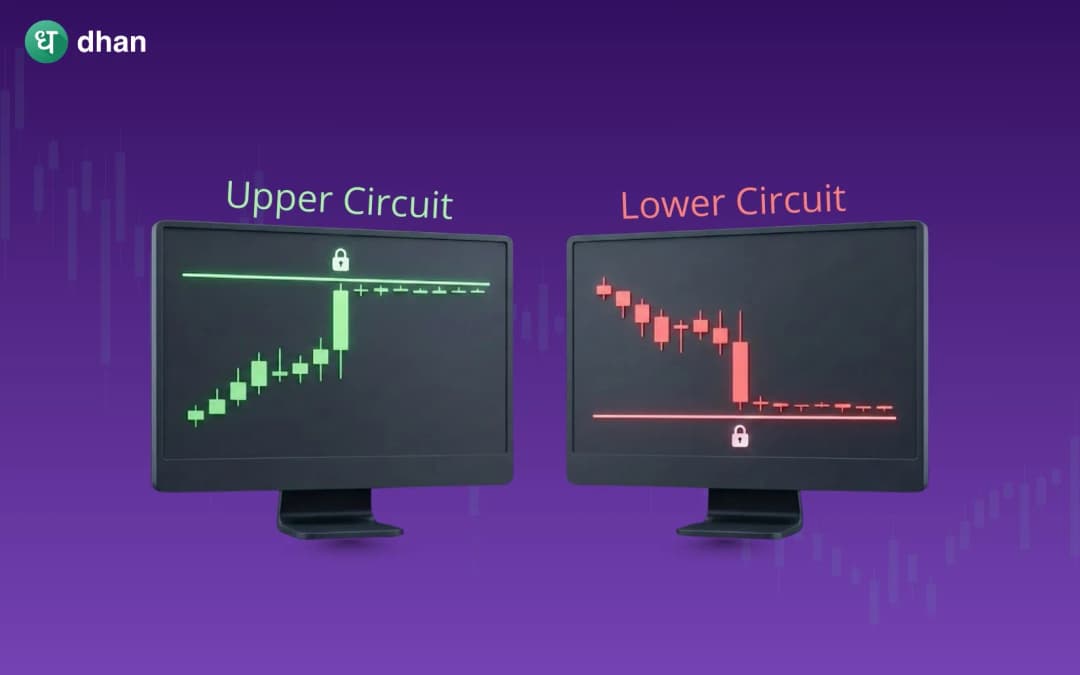
The upper circuit is the maximum price that a certain stock is allowed to reach in one trading day. It is a percentage increase from the previous day's closing price. If the stock reaches this limit, trading at prices higher than the upper limit is prohibited, and upward trading activity is temporarily stopped.
For instance, if a stock closes at Rs 100 and has an upper circuit limit of 10%, it means the highest possible stock price at which the stock can trade the next day is Rs 110. If the stock's price reaches this limit, then the upward trading activity of the stock is stopped, and this temporary pause gives time to buyers and sellers to review market conditions.
Lower Circuit
The lower circuit is the lowest price at which the stock can fall in a single trading session. It is calculated as a percentage decrease from the closing price of the previous trading day. In case the stock price reaches this lower limit, trading is stopped to prevent further downward spirals and panic selling.
For instance, if the closing price for a stock is Rs 100 with a lower circuit limit of 10%, then the stock cannot trade below Rs 90 in the next session. If the stock's price reaches this level, then the trading activity of the stock is stopped. This helps safeguard the market participants from sudden, unchecked price crashes and supports orderly price discovery.
Why stocks hit upper and lower circuit limits
Stocks often reach upper or lower circuits because of buying and selling pressures coupled with market sentiments and news events. Some of the reasons that are responsible for reaching these limits are mentioned below:
Excessive buying demand
Events like strong quarterly earnings, acquisition news, or strategic corporate decisions lead to positive trader optimism, which in turn increases the buying demand and pushes the stock prices to the upper circuit. This surge characterises strong enthusiasm in the market and could often be spotted in smaller or less liquid stocks, where fewer trades have a significant impact on the stock prices.
Intense selling pressure
On the other hand, negative news events like poor earnings reports, regulatory fines, or economic downturns may lead to heavy selling pressure. When there are more sell orders than buy orders, the stock price falls sharply, which at times results in the stock reaching its lower circuit. The market condition could be further aggravated by panic selling, margin calls, or stock downgrades.
Liquidity
Lower liquidity or float stocks can hit the circuits more frequently as the relatively small trades move prices significantly. In illiquid markets, a lack of buyers or sellers will see a rapid change in price to circuit limits.
Market-wide volatility
Sudden shocks to the market as a result of geopolitical crises or economic surprises could result in various stocks hitting circuit limits, often lower circuits during sell-offs. In that scenario, the circuit breakers could get triggered at an index level and bring a halt to trading to avoid systemic risk.
What circuit hits mean for traders
The following are some of the consequences of upper circuit, lower circuit hits for market participants:
- Liquidity Constraints: When the stock hits the circuit, one-sided order books are created with only buyers in the upper circuit or only sellers in the lower circuit. This may trap a trader who wants to exit, but they will face liquidity constraints now.
- Challenges related to Risk Management: It will also influence both stop-loss and intraday trading strategies when the circuit hits. The price movements are constrained, so making an exit from trade takes time and becomes a difficult task.
- Sentiment Indicator: Frequent circuit hits reflect extreme market sentiment, which can be either exuberance in the upper circuits or fear in the lower circuits, providing cues on overbought or oversold conditions.
- Opportunity or Caution: The savvy trader uses the upper circuit hits as an indication of market momentum, while the lower circuits highlight value-investing opportunities after capitulation phases.
The bottom line
Upper and lower circuits form the necessary tools in the armoury of stock market participants for balancing between price discovery and investment protection. They prevent runaway increases or decreases in prices by limiting the price range within a specific bracket each day to give market participants some time for rational decision-making.
It would also further facilitate market participants to navigate market volatility with awareness, make informed investment decisions during trading halts, and avoid emotional reactions to a sudden spike or fall in prices. You can stay updated with real-time data on Dhan, which can help you make informed decisions.
FAQs on Upper & lower circuits
1. How are the circuit limits decided for a particular stock?
The limit of the circuit varies from stock to stock depending on various variables such as liquidity, market capitalisation, and volatility. In India, the general daily circuit bands are 2%, 5%, 10%, and up to 20% from the previous day's closing price. These limits periodically go through review by the exchanges and regulators, such as SEBI, to strike a balance between investment protection and market efficiency.
2. Can a stock trade beyond the upper or lower circuit on the same day?
No, once a stock reaches its circuit limit, be it the upper or lower limit, it cannot trade above or below that price for the remaining part of that trading session.
3. What if a stock repeatedly hits its upper circuit?
This would be a signal for strong bullish market sentiment. However, ahead of making any investment decisions, market participants should also assess fundamentals in order to avoid chasing overbought stocks.
4. How do circuit limits work to protect market participants?
Circuit limits protect market participants, preventing irrational price fluctuations and reducing the chance of market manipulation, while assuring orderly trading and giving markets an opportunity to absorb new information without causing shock waves or surges in prices on speculative grounds.
5. Can traders trade shares after a stock hits its circuit limit?
After reaching a circuit limit, the trading of that particular stock is either suspended temporarily or restricted within that particular price band. Traders can place new buy or sell orders, but they can't transact above the upper circuit or below the lower circuit till the next trading session.