Low Latency Trading with Dhan's High Speed In-house Infrastructure







India's stock market has come a long way from the physical trading ring to a digital-first, high-frequency environment. In today's fiercely competitive environment, the speed of order execution, or latency, is the trader's real edge.
Recognising this, Dhan, which is one of the fastest growing brokerage platforms in India, developed its in-house DEXT trading engine to execute trades at lightning speed.
For Dhan users, this translates to orders reaching the exchange in milliseconds and the trades executed at the price they want, even in volatile conditions. Let's explore more about how Dhan’s in-house infrastructure helps in low-latency trading.
Overview of DEXT and its role in low-latency trading?
Execution latency is the time interval between a trader placing an order and the order reaching the exchange's matching engine. Many retail brokers have been using third-party vendor systems for routing trades to exchanges.
These legacy setups were built decades ago; they are still functional, but in today’s fast-evolving trading landscape, they often introduce some unavoidable micro delays, as they weren't built for today's rapidly changing landscape.
To overcome this delay, Dhan built DEXT (Dhan's Exchange Trading System), which is its own proprietary trading engine, built in-house by Dhan’s engineering team. It is hosted on robust cloud environments, including the AWS architecture, to process massive order volumes with deep elasticity.
By taking complete ownership of the technology stack, Dhan eliminated unnecessary intermediary layers. DEXT is structured as a multi-layered order execution pipeline, where each layer performs a particular function and runs independently. The five main layers are:
- Receiver
- Order Management System (OMS)
- Risk Management System (RMS)
- Internal Validator + Encoder
- Order Constructor
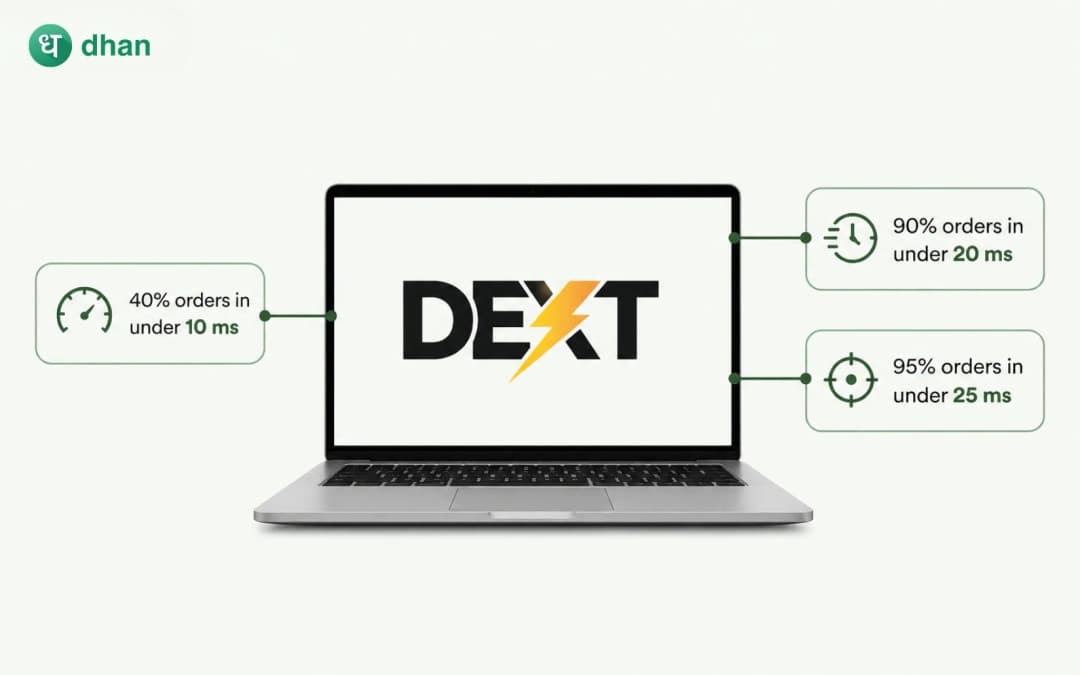
All these layers together leverage parallel processing to validate, format, and send orders to the exchange, all in under 20 milliseconds.
The architecture supporting the Low Latency Trading
Dhan’s ability to consistently achieve sub-25 ms latency for 95%+ of its orders is not by chance, but by having a highly sophisticated and modern infrastructure design. Recently, DEXT achieved important optimisation milestones in low-latency trading with execution latency of sub-20 milliseconds for the majority of trades. This is accomplished by three pillars:
Multi-region execution
DEXT is not dependent on a single geographical data centre; it employs a multi-region execution. Its order processing is geographically distributed, with servers being located in close physical proximity to the exchange's colocation facilities. This significantly reduces the physical distance data has to travel.
Smart load distribution
DEXT routes orders through a dynamic path, rather than a static one. The system consistently monitors the network in real-time. If it sees a microsecond of congestion on one route, it diverts the order through the fastest route available.
Active-active setup
Traditional broking setups use an Active-Passive (Primary-Backup) model, in which if the main server fails, it takes a bit of time for the backup to take over. In contrast, DEXT uses an Active-Active setup where multiple systems run simultaneously. This ensures absolute fault tolerance; even if one node has an issue, the traffic is seamlessly transferred to another node, without any downtime, while continuing to offer high-speed execution.
How do traders benefit from Dhan's in-house infrastructure?
Dhan is built for super traders, offering them several benefits to help them smoothly execute their trading strategies with low latency. Some key benefits include:
Minimal slippage
In highly volatile markets, especially during Nifty or Bank Nifty expiry days, option prices fluctuate wildly within a few seconds. With DEXT’s sub-20ms execution, the traders get the price at which they executed the order, thereby drastically reducing the slippage costs.
Empower algorithmic trading
For quantitative traders using APIs, speed is everything. DEXT's low latency enables automated systems to place multiple orders, modify them, and get exchange confirmation in real-time.
High reliability at scale
With the active-active setup and AWS cloud elasticity, traders didn’t have to face issues like platforms freezing or encountering order-stuck during high-volume trading periods, such as the Union Budget, RBI policy days, or the 9:15 AM market opening.
Latency improvement with DEXT
By looking at Dhan's public performance metrics, its latency improvement journey has been remarkable:
- April 2024: Around 40% of orders were fulfilled within 25ms.
- May 2024 onwards: Performance improved to 75-88% sub-25ms orders.
- March 2025: More than 95% of orders are processed within 25ms, with the majority of orders processed in 10-20ms.
These numbers represent end-to-end latency, from the moment a user places orders on the Dhan platforms to the moment the order is validated and sent on to the exchange.
The bottom line
Dhan's approach to low-latency trading is not a feature; it is a foundational commitment. It's based on the broader transformation taking place in the Indian financial ecosystem. By building DEXT in-house, operating on an active-active infrastructure that routes traffic intelligently, scales automatically, and relentlessly optimising every millisecond of the order pipeline, Dhan has moved from matching the industry standard to setting a new one.