5 high-potential AI Stocks that can be the next NVIDIA






Key takeaways:
- NVIDIA's $5 trillion success has shifted investor focus to the broader AI infrastructure stack beyond just GPUs.
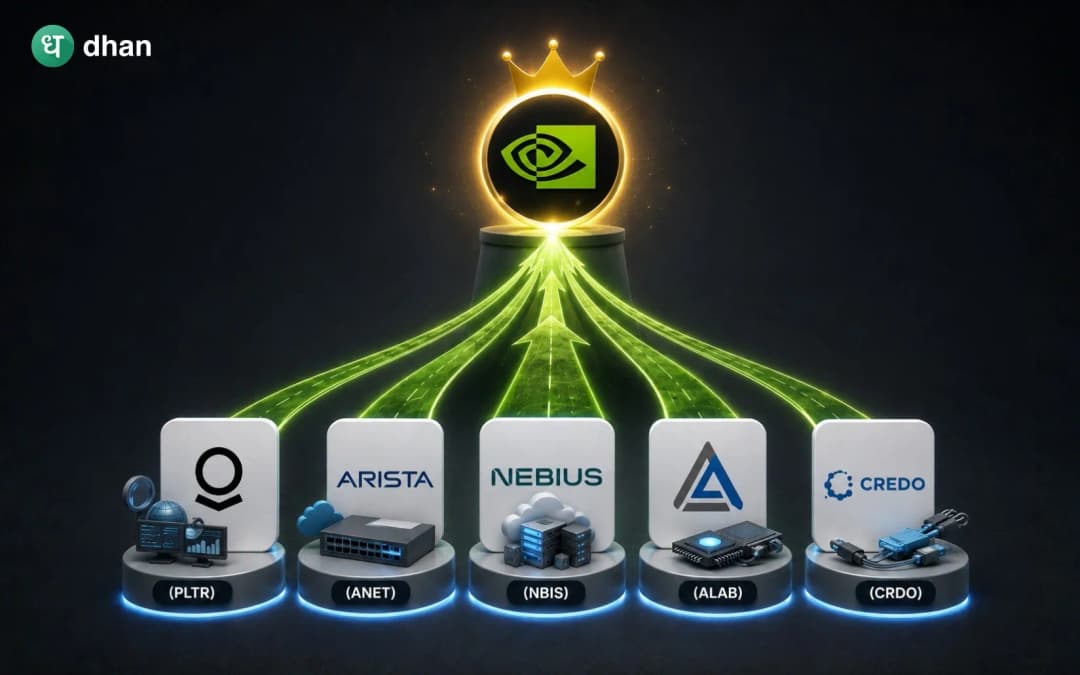
- Five high-growth AI stocks stand out in 2026. Palantir leads in enterprise AI software with 70% revenue growth. Arista Networks powers AI data centre networking. Nebius builds GPU-optimised cloud infrastructure. Astera Labs develops critical connectivity chips. Credo Technology supplies high-speed interconnects for hyperscalers.
- Each company occupies a distinct, irreplaceable layer of AI infrastructure with SEC-filed revenue acceleration and expanding customer bases.
- These are not NVIDIA clones. They carry real execution and valuation risks, but their structural positions in the AI buildout make them worth serious research for long-term investors.
NVIDIA went from a 10-year reign of GPUs to a valuation of $5 trillion. Early most investors were missing it. So, which AI stocks in 2026 are discreetly developing the same sort of structural situation as NVIDIA did in 2018?
They are supported by key infrastructure, irreplaceable technology, and a business that grows faster than costs. The five companies listed below are not clones of NVIDIA. All are at pivotal points in the AI value chain, and all have the requisite SEC-filed numbers to support the conviction.
Let's examine what makes them stand out.
What constitutes an AI Stock with high growth?
It's important to know the selection criteria before you select names. Here are the 3 filters to apply. First, there has to be a clear and non-replicable role within the AI infrastructure stack.
Secondly, the revenue data must be stated in SEC reports 10-K, 10-Q, 8-K, or 20-F to be confirmed. Thirdly, forward guidance has to demonstrate acceleration, not momentum. With no filing revenue, the talk is empty words.
Why AI Stocks beyond NVIDIA deserve attention?
While NVIDIA excels at compute using GPUs, the AI infrastructure stack has multiple layers on which value keeps mushrooming. The most needed now is the physical infrastructure to make use of such chips.
This encompasses cooling solutions, high-speed networking, memory, and optical interconnects. Additionally, hyperscalers are investing hundreds of billions in capex this year, and a larger percentage of that is going to companies that investors haven't paid close enough attention to.
5 AI Stocks with high-growth potential in 2026
Each company below occupies a distinct layer of the AI buildout. Together, they represent compute, networking, infrastructure, software, and cloud capacity: the five pillars every large AI deployment requires.
Palantir Technologies (PLTR): AI software at enterprise and government scale
PLTR Palantir's AIP platform deploys AI decision-making systems for US government agencies and commercial enterprises. It is not a generic SaaS tool. AIP coordinates real-time data, AI models, and operational workflows in a single environment.
SEC-filed numbers that matter
Per its 8-K filed February 2, 2026, with the SEC, Palantir reported Q4 2025 revenue of $1.407 billion, up 70% Year-over-Year (YoY). US commercial revenue grew 137% YoY to $507 million.
The company closed 180 deals worth at least $1 million each in the quarter, with total contract value hitting a record $4.26 billion, up 138% YoY. GAAP operating margin stood at 41%, and the Rule of 40 score reached 127%. Full-year 2025 revenue reached $4.48 billion.
2026 guidance: Management guided 61% revenue growth YoY for FY2026.
The risk: At over 200x earnings, the valuation leaves zero room for execution misses. Any guidance slip triggers outsized downside.
Arista Networks (ANET): The Ethernet backbone of every AI cluster
ANET Arista manufactures the high-speed Ethernet switches and networking fabric that connect GPU clusters inside AI data centres. Every major hyperscaler building AI infrastructure needs Arista's switching capacity to move data between chips at the speed AI workloads require.
SEC-filed numbers that matter
Per its 8-K filed with the SEC in May 2026, Arista reported Q1 2026 revenue of $2.709 billion, up 35.1% YoY, with cash flow from operations of $1.69 billion. Full-year 2025 revenue was $9.006 billion, with operating income of $3.8 billion. Deferred revenue climbed to $6.199 billion in Q1 2026, indicating strong forward demand already contracted.
2026 guidance: Management raised full-year 2026 revenue guidance to $11.5 billion at 27.7% growth and raised the AI networking revenue target to $3.5 billion.
The risk: Supply constraints across wafers, chips, and optics are actively limiting how fast Arista can fulfil demand, with management expecting tightness to persist for one to two years.
Nebius Group (NBIS): The AI cloud infrastructure challenger
NBIS Nebius develops and maintains GPU-optimised data centres for AI training, inference, and agentic AI workloads. It is an AI-powered cloud provider, but it's not at the application level. It's the infrastructure where the competition occurs.
SEC-filed numbers that matter
Based on its 20-F and earnings forecasts. Nebius expects total revenue to reach $529.8 million for 2025, a growth of 479% over 2024, and ARR to be $1.25 billion by year-end.
Revenue grew 684% YoY to $399 million in Q1 '26, with AI business sales increasing 841%, and making up 98% of revenue. Also in March 2026, NVIDIA directly made a $2-billion investment in Nebius, which accounts for approximately 8.3% of its shares.
2026 guidance: Management set 2026 revenue guidance at $3 billion to $3.4 billion, with a year-end ARR target of $7 billion to $9 billion.
The risk: Nebius is still posting net losses. CapEx guidance of $16 billion to $20 billion for 2026 is only approximately 60% funded, creating financing and execution risk.
Astera Labs (ALAB): The connectivity layer within each AI server
Astera Labs is developing semiconductor connectivity chips to transfer data at high speeds between the AI chips, servers, and memory. It features PCIe GEN 6 compatibility and the Scorpio switch family, designed for enterprise class large scale AI clusters.
SEC-filed numbers that matter
Astera's 10-Q for fiscal Q1 2026 showed revenue growing 93% YoY to $308.4 million, and adjusted EPS was up 84.8% YoY to $0.61. PCIe Gen 6 products accounted for more than one-third of Q1 revenue.
The Scorpio switch family is expected to be the biggest family for Astera in total by the end of 2026. Astera estimates that it can generate more than $1000 in revenue per AI processor it installs on a server.
The growth lever: Astera is building connectivity products inside NVIDIA's NVLink Fusion ecosystem, embedding itself directly into the dominant AI compute architecture.
The risk: Revenue is still below $1.5 billion annually. At 45x forward earnings, the stock prices are in extended hypergrowth without margin for error.
Credo Technology (CRDO): High-speed interconnects for hyperscale AI
CRDO Credo makes active electrical cables and optics that connect AI servers at the data rates hyperscalers need. Its ZeroFlap technology reduces connection failures inside large AI clusters, where downtime is structurally unacceptable.
SEC-filed numbers that matter
Per its 10-Q for fiscal Q3 2026, Credo reported revenue of $407 million, up 201% YoY, with Q4 guidance set at $425 million to $435 million. Management guided fiscal 2027 revenue growth above 50% YoY. Credo recently disclosed a fifth hyperscaler customer win, and the ZeroFlap optics business is ramping ahead of schedule.
The growth lever: Credo is expanding from hardware into AI system reliability, giving it a software-adjacent stickiness that pure cable suppliers lack.
The risk: Revenue concentration in a small number of hyperscaler accounts is a real vulnerability. Losing one large customer would materially impact results.
Build your AI portfolio with real research behind it
Strong AI foundation construction is yielding a generation of businesses with structural positions within the demand curve that won't go anywhere. Palantir's enterprise AI software is the company's exclusive property. Arista is the owner of the AI networking fabric. Nebius is expanding its cloud capacity with performance-optimised GPUs. Astera and Credo are integrated into every AI workload's chips and servers.
None of these is certain to follow NVIDIA's path. But each one has SEC-reported revenue growth, increasing customer numbers, and forward-looking guidance that indicates the best could be yet to come. Do extensive research, size positions accordingly, and invest only if there exists extensive due diligence.